I dimly remember that I read the first three of Ursula K. Le Guin’s Earthsea books in my pre-teen years. I’m fairly certain that I came across them in the library of The International School of Lusaka, possibly in sixth or seventh grade. Maybe I got them in a bookstore in Lusaka, but that seems unlikely, as I think that I would have kept the copies (or not, as I had to give up quite a few of my books from that time when leaving Zambia and beyond).
The content of those three books, The Wizard of Earthsea, The Tombs of Atuan, and The Farthest Shore, are lost in the mists of my memories. Occasionally I come across battered paperback copies of one or another of these books, but I’ve never bought them, not once in the intervening 40+ years since I first read them.
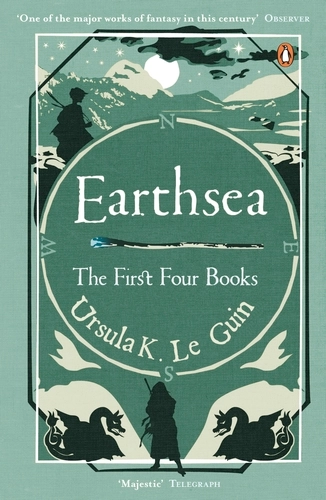
Then, by chance, I came across a pristine omnibus edition of the three books, as well as a fourth one, which I’d never read. It’s sub-titled “The first four books”; apparently there are two more set in this world. I think that I only read The Dispossessed by Le Guin. This is a UK edition, which somehow ended up in the USA.
The word “Earthsea” is a brilliant combination of two disparate words by Le Guin. There’s no preface, no introduction, no afterword. You simply dive into the book, into her world. The design from Penguin Books is brilliant. It even smells like a book is supposed to smell. I wonder, as I start the hourney to re-read these books, will they resonate the same way that they did those four plus decades ago? Likely not, but we shall see what happens.
*Brief note: The cover image here has a quote from Telegraph. My copy has a quote from Neil Gaiman, who I guess has been canceled these days.
Between 2015 and 2023 I didn’t buy a single Arkham House book. In 2023 I bought just one AH book, Lucius Shepard’s second collection published by Arkham House, The Ends of the Earth. Then, in 2025 an explosion of interest on my part suddenly resulted in me acquiring many more books from this publisher. With these four books, my collection reached a round 50 in number (I’ve since added one more). I’ve probably hit my peak (or close to it) when it comes to books from Arkham House. It’s just going to get harder and harder if I want to try to find the other 80+ books that I don’t have, without spending an excessive amount of money per book.
I bought my first Arkham House book in 1990: Michael Shea’s collection, Polyphemus. I bought this book from Austin Books (in Austin, Texas), back when they sold actual books, and not just graphic novels and comics. Between 1990 and 2015, I slowly picked up more Arkham House books, either from brick and mortar book stores or at SF conventions. Back then you still could buy AH books for between $7.50 to $15, at least the most recently published ones. After 2015, I pretty much stopped going to SF conventions. Also, local book stores didn’t really carry any Arkham House books, as they’d by now ceased to publish anything new. Fast forward a few years. The online world exists far more than the brick and mortar world. Occasionally I’ll search online for Arkham House titles, and occasionally I’ll end up with a few books like these ones:
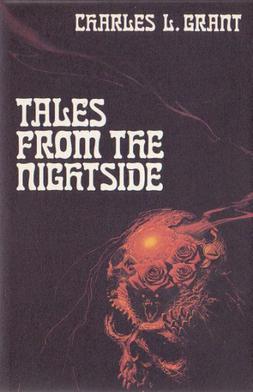
Charles L. Grant, Tales from the Nightside (1984). A collection of short stories. Bought for $50, which is to me the upper limit of what I’ll pay at the moment. Grant, who passed away in 2006, was a prolific author and editor of horror fiction. I only have a couple of his books, as opportunity never presented itself to me to find others, at least in person. This book includes an introduction by Stephen King, another prolific horror writer.
Phyllis Eisenstein, Born to Exile (1978). According to Wikipedia, she died on December 7, 2020 in Chicago from COVID-19 and a stroke at the age of 74. For some weird and unknown reason, Arkham House slapped a label of “SF” on the spine. Based on the first couple of pages, I’d consider it more in the vein of fantasy than SF.
Donald Sydney-Fryer, Songs & Sonnets Atlantean (1971). A collection of poems. Fryer, born September 8, 1934, compiled a bibliography of Clark Ashton Smith’s works, published by Donald M. Grant in 1978. From another entry in Wikipedia, I learned that “in May 2025, 91-year-old Sidney-Fryer suffered a stroke which necessitated his move to a nursing home.” I briefly corresponded with him in the 1990s, when he lived near Corpus Christi (if I recall correctly, as those emails have long since vanished). Soon he will be gone from this world, and I regret never driving down to visit him.
Gary Myers, The House of the Worm (1975). A slim book in the vein of H. P. Lovecraft. At 70-odd pages long, the text reads more like a poem in prose, than fiction. Peppered throughout are black and white sketches, almost as gloomy as the text. According to the note of the author, Myers went on to get his BA after this book, so maybe he wrote it while young. I don’t recall seeing other books by Myers, but not all Arkham House writers went on to publish a slew of books or reach fame.
To me, owning these books is like owning fragments of history, especially given the fate of several of the authors. In time, these books that I’ve acquired, either from bookstores or other owners, will move on to further owners. Hopefully they’ll appreciate them, take care of them, read them.
In my opinion, there’s a special circle in hell for people who mark their places in books with dog-ears—folding over pages in a triangle. May these people reside in eternal flames alongside people who break the spines of the books they read; use a bookmark! Then, there are those equally cursed people who paste in their personalized bookplates or stamp their ownership with “in the library of” with their names, who I cannot forgive. On the outer rim of hellish circles are those who write in books with pens. Pencil marks I can erase, but why mark a book with a pen if you don’t intend to destroy the book?
Scottish writer Iain Banks, who also published science fiction under Iain M. Banks, published books in the UK and USA. In the UK, some of these appeared in trade paperback by Abacus. A few years ago, an influx of these books appeared in the USA. I bought some as I came across them, always hoping to find more. Many years passed with no such luck. However, recently I came across a copy of The Business. Of course, in this book, someone had written “R” next to the titles Banks’ other books. I guess this is a handy way to keep track of what they had read. If so, I thought, why then would this book end up in a used bookstore in Phoenix, Arizona? What strange circumstance would put this book there? They’d also dog-eared the book, and stored it where the sun yellowed its pages. Otherwise the book was ok, and as Banks’ books are hard to find where I lived, I bought this copy.
Three of the five Abacus books I own only list other books written by Banks. The Business, as well as The Steep Approach to Garbadale, show twelve images of covers of Banks’ books from Abacus. The titles are hard to read, so I don’t quite know the seven books in this set that I lack. Given that I’m in the USA, and these are UK editions, and Banks died a few years ago, if I find any of those seven it will be a miracle.
The previous owner of The Business, the person who dog-eared the book, made it as far as chapter three ( page 61). nothing else appears to indicate they completed the book. Did they give up and chuck the book, or pass way before they could finish it? At least they didn’t write their name in the book, but even then, it would take some effort to find their fate if the name did appear there.
Somewhere in the USA those other books must exist. If I find them, I hope they’ll be absent of writings, ownership stamps, and other jiggery-pokery.
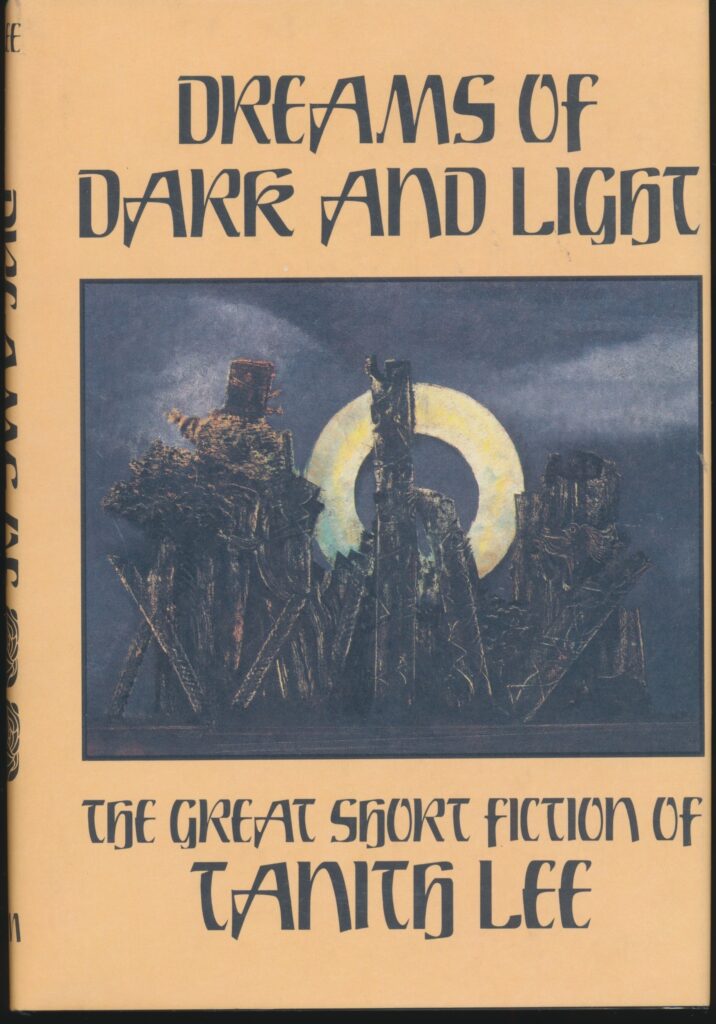
Dreams of Dark and Light is a collection of stories by Tanith Lee (1947-2015), published by Arkham House in 1986. This my 51st Arkham House book. There are a few barely imperceptible spots on the outside edges of the pages, but otherwise it’s in good shape. I’d missed out on a couple of bids for other copes this book, so I was somewhat surprised when I ended up with this one. At any rate, I’ve long wanted a copy. So, many years after it was first published, I ended up with my copy at twice the original price.
I own only a handful of paperbacks by Lee (ok, five, but were it not the fact that I avoid paperbacks with broken spines I would own a fair amount more), which is a tiny fraction of her total output of “90 novels and 200 short stories.” She’s one of three authors in Dark Harvest’s first volume of the horror/dark fantasy anthology series, Night Visions. I bought that book many years ago. I’m fairly certain that I read her stories, but since then I’ve read so much that they’ve long vanished into the mists of time. Finding her books in bookstores, at least since the late 1990s and 2000s, however, is almost impossible.
According to an obituary in The Guardian, “her career went through the doldrums, exacerbated by changes in publishing in the 90s and thereafter. [T]hose qualities that had built her career…were liabilities in a publishing world obsessed with strict category and with authors who produce the same reliable product. At one point, she complained that she was writing books because she could do no other, but was stacking them unpublished in a cupboard.” This probably explains why it’s hard to find her books these days, and also makes you curse those publishing changes. I don’t really read modern fantasy, and maybe that’s due to those changes.
Perhaps now is a good time, as I start to read these stories, to take another look at her other books, and those stories of Lee’s in Night Visions 1.
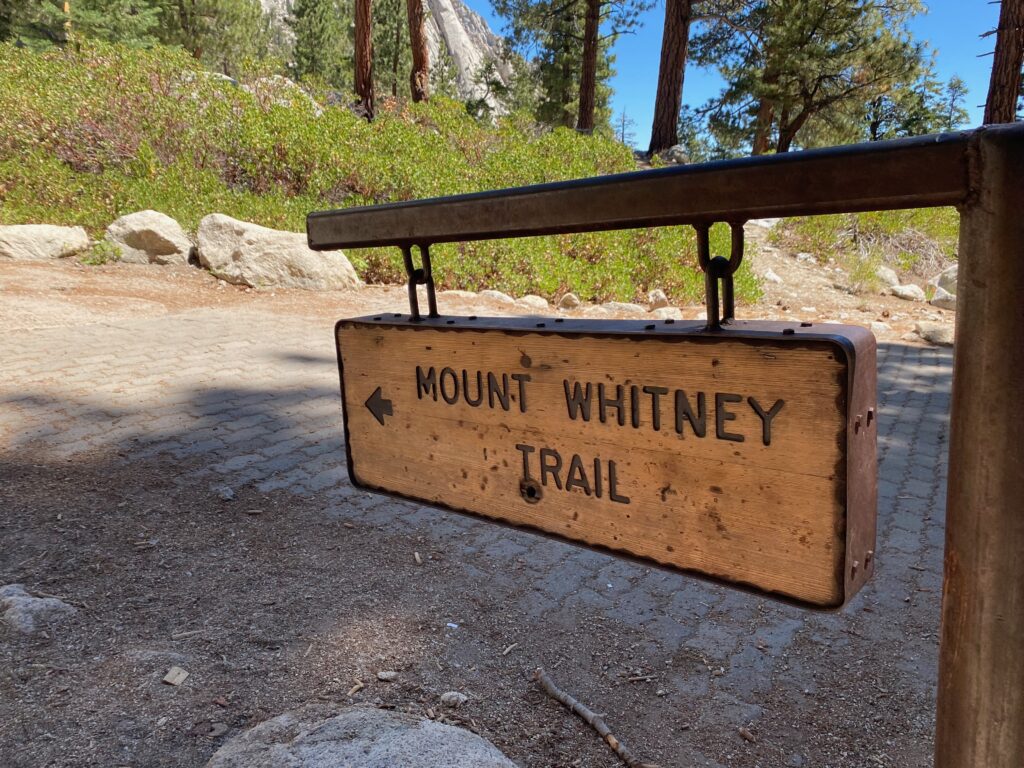
Not even halfway up the trail to Mount Whitney, disaster struck. Shouldering my Gregory Zulu 30 backpack after a short break, the sternum strap snapped, sending two pieces flying into the night. In the darkness I managed to find both pieces, but there was nothing I could do except pocket them. For the rest of the hike I would be forced to occasionally grip my shoulder straps or continually adjust them, as they constantly cut into my shoulders. At least this effort took my mind off the endless switchbacks.
We’d started our hike, as planned, around 10pm Sunday night. Along the trail we’d met a few people heading downhill. The two or three people who were friendly enough to chat said they’d summited around 2pm that day. They’d then made the perilous descent from Trail Camp in the dark, while we would do the reverse. They trudged in silence past us, maybe too tired to care at that point. At 11:30 we reached the Whitney Zone sign. There, we sat for half hour in the quiet dark waiting for our moment.
At a few seconds after midnight, we stepped into the Whitney Zone. The first mile or so to Outpost Camp and slightly beyond is an easy hike. A short distance past Outpost Camp we crossed a creek, where we met a solitary figure on the other side. It was nearly 1am at this point. The lone figure, a man, asked if this was the path to the trailhead, and we assured him that he was only four miles away. He sighed, gestured at his feet, and said that with his sore feet he hoped he’d be able to make it. We wished him good luck. Our path took us onward, and from here it was almost all uphill.
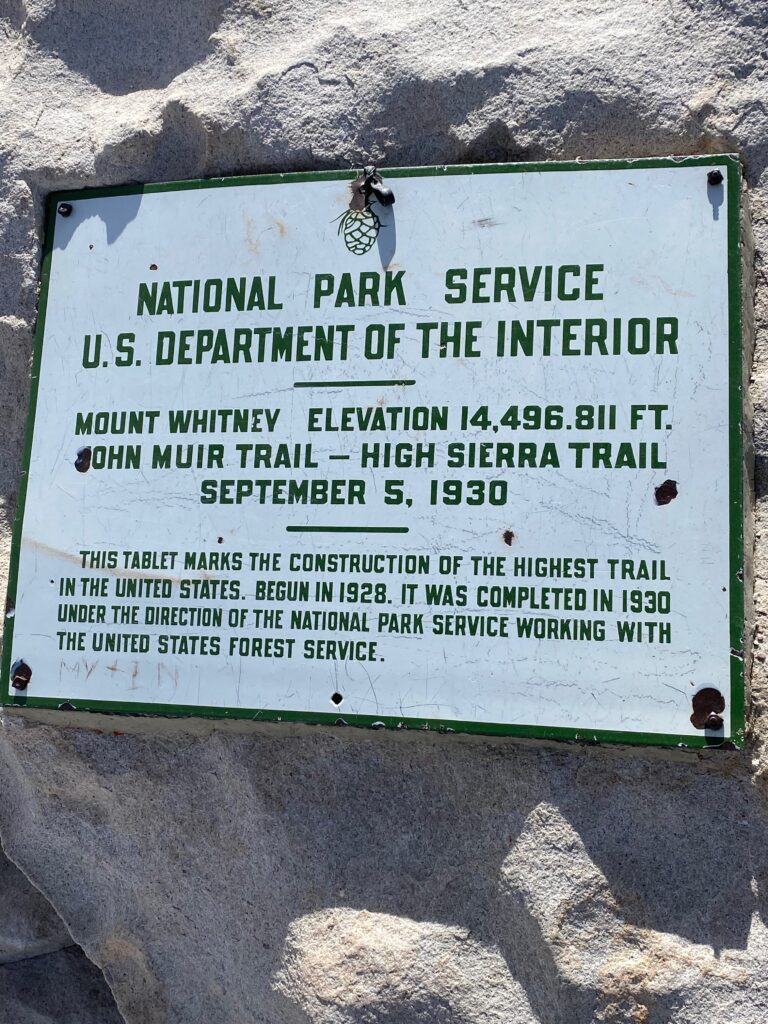
In the darkness we made our winding way up, up, up, for what seemed like the entire night. We took several breaks, including one where my sternum strap met its sad fate. For a long time it seemed that we were the only people on the trail. At last, we reached Trail Camp. It was still dark, and we tried to not make too much noise as we walked past the tents. At the far end of camp we encountered two groups of hikers as they emerged from their campsites. Together we started the infamous 99 switchbacks, and then spent the next hour plus leapfrogging each other. At the sun struck the horizon to the east, we arrived at Trail Crest, a pass that lay around 13,000 feet above sea level. Here we paused for a longer break, then walked down to the intersection to the John Muir Trail. Past this intersection stood a sign warning people of lightning danger. As it was around 6:30am, we didn’t think this would be an issue for us. From here, however, the summit is still nearly two miles away, and pur pace would slow.
Those next two miles were almost the toughest miles of the trip. The trail hugged the mountain side. Occasionally we scrambled ove boulders, where one wrong step would send you plummeting many hundreds of feet below. We passed a couple of windows between more solid paths, then walked along some dagger-like smaller peaks. At last, we were on Whitney proper. The summit at this point still seemed distant. We crossed a small ice-field; no need for micro-spikes here. Then, it was a matter of surviving the final push. We took many breaks the last half-mile, then finally reached the Smithsonian hut at the summit. Here we rested for a while, before making our way back.
Getting to Trail Crest from the summit was still tough, but the 99 switchbacks in daylight was nothing short of torture. The sun at this point was out, and no shade was to had for many miles. We staggered back and forth along endless 180 turns. As we made our way down toward Mirror Lake, we thought we were on the wrong trail. I kept checking my GPS, which showed us on trail, and we even stopped and asked people if it was the right trail. We’d walked up here in the dark, so nothing looked familiar. I can only imagine how the hikers who walked through this part of the trail at night must have felt. Did they go off trail? Some people have fallen here, several have died. So close to the end, and yet such a lethal place. Here we saw our first and only marmot, a curious little fellow.
We walked through Outpost Camp, crossing creeks and dusty plains. Then, more switchbacks, and finally exited the Whitney Zone. No one asked for our permit, which was somewhat disappointing. The last three miles from Lone Pine Lake to the trailhead took forever; we finally reached the trailhead at 3pm. We’d been awake for close to 40 hours at this point, and headed back to our car and Lone Pine consumed only by thoughts of food and sleep.
Hiking Mount Whitney in one day is no joke. I’m glad we started at night, especially in the Summer. Afternoon thunderstorms would mean that people summiting past noon would be exposed to lightning, rain, hail, and also would have to hike from Trail Camp to the trailhead in the dark. To me that doesn’t sound like fun, especially when tired. I’ll never do the trip in a single day again. That said, if I were to hike Mount Whitney again, I would plan a multi-day trip from Horseshoe Meadows instead. Take three or four days, enjoy the lakes and meadows, even though it would mean going down the endless switchbacks again.
Now, if only there was an easy way to slide the replacement sternum strap back on my backpack…
Slowly, slowly, I’m trying to acquire more Arkham House books. It seems that I’m mostly picking up books from the 1970s onward, as older books are harder to find.
Frank Belknap Long, mostly a writer of fiction within the Lovecraft circle, published a slim (66 pages!) Arkham House book in 1977. In Mayan Splendor collects a variety of poems by Long, and is illustrated by Stephen Fabian. Originally sold for $6, I picked this book up for just under twice the cover price, many, many years after it first was published.
From Evil’s Pillow is my third Basil Copper Arkham House book, but his first published by them. I already have And Afterward, the Dark (1977) and The House of the Wolf (1983), but when I saw this book listed for less than $12 I went for it without hesitation. There are a few scrapes or smudges on the back cover, but all in all the condition is quite good for a book published in 1973 and listed at $11.75. This book also originally was listed at the low cover price of $6.00, which makes me somewhat nostalgic for the 1970s.
Books like this in the current age would fetch $25 of more, given inflation and other related changes based on small press publishers. Of course, these days such books would have multiple states, such as signed/limited copies, vs. just published in an announced number of copies (3,500) in this case. It collects five short stories, with a cover by Frank Utpatel, who illustrated many Arkham House books.
This year I’ve been on an Arkham House bender, after many years of not looking for their books. I think that most of my AH purchases prior to 2025 were in-person acquisitions, but now I’m tossing my hat more in the online world. In many cases, at least where there are auctions involved, I’m losing out on books. So, instead, I’ve turned to fixed price options from resellers elsewhere. This means I’ll probably stall in terms of adding more books, as I do have an upper limit in terms of what I want to spend, and most fixed-price AH books from earlier than 1970 are well beyond my price range.
James P. Blaylock’s The Adventures of Langdon S. Ives collects four short stories (“The Ape-Box Affair”, “The Hole in Space”, “The Idol’s Eye”, “Two Views of a Cave Painting”) and two novels (Homunculus and Lord Kelvin’s Machine) featuring Victorian inventor, Langdon St Ives in various adventures and escapades.
I already own both novels—Homunculus in the Morrigan edition and Lord Kelvin’s Machine from Arkham House. The short stories appear in other books that I also already own; “The Hole in Space” in the Subterranean Press edition of The Man in the Moon, and the other three in the Edgewood Press collection, Thirteen Phantasms. Why then buy this book? I recall buying The Further Adventures of Langdon St. Ives because, although I owned three of the novellas collected in that book, I lacked two of the short stories. But, I’d looked at the contents of the first Langdon St. Ives book many years ago and decided back then that I didn’t need it.
The itch was still there, somehow, and when an opportunity came along to pick it up at cover price, I took it. Originally published in 2008 as a trade and limited edition, I thought the copy I bought was a trade edition. However, when I received the book, the dust jacket listed the trade edition price, but the book was one of 200 numbered and signed copies, which matched the limited edition description. I suspect that I have a mix of book and cover, which is a strange circumstance. At any rate, it looks good next to my other Subterranean Press Blaylock books, and the introduction by Tim Powers and afterword by Blaylock are fun reads. Blaylock’s afterword, however, covers much of the same territory as his afterword to “The Hole in Space” in The Man in the Moon. I’ve read, I think, almost all of Blaylock’s works, barring a short story or two. So, all in all, I’m happy that I finally went ahead and got this book.
I mostly know of Lin Carter (1930-1988) as an editor of fantasy anthologies (such as the Years Best Fantasy books from DAW, as well as the Ballantine Adult Fantasy series), plus so-called pastiches of earlier tales (H.P. Lovecraft, Robert E. Howard, and other sword and sorcery writers).
Dreams from R’lyeh is a collection of some of Carter’s poems, published in 1975 by Arkham House. It’s a slim volume, originally priced at $5, with a fantastic cover by Tim Kirk. I recently obtained a copy, in my effort to try to broaden my Arkham House collection, an effort that remains ongoing, at least to some slight degree.
It’s strange—at least I think so—to read L. Sprague de Camp’s introduction and Lin Carter’s afterword in 2025, as these were written more than 50 years ago. Both de Camp and Carter are now long gone. I met de Camp many years ago (1989? 1990?) at a convention in Austin. I shook his hand, and he remarked that he had shaken the hand of someone who once had shaken the hand of Charles Darwin. It’s almost eerie, as I start to read Carter’s poems (at least those he wanted preserved), to think that by the time I shook de Camp’s hand, Carter was already dead, and yet at that time I was just starting to look for books written and edited by Carter.
There are less than 100 pages between the covers of Dreams from R’lyeh, and yet I sense a great deal of presence in this book.