Centipede Press publishes a variety of high quality books. These may be one-off titles, series by certain writers (i.e Fritz Leiber, Frank Herbert, others), or collections in SF, fantasy, and horror genres. One of their series is their “Library of Weird Fiction.” Their latest book in this series is a collection of stories by Carl Jacobi (1908-1997). Jacobi is considered as a minor writer in H.P. Lovecraft’s circle, but is so much more (see this appreciation by D. H. Olson, reprinted in this collection). He published multiple stories in horror/SF magazines such as Weird Tales during the 1920s and 1930s, as well as in mystery magazines. A classmate of Arkham House’s Donald Wandrei, he attended the University of Minnesota in the late 1920s. He published three collections with Arkham House and one with Fedogan & Bremer.
This new collection from Centipede Press is huge. At almost 1,000 pages it’s one of their thickest “Library of Weird Fiction” books, and an instance classic. Upon publication this book is priced at $65, but I’m sure it soon will sell out and you’ll need to pay a premium in a year or more. The book includes an introduction by John Pelan from 2013 (Pelan died in 2021), a brief note from Robert Bloch, and the aforementioned appreciation by D. H. Olson.
Recently I picked up three mystery books by small press publisher, Dark Harvest. This publisher was active from the late 1980s to the early 1990s. I now have 40 books by this publishers, with maybe a dozen more left in order to collect all of their books. Most of these I have as their “trade” editions, with a handful of the “signed/limited” variety.
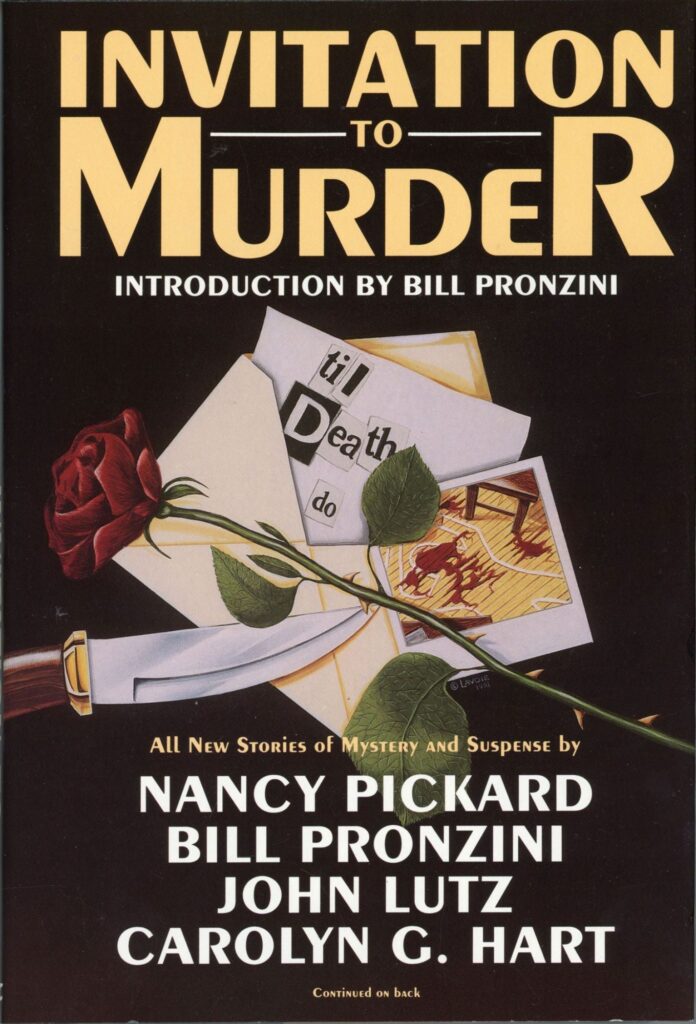
Invitation to Murder (1991). This is anthology or mystery stories, all with the same premise: a young woman is found dead in a room. Around this time (early 1990s), Dark Harvest appeared to switch from horror/dark fantasy to mystery. It didn’t work, and a couple of years later they closed shop. This anthology collects a few stories with noted mystery writers (as well as writers from other genres). I bought the trade edition, and have just started reading the stories, starting with the first one, by Nancy Pickard; I’ll admit that I didn’t expect the ending on this one. I guess the market for limed edition mystery books is not as sustainable as horror/sf/fantasy books, since a year or so later Dark Harvest stopped publishing anything at all.
Junius Podrug’s Frost of Heaven (1992). I have not yet read this book, nor have I seen any other books by Podrug. I was able to get this book as a limited edition, and my copy is number 4 of 250 signed and numbered copies. The cover is boring, though it does have a nice endorsement by Nancy Pickard. It’s on my To Read list, but I know nothing about it.
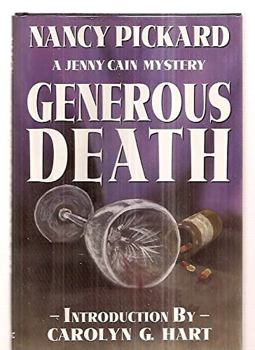
Nancy Pickard’s Generous Death is not listed as one of the books from Dark Harvest on ISFDB. It was reprinted by Dark Harvest in 1992, possibly as part of their failed foray into the mystery genre; after they abandoned the horror/dark fantasy books that made their name, they ceased to exist shortly thereafter. Maybe that switch wasn’t the direct cause of their demise, but it’s hard not to associate the switch to them stopping all books.
Generous Death is the first in a series of books about the main character, Jenny Cain. Packard had a significant career in the mystery/crime genre, but this is the first time I’ve encountered any of her books. My copy is signed and numbered 268 of 300 copies. After I bought this book I looked for her books elsewhere, but so far have not found any. Maybe that will chance, as now her books are on my radar.
Out of the ca. 52 books from Dark Harvest’s publication history, I now only need 12 (or so) more. Some of these might be tough to track down at acceptable prices (to me), and as evidenced by the Pickard books, there might be one or two not listed in the publication history. Althought I have a handful of the signed/limited variety of their books, I’ll probably look for the others in trade editions. If I manage to collect them all, that would be quite a feat, at least in my eyes.
The first Lucius Shepard book I ever bought and read was Green Eyes, which happened to be his first novel. This was probably around 1989-1990, when I vacuumed up any and all cheap SF books I could find at the time in new and used book stores in Austin, TX. Shepard (1943-2014) wrote fantasy and science fiction, and often was linked to the Cyberpunk movement in SF. He also was noted for writing about Central America and war from a leftist perspective. I bought his novella, Kalimantan, in the Strand Bookstore in New York City, back in 1992 or 1994. Then, a pair of novellas from Golden Gryphon, a publisher whose books of whom I attempted to collect a complete set. A few years later, I bought a collection of his stories published Arkham House, called The Jaguar Hunter. Many years passed until I came across another of Shepard’s books, but between 2023 and 2025 I amassed half a dozen of his books.
Several of the books I bought are novellas set in his Dragon Griaule “universe.” This is a fantasy world centered around a dragon that’s a mile long. While it appears to be dead, it still exerts influence in the world around it (usually malign). There’s also an entire ecosystem inside the dragon. Several of the novellas have been published in book form by Subterranean Press and other small press publishers. These include “The Scalehunter’s Beautiful Daughter,” “The Father of Stones,” “Liar’s House,” and “The Taborin Scale.” I have the first three, but as I’ve sort of picked up the books at random, have so far not seen any copies of the last one.
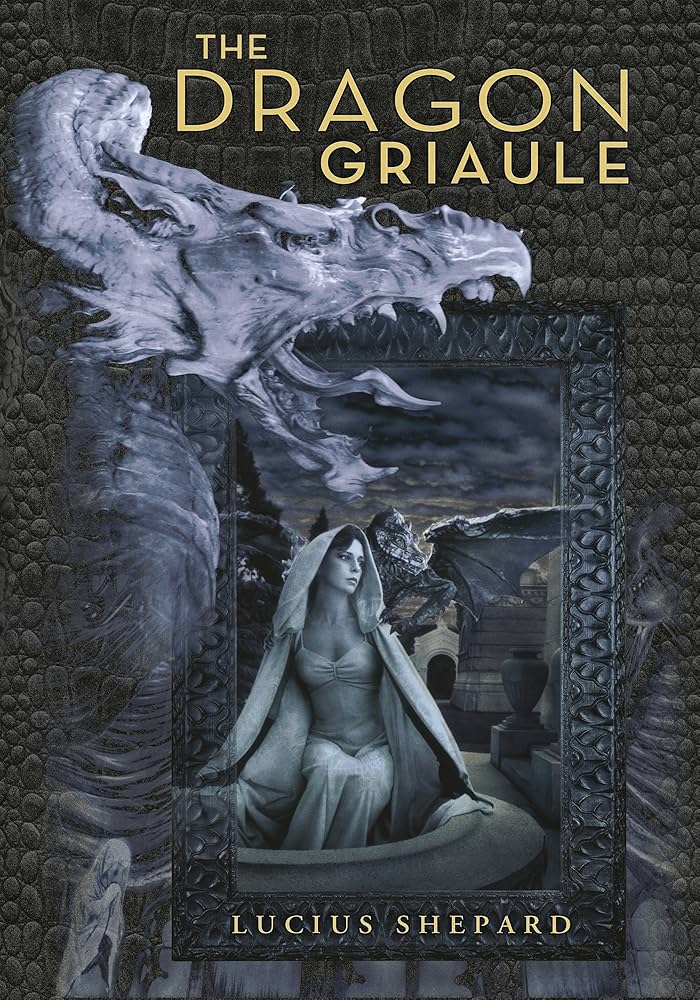
The Dragon Griaule, published by Subterranean Press in 2012, collects six Griaule stories, including the first one, “The Man Who Painted the Dragon Griaule,” as well as “Skull,” which appears to be his last story in this universe. Two years after the publication of this collection, Shepard died at the age of 70 from the complications of a stroke. “The Man Who Painted the Dragon Griaule” appears in his Arkham House collection, The Jaguar Hunter. I don’t know if it’s been published as a stand alone novella like some of the others. This edition also includes a section with story notes: short snippets about the origin of each of the stories. I enjoy reading these notes almost as much as the stories themselves.
Shepard led an interesting and peripatetic life, which he hints at in some of these story notes. Some of the locations and events at the time he wrote the stories influence the tales, which is inevitable.
I probably over-paid for my copy of the book, even though it’s signed by Shepard, but having read many of those Griaule stories recently, and, as it was in my hands in a book store, I could not put it down. The special signed edition states that it was limited to 300 copies, but there must have been an overlap, as mine is numbered “PC,” which means it was a presentation copy. The artwork is by J. K. Potter, a noted SF/Fantasy illustrator. Two of the stories are new to me, so I look forward to reading them. There are other Shepard books out there that I don’t have, but I expect that if I get them, they’ll be spur-of-the moment buys vs. deliberate actions.
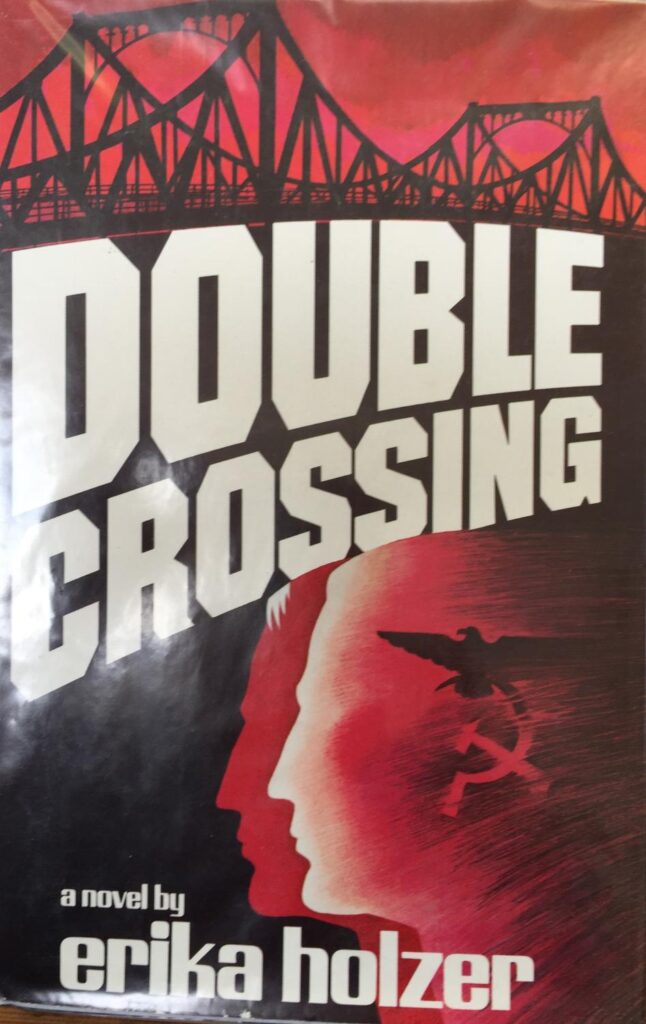
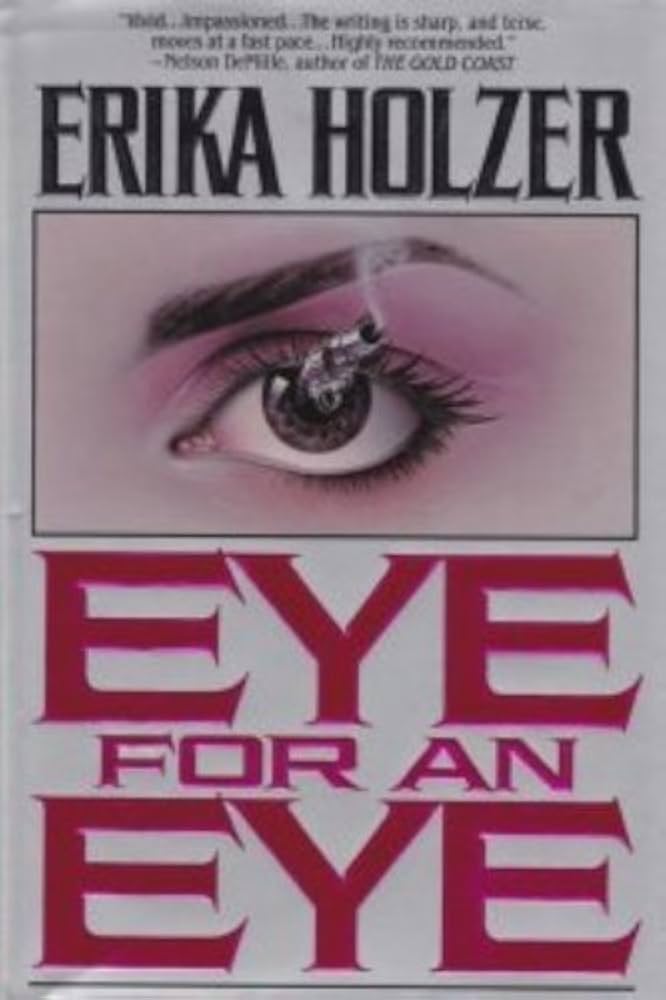
For the cheap price of $8 I recently bought a signed copy of Erika Holzer’s An Eye for an Eye, first published back in 1993 by Tor Books. This novel also was the basis for a major motion picture of the same name, thought I’d never come across it until now. Holzer apparently was a close associate of Ayn Rand. Erika Holzer was born Phyllis Tate, received her law degree and married Mark Holzer, also a lawyer, and at some point after her marriage changed her name to “Erika.” In the 1960s the Holzers were students of Rand’s philosophy of Objectivism, and Mark Holzer became Rand’s personal attorney. Erika Holzer’s first novel, Double Crossing (1984) was a finalist for the Prometheus Award in 1984 (although the publication date is 1980). She died in 2019 at the age of 83 or 84, but I’ve only found two novels under her name.
Her second novel, An Eye for an Eye (1993) is a vigilante story. Well, that’s according to the dust jacket. I’ll see how it goes, as I’ve not yet read the book. I do own Double Crossing, which I bought some time in the 1980s; my copy is battered, torn, and price clipped. I can’t remember from where I acquired it, nor much about it since I read it back then, but I recognized the name when I came across An Eye for an Eye.
My copy of An Eye for an Eye is signed by Holzer, dated May 1st, 1993. She appears to only have written two novels, with 13 years between them. If she switched careers from law to writing due to Rand’s influence, a couple of novels is not a significant result. I was disappointed to learn there were only two novels under her name, but sometimes that happens.
I don’t know much about Chad Oliver. Without looking up his information online, I simply recall this: In the 1990s, when I lived in Austin, Texas, some of the authors I knew, or knew about, or read (Bruce Sterlin, Lewis Shiner, Neal Barrett, Jr., Howard Waldrop) would name-drop Oliver. I don’t think I ever found any of his books in bookstores, although I think I saw one or two of them at SF conventions in Austin. A glance online shows that he died in 1993 (at the young age of 65), so I never met him. He was twice chairman of the department of anthropology of the University of Texas, where I got my undergrad degree (English and History) in 1995. I never took any anthropology courses, however, and I’ve never read any of his stories. An interesting tidbit that I just learned is that he “supported the Guadalupe River Chapter of Trout Unlimited and the cold water fishery downstream from Canyon Dam,” where once I fished and caught some trout. If only for that reason, I’ve become a huge fan of Chad Oliver. Then again, there are his books…
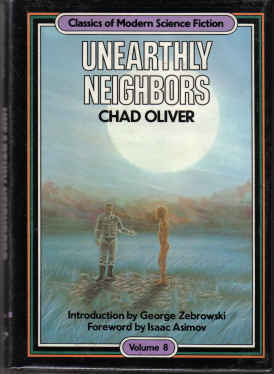
Unearthly Neighbors was first published in 1960. It was revised and published in 1984 as a “Classics of Modern Science Fiction” by Crown Publishers in New York. Recently I picked up a copy of this book at Book Gallery in Phoenix, for what seemed a high price of $20, but it’s the first Oliver book I’ve seen in forever. It has an introduction by George Zebrowski, and a foreword by Isaac Asimov, both now also dead (Asimov in 1992 and Zebrowski in 2024). The book is volume 8 in this series. I wonder if I’ll ever come across any of the other seven (or if there were additional books beyond this one).