Lost worlds and ports of call

Month: March 2026

Jack Dann: Masters of Science Fiction

Centipede Press has published a ton of great books over the years. From individual novels, collections, anthologies, non-fiction such as studies of horror movies, author series by writers like Gene Wolfe, R. A. Lafferty, Fritz Leiber, Michael Moorcock, Karl Edward Wagner, Michael Shea, and more, plus various themed series. They cover multiple genres, such as fantasy, SF, crime, and horror. Their themed series include the massive Library of Weird Fiction books, collecting fiction by noted writers from yesteryear: H.P. Lovecraft, Bram Stoker, Ambrose Bierse, Edgar Allan Poe, and more. Then, there’s their Masters of Science Fiction.

Starting with James Patrick Kelley and Fritz Leiber in 2016, followed by Richard Wilson in 2018, then the two-volume set by Kate Wilhelm in 2020, with over 1,500 pages of stories. Next, Robert Sheckley and Jack Dann in 2022, followed by Pamela Sargent in 2025, and then Howard Waldrop in 2026, with even more authors on tap. If you were lucky enough to buy the books upon publication, good for you. In my case, although I’ve bought a few Centipede Press books over the years, I really didn’t pay attention to this series until I bought the one by Pamela Sargent in 2025. Then, as a Waldrop fan, I had to get that book the moment it was announced in early 2026. Then, I checked availability for the other books. When I saw them listed on the second hand market for well over $300, I said, “No way.” All too often with Centipede Press books, if you don’t act fast, you pay a premium. I wasn’t prepared to pay that much.
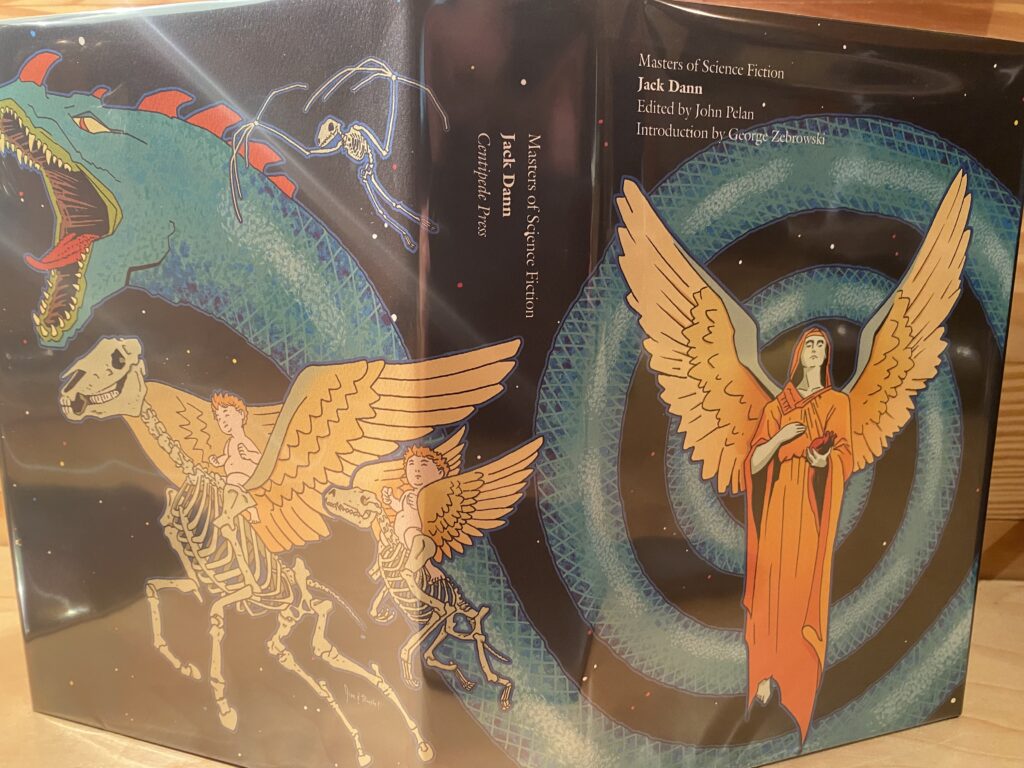
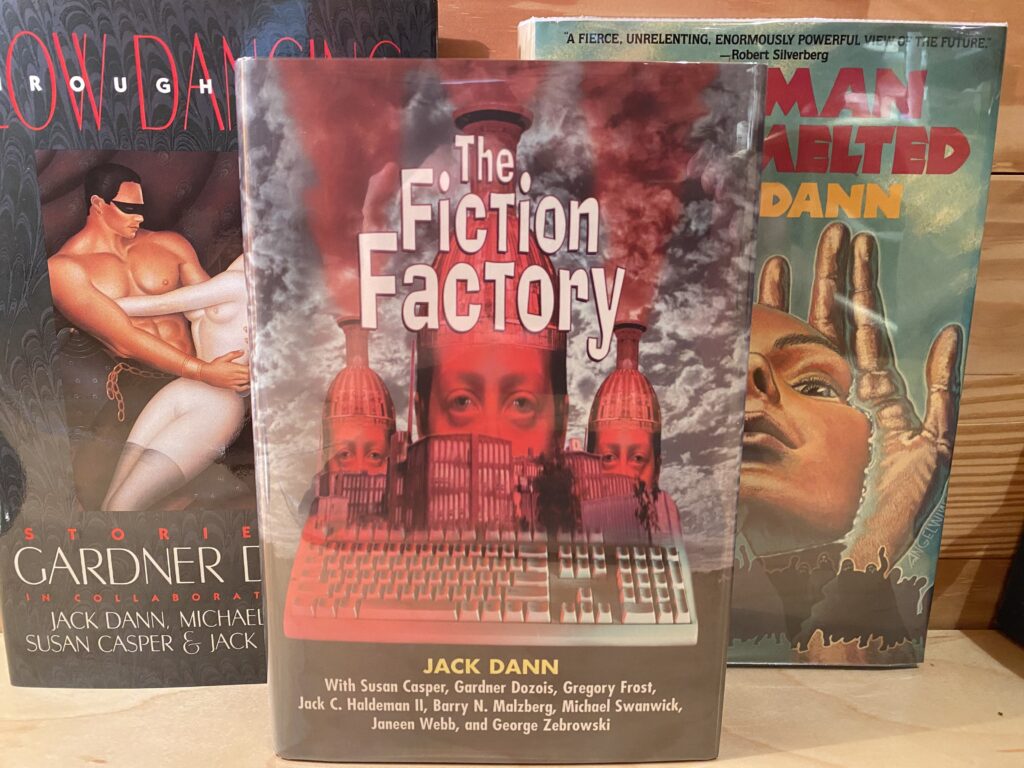
Still, recently I was able to find a decent copy of the Jack Dann book. It wasn’t available at the publication price, but then it wasn’t listed for $300 or more like the others. With over 700 pages of fiction and close to 30 stories, it’s a massive collection. From before, I already owned one of Dann’s novels, The Man Who Melted (Bluejay Books hardcover from 1984). I’d also read his collection from Golden Gryphon: The Fiction Factory, which gathered a bunch of stories where Dann collaborated with other writers. Plus, I have a signed edition of Slow Dancing Through Time, an anthology of stories edited by the late Gardner Dozois, which included fiction by Dann. Still, there are many early Dann books that I don’t have, as they’re next to impossible to find. All that aside, the Centipede Press edition is without equal.
These books likely take years to assemble, with time added for publication. For these are not shabby productions, and they’re worth the wait, for sure. Up next in the series is Alfred Bester (a two volume set), and then likely even more great writers to follow.

Move quickly, if you want any of these, or be prepared to shell out significant amounts of money, if you’re can even find any of those books listed anywhere now. Why? Each edition appears to be limited to 500 copies, and there likely are that many (or more) eager Centipede Press collectors out there, almost all unwilling to surrender their copies. My Dann edition was edited by John Pelan; maybe he died before he could sign the book, as my copy is signed by Dann, George Zebrowski (who wrote the introduction), and the artists: Jim & Ruth Keegan.
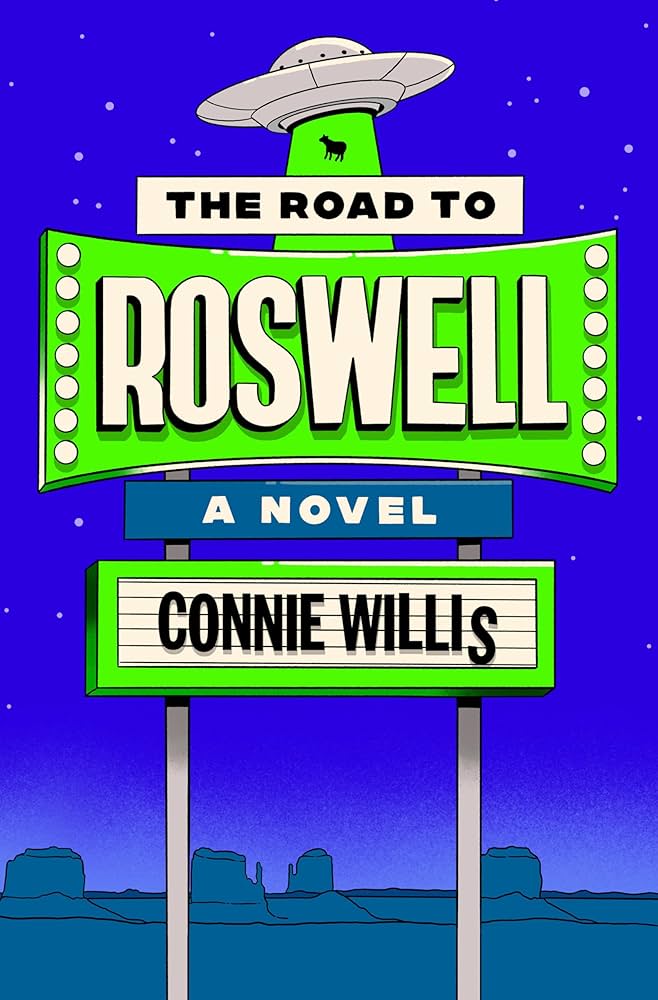
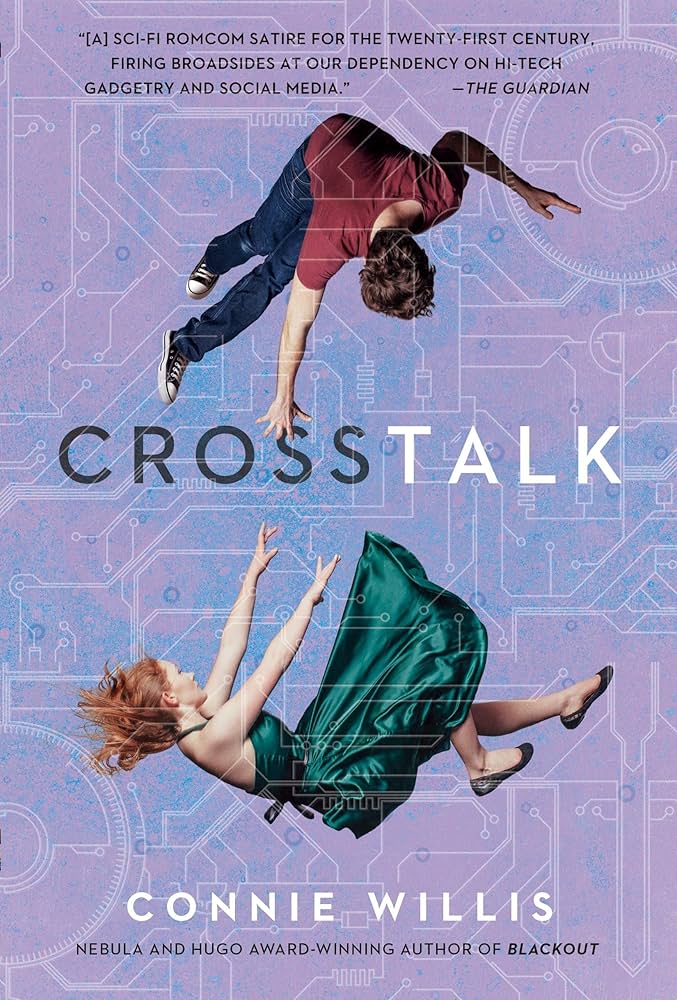
More Connie Willis books

Many years ago I bought my first Connie Willis book, To Say Nothing of the Dog. Time passed, and I came across a novella of hers called All Seated on the Ground. It was a quick read, but a funny and brilliant story. Since then, I’ve been on the lookout for books by Connie Willis. This weekend I was in Austin, and found a couple of her novels that I didn’t have; well, there was a third, but I am too picky, and as the cover had a long scratch, I reluctantly put it back on the shelf. To be honest, I’ve mainly been looking for Blackout and Doomsday Book. Along the way I’ve come across several unexpected titles, and none have disappointed me so far.

The Road to Roswell (Del Rey, 2023) I started reading this book on the way back from Austin. It’s a funny alien abduction story, starting in the town of Roswell, New Mexico. Roswell is known as a site of an supposedly alien ship crash landing in 1947. I’ve been to Roswell a couple of times on the way to other places, and they do sell their alien landing story as a major part of the town. In this book, which takes place during a wedding at a Roswell alien festival, there’s a real alien kidnapping. I read this book in a couple of sittings. For the most part, I enjoyed it, though I found the ending too abrupt. A note in the book states that Willis is working on another time-travel novel, so that’s some good news.

Crosstalk (Del Rey, 2016) I’d never heard of this book, but it seems to be a take on the burgeoning world of social media. The novel was published in 2016, back when facebook, Twitter, Instagram, etc. were all the rage, and the rise of influencers dominated media. As such, it’s maybe an attempt to tap into the pulse of the current state of society, and extrapolate this in ways on SF writers are able. So, if I dive into the book, it will be interesting to compare it to the present, a decade after it was published. The world has changed many times since then, but social media and influencers sadly remain a part of it. I found a nice copy of the hardcover edition on my recent Austin trip. Not high on my “To Read” stack, since I don’t care much about social media, though looking back a decade will be strange, given the rise of social media since that time.

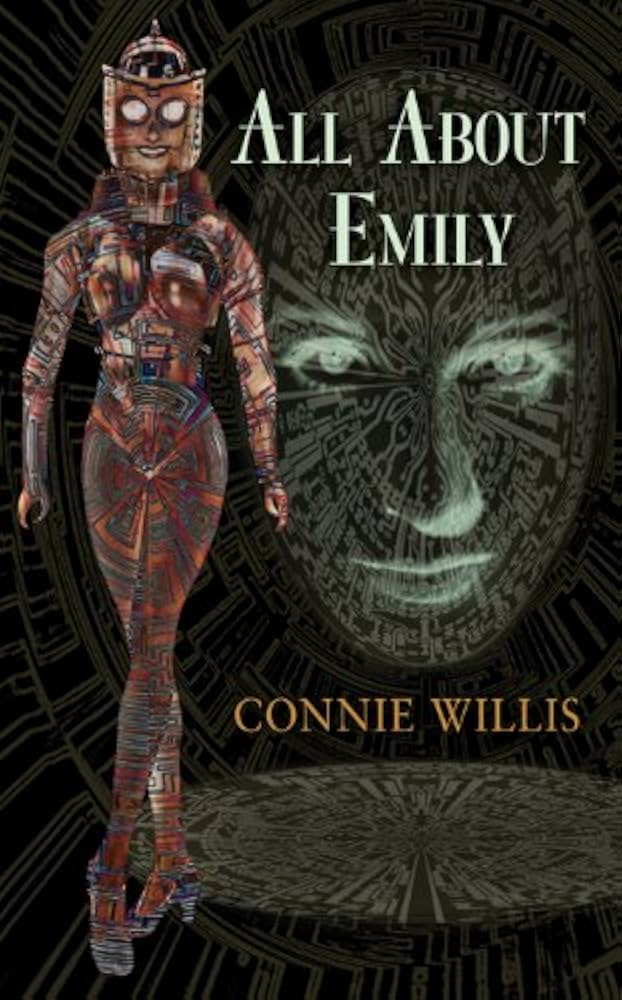
All About Emily (Subterranean Press, 2011). A novella, so in essence, a short novel. Illustrated by J. K. Potter. One of a handful of books I recently bought from Lawrence Person’s Lame Excuse Books. This book was limited to 400 signed and numbered copies, plus an unknown number of unsigned copies. My book is signed by Willis, and numbered 176 out of 400. Subterranean Press has published a fair number of Willis’s books, and they always do a bang-up job with each edition.

Dan Simmons, RIP

This weekend, while traveling, I learned that writer Dan Simmons died on February 21. Vita, brevis; ars, longa – life is short, art is long.

The first Simmons book I read was his debut novel Song of Kali, the first edition of which I found in 1989 in a used book store in Austin for $5.95. He could have kept writing horror, but in 1989 he published his landmark science fiction novel, Hyperion. I missed out on the hardcover edition, but with The Fall of Hyperion and onward, I bought all his books, in hardcover if I could find them, in paperback on a couple of occasions: Carrion Comfort I read as a paperback book (only decades later was I finally able to buy the oversized Dark Harvest hardcover edition); Phases of Gravity also came out first in paperback, and when I found a copy of the UK hardcover edition, I bought that book with no hesitation. (I even had to buy Ilium and Olympus twice. I foolishly lent my first copies to some friends, with whom I lost contact with a year or two later. So, when I came across another pair I bought those as well. Twenty years later I still don’t have the first books that I bought, and I doubt I’ll ever see those copies again.)

I met Dan Simmons just twice, in 1990 and 2000. The first time was at an SF convention, where he signed my Song of Kali copy. Then, a decade later he was on a book tour for The Crook Factory. He happened to stop at Adventures in Crime and Space, genre bookstore in Austin, Texas. I spent several minutes talking to him at this book store. He was gracious enough to sign a stack of my books at that occasion, as I brought along all of his books I’d bought since 1990. On both occasions, he came across as the kind of guy you want to sit across the dinner table. Listening to him talk was just as captivating as his fiction.

For many years, news about a new Simmons books virtually disappeared. His last novel, Omega Canyon, has been announced for publication several times, but nothing has materialized. A few years ago he suffered a head injury, which may have affected his meticulous approach to research and writing. What a shame.

His over 30 books stand as superb entries in such varied genres as horror, science fiction, historical/parallel fiction, and mystery/crime fiction. Song of Kali, published by Bluejay Books in 1985. It bore a blurb from F. Paul Wilson on the back cover, and that was enough for me. Plus, when I found the book on a shelf in 1989, I’d already heard rumblings that Simmons was an up-and-coming writer. For a poor college student working a part-time minumum wage job, who then usually only bought cheap paperbacks, spending $6 for a book was a big deal back then, but I think I read the book in one sitting. Thanks to my brother-in-law, at that time a book dealer, I was able to get a great price on another hardcover book, the Dark Harvest horror anthology, Night Visions 5. This book contained stories by Stephen King, George R. R. Martin, and Simmons. When Hyperion was published, I could not get a hardcover copy, so I bought and read the paperback book. Little did I know then that the hardcover would later prove next to impossible to buy, unless you were willing to shell out hundreds of dollars. From then on, I bought every Simmons book I could find (and afford). In some cases, this meant haunting used books stores. In other cases, buying them the moment I found a new copy.

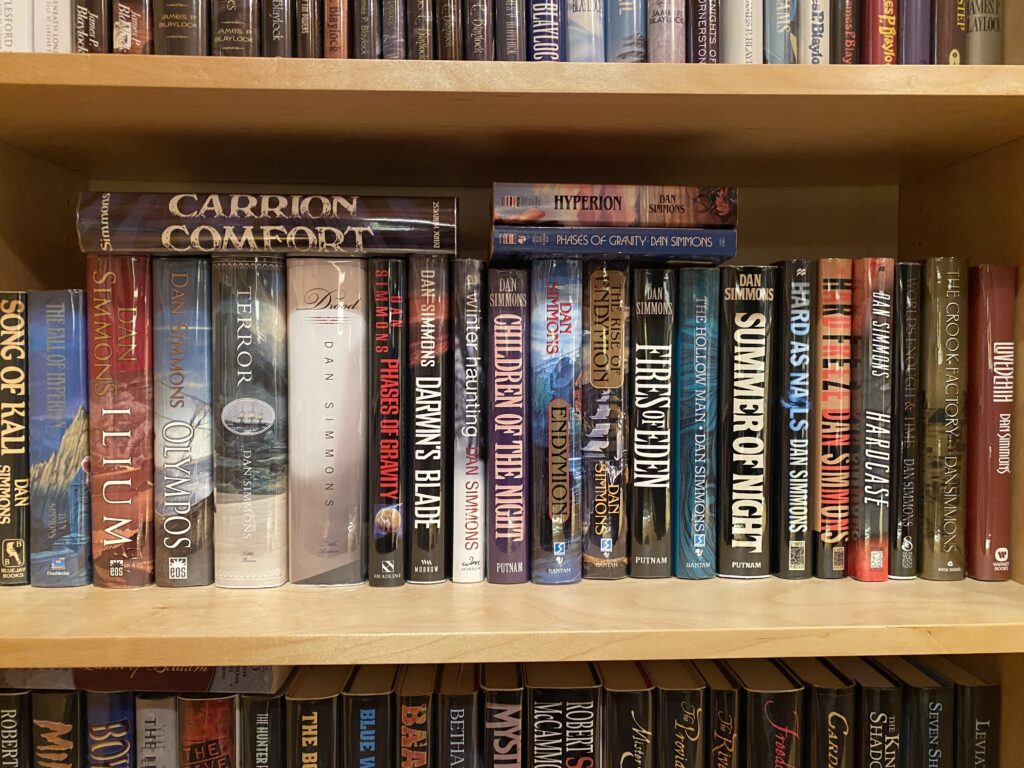
A shelf of books by Dan Simmons (Not pictured as they’re on another shelf: Prayers to Broken Stones, Flashback, The Abominable, Black Hills, The Fifth Heart, Night Visions 5, the Lord John Press edition of “Entropy’s Bed at Midnight” and Summer Sketches)

In terms of science fiction, he has writing such standout novels as Hyperion, Fall of Hyperion, Iluim, Olympos, Phases of Gravity. For horror, there’s Carrion Comfort, A Winter Haunting, Summer of Night, Children of the Night, and Fires of Eden. He wrote three hardboiled mystery/suspense novels: Hardcase, Hard Freeze, and Hard as Nails. Meanwhile, Darwin’s Blade is a pure suspense novel, as is The Hollow Man. He could have stuck to writing books in any genre, but Simmons was never one to be limited by success or genres.

His stort stories were collected in Lovedeath, Prayers to Broken Stones, and Worlds Enough & Time. One of his short stories appears in The Last Dangerous Visions, edited by Harlan Ellison and J. Michael Straczynski. His novella, Muse of Fire, is an SF classic. He wrote a Jack Vance appreciation story, “The Guiding Nose of Ulfänt Banderōz,” which first appeared in a collection of new fiction in the style of Vance, and later as a novella from Subterranean Press. Several of his short fiction remains uncollected, as do many of his non-fiction essays. See here for a bibliography.

He even wrote several books with a theme of parallel history, books that drew in real-live people with a twist of fiction. The Crook Factory featured Ernest Hemingway during his Cuba years; Simmons went mountain climbing on Everest with The Abominable, ventured into the icy wilderness with Franklin’s failed Northwest Passage expedition in The Terror, shadowed Charles Dickens last and unfinished novel with Drood, then delved into the history of Mount Rushmore with Black Hills. Lastly, he gave us a mix of fiction and metafiction with The Fifth Heart, possibly the last book published in his lifetime, back in 2015. For years after than book came out, I kept looking for new fiction from Simmons, but to no avail. Now, one more of the great genre writers has fallen silent.

Tempus edax rerum – time, the devourer of all things. Another giant in my golden age of SF (and other fiction) has fallen silent. Rest in peace, Dan Simmons.

© 2026 Anders Monsen

Theme by Anders NorenUp ↑

css.php