To be accurate, three of the books recently acquired are under the Arkham House imprint, and one under their mystery books imprint, Mycroft & Moran (even though the dust jacket has Arkham House on the spine).
Recently I’ve turned my eye toward trying to collect more Arkham House books, although I know there are a few that probably will remain out of reach, including the ones from the 1940s, plus some of H. P. Lovecraft’s books (which I may well skip, anyway). I don’t have the exact number of books they published, but I believe that it’s close to 200 (this may include pamphlets and other association material). Despite the value of the name, Arkham House, the owners of this brand have failed it, given that nothing’s been published since 2008, and less than 10 books have appeared since 2000.
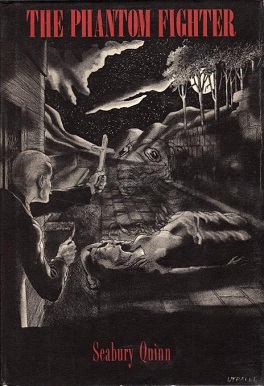
First published in 1966, Seabury Quinn’s The Phantom Fighter collects ten of his Jules de Grandin stories. This is the first time I’ve bought a Quinn book, or read any of his stories. Apparently he was quite popular among Weird Tales readers, but has faded somewhat in modern times, at least compared to Lovecraft or Robert E. Howard.
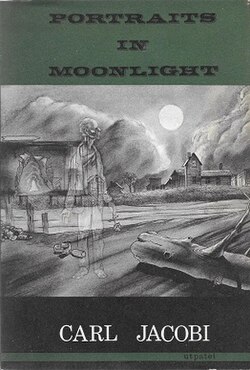
Portraits in Moonlight, by Carl Jacobi. Published in 1964, and along with the next book mentioned below, the oldest of my Arkham House books. Collects 14 stories, many of which originally appeared in Weird Tales magazine. My first Jacobi book, although I’d tried for years to find his Fedogan & Bremer book, Smoke of the Snake, to no avail.
Tales of Science and Sorcery, by Clark Ashton Smith. Also published in 1964, this book contains 14 short stories, and a memoir by E. Hoffmann Price. Perhaps I’ve already read these stories elsewhere, as I own a fair amount of non-Arkham House CAS books. This is only my third Arkham House book, the other two being a collection of letters and a book published in 1988. Most of his other AH books date back much further than what I have.

Eight Tales, by Walter de la Mare. Another book from an earlier era, published in 1971. A slim volume of never collected early tales. This book also includes an interesting introduction by Edward Wagenknecht, where he discusses different writers and their thoughts on their early fiction. Some writers want to forget, hide, or revise their early works, as, looking backward with what they’ve learned they see the embarrassment of their earlier attempts at writing. I’ve never read anything by de la Mare (much like Quinn and Jacobi), so this will be an interesting dip into the past. It does appear, at least from an initial glance, that de la Mare at least allowed his earlier works to once more see the light of day. It would be interesting to compare these to more mature tales.

With these four titles, I now own 40 Arkham House books and two Mycroft & Moran books. That’s a decent number, but still less than 25% of their published works. I think that I might be able to acquire another 30 or 40 or so books, before I encounter those volumes that are insanely rare or expensive. If I’m able to collect all of the books published since 1970, or maybe 1960, I think that I’ll stop there (though now that I have a few from the 1960s, it tempting to add that decade to my goal). I really wish that they had made an effort to continue to publish books under their name. What a waste of a great imprint.
