 The big news today is that Amazon announced it’s bought the rights to Consider Phlebas, Iain M. Banks’s Culture novel. I’m still surprised (no, not really) that Banks never won a Hugo Award for any of his Culture novels, as they are pure SF through and through. The novel will be turned into a series, and likely if successful will spawn adaptations of other novels. Alas, Feersum Endjinn isn’t a Culture novel, but still one of my favorite Banks books, as well as the non-M mainstream novel, Whit.
Category: books (Page 16 of 25)

There are some novels that seem anchored in a specific place or time, or sometimes both. That doesn’t mean they are bad, but they exist like flies in amber—stuck in place. Then there are books that span ages. Eric Ambler’s outstanding novel, published in the US as A Coffin for Dimitrios and in the UK under the more sinister title, The Mask of Dimitrios, is set in the 1920s, and 1930s in Europe, but feels as current as today.
From Constantinople to Smyrna, from Sofia to Geneva, and finally Paris, Ambler weaves a tight tale of detection by a deceive writer tracing the path of a wily criminal. There is no motive other than curiosity here, yet Latimer, the protagonist, places himself in difficult and often dangerous situations, a strange affair for someone used to sitting behind a desk writing stories, not living them.
The criminal whose paths he traces built a life upon exploration, from fellow criminals to prostitutes to drug users and dealers. He worked himself up form the very bottom toward a place of potential respectability, something that seems true to life as well as multiple works of fiction, where the past of people in power often contains many skeletons.
Although written at the cusp of WWII, this novel could just as well have taken place during almost any decade in the past two hundred years, with wars, smuggling of people and drugs, and criminals quick to murder and betray. The prose is superb, the plot never wavers, and the ending both tragic and amusing.
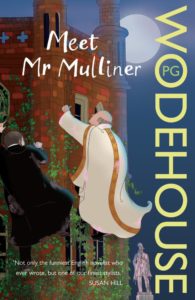
Since my last foray into the world of Wooster and Jeeves I’ve found a few more stacks of Wodehouse books, increasing my library by nearly a dozen books. While not ideally suited to binge reading, I’ve read a couple more Wooster books, and a pair featuring the tales by a certain Mr. Mulliner, as related to a rapt audience in a local pub. (The fact that my compute attempts to auto-correct the name to Milliner is a sad testament to computer illiteracy.)
The two Mulliner books that I’ve read so far are both collections of short stories, each a tale of some hapless nephew, or cousin, or other relative of Mr. Mulliner’s. Nearly each story tells of a young(-ish) lad falling in love, his travails and eventual triumph. The stories are islands in time, so ideally suited for PBS costume dramas set in England between the wars, although likely some were written after WWII. They tell of a time when young men were gentlemen, often of leisure, with butlers and other people to take care of vital needs. Back then people belonged to various clubs, Great Britain still had traditions, and public school chums were chums for life. Some of the characters that appear in the Wooster and Jeeves books appear in these stories, so they exist in the same fictional universe.
Some of those things are obvious inventions, but I found it jarring to read a throw-away line about a tuck-shop, since that’s the term we used for such a place back when I went to school in Lusaka, Zambia, in the 1970s and 1980s. Some British traditions and nomenclature spans decades. This fact sounds trivial, but the reach of the British Empire stretched far across the world in untold ways. Does the tuck-shop still exist in places today?
While not every Mulliner story amuses on the same scale, and they tend to follow for the most part a certain formula, the ones that are good are dashed good, in Wodehousian terms. They’re maybe not Jeeves and Wooster good, but the best ones rise almost to that level.
 Twenty or so years ago I bought my first Fritz Leiber book. It might have been The Swords of Lankhmar or one of the other books in the Fafhrd and Gray Mouser series. Back in the late 1980s, early 1990s you could still find the old Ace paperbacks in good condition in used book stores. If you were lucky.
At any rate, I bought The Knight and Knave of Swords in hardcover in 1988 or 1989, since this was the first publication date, and picked up The Leiber Chronicles, the massive collection published by Dark Harvest, in the same year or shortly thereafter. I bought as many of Leiber’s fantasy books as I could find, especially the books set in and around Lankhmar with those two rogues. Yet one book eluded me – Swords Against Wizardry. Maybe I didn’t look hard enough, or I rejected the beat-up copies I found whenever there was a Leiber book in the paperback section of the (mostly) local used book stores I visited over the years.
This weekend I found a decent copy of the missing book, merely by chance, twenty or so years after my first introduction to Leiber’s works. For the princely sum of $3, marked down from $5, with an extra 20% that weekend, I’ve now added this book to my collection, garish cover and all.
I find it somewhat amusing since Centipede Press has begun the process to reprint in nice, expensive editions the entire eight books in the series, and likely I will end up buying them over the next few years. At least I have a reading copy.
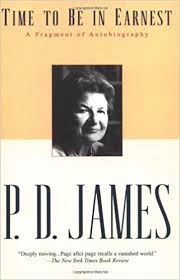
Just over 20 years ago, on August 3rd 1997, the writer P. D. James began a one-year project, intending to keep a diary of her activities for 365 days. The complete title is Time to Be In Earnest: A Fragment of an Autobiography. Although herself a fan of reading diaries, she admitted to never keeping her own diary. Somewhat reluctant to partipate in someone writing an authorized biography, her short memoir is a begrudging nod in that direction, claiming for herself the right to write about her personal thoughts and histories. She includes personal information in brief snippets along with daily activities, so this may be the closest we get to learning about her life, aside from any unauthorized biographies. James doesn’t follow a rigorous schedule (a fact which she remarks upon at the end of the book), and there are almost as many gaps as there are entries.
The writing of this diary coincides with the publication of her then latest novel, A Certain Justice. During the year that followed its publication she embarked on multiple book tours, including one to Canada and one to the US. She also signed books at bookstores in the UK, including bulk signings for stock of 1,000 and 750 copies. On my bookshelf sits a signed first edition of A Certain Justice. Although it’s the US edition, the inlaid letter addressed “Dear Bookseller, please enjoy these signed copies…” implies James carried out stock signings in the US as well, which seems remarkable generous on her part.
In 1997 P. D. James owned a house in London, another house on the Atlantic coast in East Anglia, and an apartment in Oxford. She flitted between these three locales as well as many other places, a dizzying schedule for a full-time writer. As she’s not a driver, James relies on trains, busses, taxis, and friends to drive to engagements. This allows her to be a constant observer. Twice while on trains she complains (gently, it seems) about the noise from people on their mobile phones or audio devices. Imagine were she to take the train today, where smart phones are everywhere, and not just the nascent audio and texting devices of the late 1990s. On both occasions she wishes for a quiet compartment, which I found amusing when taking the train from London to Reading and Cardiff this summer. On those trains there was a quiet compartment, so obviously James was ahead of her time. Not just relying on public transport, she also walks along the streets of London. Her home, on Holland ParkAvenue just west of Kensington Palace and Hyde Park, means she often travels through Kensington Gardens on her way into central London.
I found it almost jarring when she mentions the Princess of Wales early in the book, wondering on the 17th of August why the public really cares about the antics of Diana and her lover. Only a few days later, on August 31, the Princess of Wales died in a car crash, spurring a waves of mourners depositing flowers outside Kensington Palace. I mention this, not because I particularly care about the British Royal family, but because 2017 is the 20th anniversary of this event, and it’s been in the news consistently over the past month. Reading James book for the first time, 20 years almost to the day she began her diary, the convergence of events is unsettling.
Throughout her entries James muses on her personal history as well as presents some thoughts on writing the detective novel. She elaborated on this in a dedicated book, Talking About Detective Fiction (2009) though much of her thoughts on the genre maybe surfaced first in her diary. On the other hand, she’s probably had thoughts about the genre and its writers for many, many years.
Often we forget that writers live their lives just like any one else, but I found it amusing to read about her travails with surly bus-drivers as she took the Number 94 bus down Bayswater Road, or shopped at Marks and Spencer for weekly groceries, or even at John Lewis, the department store that seemingly has everything, to judge by the one in Reading I walked through in 2017. Alongside these quotidian events she talks about her role at the House of Lords or jetting to Grand Cayman to visit fellow author, Dick Francis, or to visit Oxford and Cambridge, or other places in the UK. Such a busy schedule, I wonder how she ever had time to work on her fiction. She kept busy well into her 90s, although in this book she mentioned taking on fewer and fewer engagementsas she aged. As an aside, since the event took place after the publication of this book, she opened the crime section at Foyles bookstore in Charing Cross, a store I visited this past summer. It’s strange to think of James’s echoes haunting the very location where I stood and looked at her books.
This is a slim book, and as mentioned not every day of her so-called diary receives an entry. Still, James is a goddess in the field of British crime fiction, and anyone who reads her books will gain insight into the mind behind Inspector Adam Dalgliesh from these pages. Maybe one day we’ll get an authorized biography, even though P. D. James is now dead, and delve more into her mind and life, but for now this small book is a charming wonder and great way to remember her life.
 Hideo Yokoyama’s sixth novel, Six-Four, is his first to be published in English, appearing in early 2017 under the imprint of Farrar, Straus and Giroux, and weighing in at 566 pages. My knowledge of Japanese detective fiction is admittedly limited. Aside from having read all of Haruki Murakami’s books, the only other Japanese book I’d read before Yokoyama’s novel was Natsuo Kiruno’s Real World, another crime novel.
The title of the novel, Six-Four, is evocative and multi-layered. Its meaning refers to the 64th year of the Showa period, the last year of Emperor Hirohito’s reign. Hirohito died in January 1989 and a new Emperor ascended the throne, starting the Heisei period. The novel takes place fourteen years after 1989, with Six-Four now the unofficial name of an unsolved kidnapping and murder case that forms the background of the novel.
Yoshinobu Mikami, a former homicide detective recently appointed as press director, finds himself fighting many battles. His teenage daughter has run away from home. His relationship with his wife, Minako, herself a former police officer, is crumbling under the stress of their daughter’s disappearance. Meanwhile, he is assigned from homicide to become the director of the press relations group, and feels veru much like a fish out of water.
Mikami is new in his role, still finding his feet when balancing police needs to keep certain details from the the public while still satisfying a hostile press corps who question that very need for secrecy. Almost from the outside he finds himself at odds with the press contingent that covers crime and the police, when he withholds the name of a person involved in a fatal car accident. The fact that this person is connected to a government official makes his position more delicate. To the press that news would become a leading story, no matter any extenuating circumstances. The small but loyal police press department consists of two young male assistants (one of whom likely envisions himself one day in the job of press director himself), and a young female officer busted moved over from the transportation division. Mikami places himself almost in a fatherly role with the young Mikumo, limiting her contact with the devious and salacious members of the press, who frequent karaoke bars with the police outside work in a two-way street in terms of information and disinformation efforts.
As if dealing with the press and disappearance of his daughter wasn’t enough, Mikami also finds himself fighting internal political battles inside the police department. The press division isn’t the greatest of tasks, and supervisors and other divisions appear to be plotting against Mikami in various internal battles, jockeying for future appointments within the precinct and greater Tokyo police force infrastructure. A former classmate seems to be behind many of the plots, at least as envisioned by Mikami. This person, Ishii, hovers in the background, runs unofficial investigations of past cases. One such past case, Six-Four, becomes yet again a present case, as a high-ranking inspector from Tokyo plans a visit to pay his respects to the dead girl’s father, Yoshio Amamiya, who has suffered in silence for many years, and lost his wife one year ago, compounding his pain.
To facilitate the meeting between Amamiya and the police contingent, Mikami is sent to pave the way, both in his role as press director and as a detective from criminal investigations who worked the case, which remains unsolved to this day and weighs heavy on Mikami. The initial meeting doesn’t go well, and Mikami emerges with the feeling that he has failed his role, a feeling compounded during a meeting with his superiors. In that meeting the seeds are sown in his mind about internal plots within the department, various groups working at odds with each other, and maybe at the root is the failure of the Six-Four case fourteen years ago.
Events accelerate when a copy-cat crime takes place, with another young girl kidnapped and the exact same process as in the previous crime repeats itself. Finding himself at the center of various threads, from a rebellious and antagonistic press to imperious commanders and police chiefs seemingly plotting against him, Mikami sees the new case as a way to atone for past wrongs, and dives into his own investigations.
Although some of the plot points seems byzantine and contrived, Yokoyama’s massive novel became impossible to put down once the various plots had settled into their individual paths. The language is sparse, economical. As a reader I felt almost one with the protagonist, felt his paranoia and anguish, and wondered how the various elements would come together. Not everything is tied neatly at the end, and some mysteries remain, but Six-Four is one of the best crime novels I’ve ever read. Admittedly it felt slow to start, and the dispute with the press somewhat contrived, but the characters come to life in the pages. I should also note that the book was made into a two-part movie. I’m not sure if this was for the big screen or television, as I watched it this summer on an intercontinental flight between the UK and US. The movie remained relatively faithful to the book, something probably difficult for a book of that length and complexity.
 Although I have generally moved away from reading science fiction and fantasy, there are a few writers I never will abandon.
Fritz Lieber’s sword and sorcery series about the two rogues, Gray Mouser and Fafrhd (the latter whose names I continually misspell) have a special place in my heart.
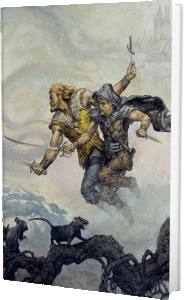
Centipede Press, publishers of exquisite limited edition books, have started the process to publish eight (8) books collecting all the fiction with these two characters. The cost starts at $75 per book, which will set any collector back a pretty penny by the end of the venture.
The first book, Swords and Deviltry, contains the original tales, some poems, notes by Leiber, and the origin of the two characters. The wrap-around cover by Tom Kidd is unreal and gorgeous. Anyone who manages to own the entire set will guard them jealously. It even smells unique.
I stumbled upon James Crumley’s name amid a list of recommended crime novels. His novel, The Last Good Kiss, apparently rated as one of the best crime novels of the last century, featuring a tough gumshoe by the name of C. W. Sughrue. Other writers hail Crumley as a genius in the field, while readers still haven’t flocked to his books en masse.
Crumley’s style is uniquely American, hewing to the hardboiled sub-genre of crime fiction, with tough men and tougher women. Live is short, hard, and often involves guns, liquor, and deadly relationships.
Bordersnakes, originally published in 1996, is the second Crumley novel I’ve read, kicks up the hardboiled feel a notch or two. The description at the back reads like something from a melodramatic Twilight Zone episode: two tough guys on “a death trip across a country called Texas, to a state of mind called revenge.” Texas, although one of the fifty states in the union, often is considered both another country and a state of mind, and features heavily but not solely as the setting of the novel, which ranges from California to Montana, New Mexico and old Mexico, to almost every corner of Texas. Sughrue and Milo drive and fly from El Paso to Austin, San Antonio to the Valley, to Kerrville and the Hill Country west of Austin, and along the various towns of West Texas between El Paso and San Angelo, and finally across the border into Mexico.
Crumley wrote several novels that featured Sughrue, yet he also introduced another private detective protagonist in his own series of novels. Sticking to names that are difficult to spell, this detective is Milo Milodragovitch, a former cop based out Montana like Sughrue. In Bordersnakes, the two men join forces in dual quests for revenge that, like all fiction, seem disconnected but are tightly intertwined. This makes the resolution simple, as two problems are solved with one bullet, in a manner of speaking.
Crumley’s style is rife with adjectives and contrasts. In a run-down motel, “[t]wo puke-plastic chain lights flank the filthy bed with dim stagnant streams from forty-watt bulbs.” Later, at a party held by a former general at his ranch in West Texas, with Hollywood actors and washed up directors, a rattlesnake appears on the lawn. One of the female guests shrieks and then pulls a Smith and Wesson “Ladysmith Auto” from her purse and kills it, prompting all the other guests to drawn their weapons before realizing none of the guests were the targets. It’s almost comical, but fits in with the general perception that all Texans carry guns.
The story itself features two main threads. In the first, Sughrue is shot in the gut and left to die in a ditch. He recovers, slips into a funk until Milo appears and sets him on the righteous path of revenge. The second thread features Milo, whose inheritance worth multi-million dollars has been siphoned from a bank account and the perpetrators vanished. Although apparently not worth much, Milo throws around money as if it’s renewable paper in his effort to grease the gears needed to reclaim his full fortune. When Milo shows up looking for Sughrue and the start their journey across the Southwest, they bounce around like confused pinballs. Their first trip recreates Sughrue’s shooting, which leads to a gun traced back to an accountant in Austin. Discovering the accountant and his wife dead, they rescue their dog shot by the killers and drop it off at an emergency clinic, before resuming their connect-the-dots journey from person to person, each one more devious and vicious than the last. There are no coincidences in this novel, and every character leads somewhere, every person is connected to their goals. Yet even were they both to succeed, I got the feeling they enjoy this journey too much to really care about the end result.
Many of the settings and landscapes in the novel were familiar to me, especially the locations in Austin and West Texas. A good part of the novel takes place in Austin, around the same time I lived in that city and traipsed around to many of the same places. Since it was published in 1996 and probably written a year or two earlier, it took place at the exact same time as I drove around the city, from Mount Bonnell to Town Lake and in between.
In terms of American crime novels in general and hardboiled in particular I’ve still a neophyte. I see echoes of Raymond Chandler, John D. MacDonald, and Joe R. Lansdale in Crumley’s fiction. It’s likely I’ve not yet read widely enough, and therefore these authors’ styles all bleed together. Having read quite a few of Lansdale’s novels, many of which have the same style, tone, topic, sense of violence and occasional poetry, I could not help but think of those two writers somehow connected at the literary hip. Much of Lansdale’s fiction takes place in Texas, like Bordersnakes. I didn’t get as deep a sense of similarity with Crumley’s more famous novel, The Last Good Kiss, which took place in California and Montana, but this one feel like an extension of Lansdale’s fictional world, especially his Hap and Leonard novels.
There are several other novels with Sughrue and Milodragovitch. I suspect I’ll read them as I find them, but in small doses. There are distinct differences between European crime fiction and American crime fiction, and I still find myself favoring the former over the latter.
John D. MacDonald’s Travis McGee books spans 21 novels across 21 years. They were published between 1964 and 1985, which roughly correspond to the first two decades of my life. Growing up I remember seeing (and probably reading) several of the McGee novels in my parents’ library, as all the titles contain a color in the name. They also usually featured bikini-clad women, which to a teenage boy must have seen like incentive enough to read the books. However, unlike many of the novels by Dick Francis that I read around the same time during formative teenage years, I remember little about MacDonald’s books, except that they were set somewhere along the coast in the US.
Recently I read the first book in the series, The Deep Blue Good-By. Instead of a fading paperback with an embarrassing cover, the recently republished trade paperback edition’s cover is far more sedate, showing only elegant legs dangling over a swimming pool. Noted writers such as Stephen King, Mary Higgins Clark and Jonathan Kellerman provide blurbs, while Lee Child pens the introduction.
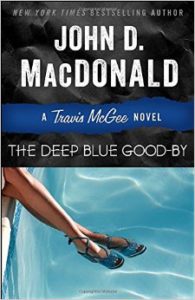
The protagonist, Travis McGee, hires himself out as a person who retrieves stolen property. People who can’t get back their property through regular channels turn to McGee. The work is such that he spends downtime relaxing on his large houseboat, the Busted Flush, somewhere in Florida. He works only when his funds run low, usually able to pick and choose his various jobs. As the book opens he’s currently between jobs, letting his houseboat be used as a space for a friend to tune her dance routine. McGee, the eternal gentleman, gently rebuffs her advances after her routine, which makes her both angry and thankful. This introduces to the reader a sense that McGee has a moral code, one that slips slightly after he picks up a young college student at a bar for a one-night stand later.
The dancer is there not just to highlight McGee’s ethics, but she also introduces him to a new job, Cathy Kerr. One of her dancers had her family fortune stolen by a conniving ex-lover, who used her to find a fortune in jewels smuggled back from Asia after WWII by her father. Junior Allen, a sadistic and manipulative person, had spent time in military prison with Cathy’s father, who died in prison after boasting he had a hidden fortune somewhere back home. Allen seduced Cathy, learned all he could about her father, then dumped Cathy and showed up a few months later a wealthy man with a high society woman on his arm like a trophy. Now Cathy wants to retrieve part of her fortune, for the sake of her family.
The actual work undertaken by McGee is cautious and indirect. He never confronts Allen, but gathers information through research and surveillance, with a dash of deception. Via his research McGee comes across Lois Atkinson, the high society woman last seen with him as he parade his new-found wealth around Cathy’s town in the Florida Keys. Used and abused by Allen both physically and psychology, Lois is a wreck barely hanging onto existence when McGee finds her. He nurses her back to health and sanity first at her house and then aboard the Busted Flush, while planning how to get the better hand of Allen. Yet Allen is not only sadistic, but cautious. He thwarts McGee’s plan to travel as a guest on Allen’s boat into the Gulf, and when Lois arrives to rescue him she’s taken prisoner as well.
With everyone aboard Allen’s boat, we get to the meaning of the title of the novel. Amid the deep blue waters of the Gulf Stream some of the characters will truly say farewell to life, in a most brutal fashion.
The action of the novel spans only a small portion of the book. The rest establishes the characters, settings, and background, building tension slowly until a sudden rush that’s almost shocking in speed and force.
Published over fifty years ago, The Deep Blue Good-By stands the test of time with mixed results. When the novels first appeared, McGee might have been a unique character. Today, with so many similar characters in fiction and movies, that uniqueness seems diminished. MacDonald’s writing at times seems dated, his view on gender old-fashioned. The prose is tight, descriptions of people and places vivid. Some of the prose is rough around the edges, but in this first book of the long series Travis McGee stands out as a unique character. I certainly intend to continue reading the series. There’s a mix of both the hard-boiled and more gentler themes, at least in this book.
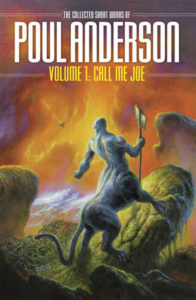
Recently I picked up six volumes of the collected stories of Paul Anderson, published by NESFA press between 2009 and 2014. Since the last book appeared over two years ago, I’m not sure if there are future volumes planned.
Each book is hefty, full of classic short stories, novellas, occasional poetry, cover art by Bob Eccleton, John Picacio and introductions by noted writers in the SF field. Reading through all the stories could take a year or more, as each book is so dense and rich. I’ll have more to say as I read the books. For now I’ll just enjoy the covers.