Lost worlds and ports of call

Tag: Arkham House (Page 1 of 2)

Lucius Shepard’s Dragon Book

The first Lucius Shepard book I ever bought and read was Green Eyes, which happened to be his first novel. This was probably around 1989-1990, when I vacuumed up any and all cheap SF books I could find at the time in new and used book stores in Austin, TX. Shepard (1943-2014) wrote fantasy and science fiction, and often was linked to the Cyberpunk movement in SF. He also was noted for writing about Central America and war from a leftist perspective. I bought his novella, Kalimantan, in the Strand Bookstore in New York City, back in 1992 or 1994. Then, a pair of novellas from Golden Gryphon, a publisher whose books of whom I attempted to collect a complete set. A few years later, I bought a collection of his stories published Arkham House, called The Jaguar Hunter. Many years passed until I came across another of Shepard’s books, but between 2023 and 2025 I amassed half a dozen of his books.
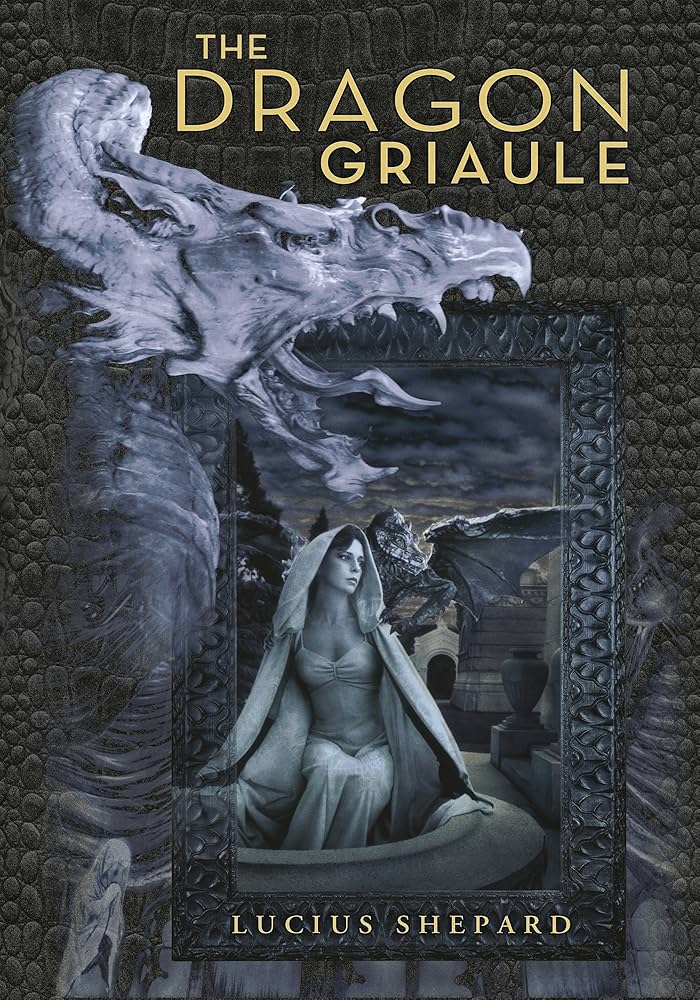
Several of the books I bought are novellas set in his Dragon Griaule “universe.” This is a fantasy world centered around a dragon that’s a mile long. While it appears to be dead, it still exerts influence in the world around it (usually malign). There’s also an entire ecosystem inside the dragon. Several of the novellas have been published in book form by Subterranean Press and other small press publishers. These include “The Scalehunter’s Beautiful Daughter,” “The Father of Stones,” “Liar’s House,” and “The Taborin Scale.” I have the first three, but as I’ve sort of picked up the books at random, have so far not seen any copies of the last one.
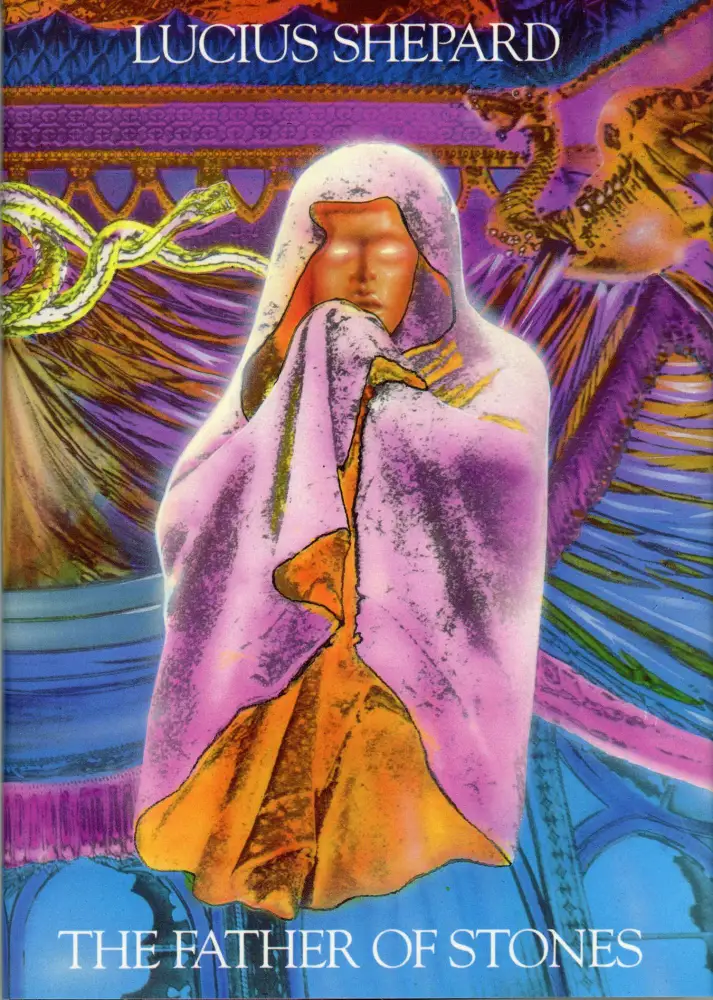
The Dragon Griaule, published by Subterranean Press in 2012, collects six Griaule stories, including the first one, “The Man Who Painted the Dragon Griaule,” as well as “Skull,” which appears to be his last story in this universe. Two years after the publication of this collection, Shepard died at the age of 70 from the complications of a stroke. “The Man Who Painted the Dragon Griaule” appears in his Arkham House collection, The Jaguar Hunter. I don’t know if it’s been published as a stand alone novella like some of the others. This edition also includes a section with story notes: short snippets about the origin of each of the stories. I enjoy reading these notes almost as much as the stories themselves.
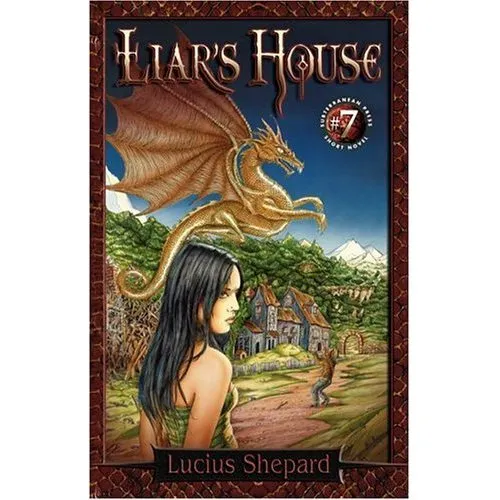
Shepard led an interesting and peripatetic life, which he hints at in some of these story notes. Some of the locations and events at the time he wrote the stories influence the tales, which is inevitable.

I probably over-paid for my copy of the book, even though it’s signed by Shepard, but having read many of those Griaule stories recently, and, as it was in my hands in a book store, I could not put it down. The special signed edition states that it was limited to 300 copies, but there must have been an overlap, as mine is numbered “PC,” which means it was a presentation copy. The artwork is by J. K. Potter, a noted SF/Fantasy illustrator. Two of the stories are new to me, so I look forward to reading them. There are other Shepard books out there that I don’t have, but I expect that if I get them, they’ll be spur-of-the moment buys vs. deliberate actions.
Adding a quartet of Arkham House books

Between 2015 and 2023 I didn’t buy a single Arkham House book. In 2023 I bought just one AH book, Lucius Shepard’s second collection published by Arkham House, The Ends of the Earth. Then, in 2025 an explosion of interest on my part suddenly resulted in me acquiring many more books from this publisher. With these four books, my collection reached a round 50 in number (I’ve since added one more). I’ve probably hit my peak (or close to it) when it comes to books from Arkham House. It’s just going to get harder and harder if I want to try to find the other 80+ books that I don’t have, without spending an excessive amount of money per book.

I bought my first Arkham House book in 1990: Michael Shea’s collection, Polyphemus. I bought this book from Austin Books (in Austin, Texas), back when they sold actual books, and not just graphic novels and comics. Between 1990 and 2015, I slowly picked up more Arkham House books, either from brick and mortar book stores or at SF conventions. Back then you still could buy AH books for between $7.50 to $15, at least the most recently published ones. After 2015, I pretty much stopped going to SF conventions. Also, local book stores didn’t really carry any Arkham House books, as they’d by now ceased to publish anything new. Fast forward a few years. The online world exists far more than the brick and mortar world. Occasionally I’ll search online for Arkham House titles, and occasionally I’ll end up with a few books like these ones:

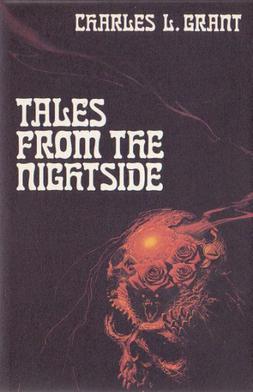
Charles L. Grant, Tales from the Nightside (1984). A collection of short stories. Bought for $50, which is to me the upper limit of what I’ll pay at the moment. Grant, who passed away in 2006, was a prolific author and editor of horror fiction. I only have a couple of his books, as opportunity never presented itself to me to find others, at least in person. This book includes an introduction by Stephen King, another prolific horror writer.

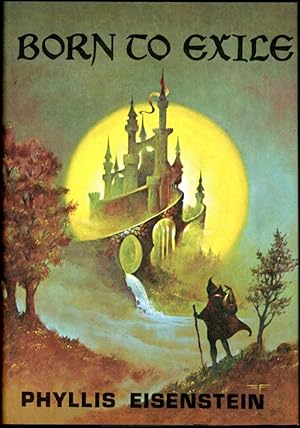
Phyllis Eisenstein, Born to Exile (1978). According to Wikipedia, she died on December 7, 2020 in Chicago from COVID-19 and a stroke at the age of 74.
For some weird and unknown reason, Arkham House slapped a label of “SF” on the spine. Based on the first couple of pages, I’d consider it more in the vein of fantasy than SF.

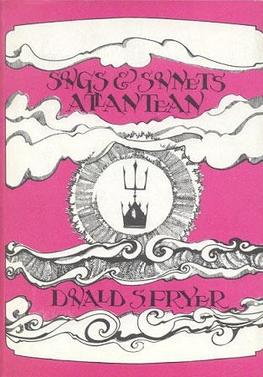
Donald Sydney-Fryer, Songs & Sonnets Atlantean (1971). A collection of poems. Fryer, born September 8, 1934, compiled a bibliography of Clark Ashton Smith’s works, published by Donald M. Grant in 1978. From another entry in Wikipedia, I learned that “in May 2025, 91-year-old Sidney-Fryer suffered a stroke which necessitated his move to a nursing home.” I briefly corresponded with him in the 1990s, when he lived near Corpus Christi (if I recall correctly, as those emails have long since vanished). Soon he will be gone from this world, and I regret never driving down to visit him.

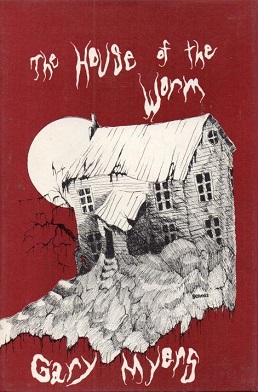
Gary Myers, The House of the Worm (1975). A slim book in the vein of H. P. Lovecraft. At 70-odd pages long, the text reads more like a poem in prose, than fiction. Peppered throughout are black and white sketches, almost as gloomy as the text. According to the note of the author, Myers went on to get his BA after this book, so maybe he wrote it while young. I don’t recall seeing other books by Myers, but not all Arkham House writers went on to publish a slew of books or reach fame.

To me, owning these books is like owning fragments of history, especially given the fate of several of the authors. In time, these books that I’ve acquired, either from bookstores or other owners, will move on to further owners. Hopefully they’ll appreciate them, take care of them, read them.

Tanith Lee’s Arkham House collection

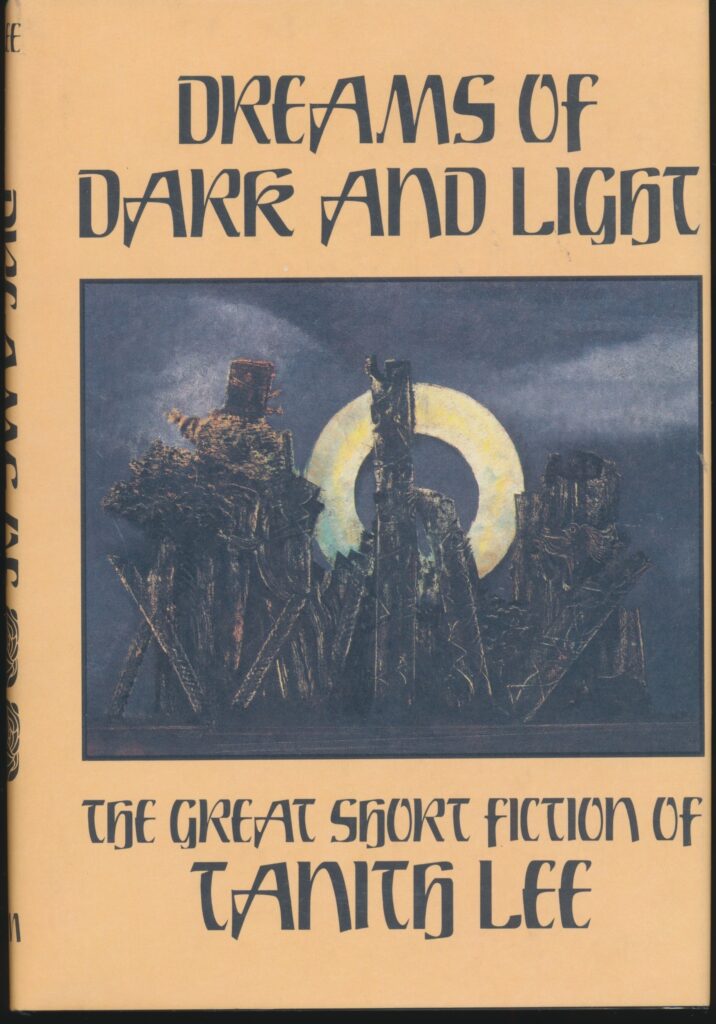
Dreams of Dark and Light is a collection of stories by Tanith Lee (1947-2015), published by Arkham House in 1986. This my 51st Arkham House book. There are a few barely imperceptible spots on the outside edges of the pages, but otherwise it’s in good shape. I’d missed out on a couple of bids for other copes this book, so I was somewhat surprised when I ended up with this one. At any rate, I’ve long wanted a copy. So, many years after it was first published, I ended up with my copy at twice the original price.

I own only a handful of paperbacks by Lee (ok, five, but were it not the fact that I avoid paperbacks with broken spines I would own a fair amount more), which is a tiny fraction of her total output of “90 novels and 200 short stories.” She’s one of three authors in Dark Harvest’s first volume of the horror/dark fantasy anthology series, Night Visions. I bought that book many years ago. I’m fairly certain that I read her stories, but since then I’ve read so much that they’ve long vanished into the mists of time. Finding her books in bookstores, at least since the late 1990s and 2000s, however, is almost impossible.

According to an obituary in The Guardian, “her career went through the doldrums, exacerbated by changes in publishing in the 90s and thereafter. [T]hose qualities that had built her career…were liabilities in a publishing world obsessed with strict category and with authors who produce the same reliable product. At one point, she complained that she was writing books because she could do no other, but was stacking them unpublished in a cupboard.” This probably explains why it’s hard to find her books these days, and also makes you curse those publishing changes. I don’t really read modern fantasy, and maybe that’s due to those changes.

Perhaps now is a good time, as I start to read these stories, to take another look at her other books, and those stories of Lee’s in Night Visions 1.

A pair of Arkham House books

Slowly, slowly, I’m trying to acquire more Arkham House books. It seems that I’m mostly picking up books from the 1970s onward, as older books are harder to find.

Frank Belknap Long, mostly a writer of fiction within the Lovecraft circle, published a slim (66 pages!) Arkham House book in 1977. In Mayan Splendor collects a variety of poems by Long, and is illustrated by Stephen Fabian. Originally sold for $6, I picked this book up for just under twice the cover price, many, many years after it first was published.

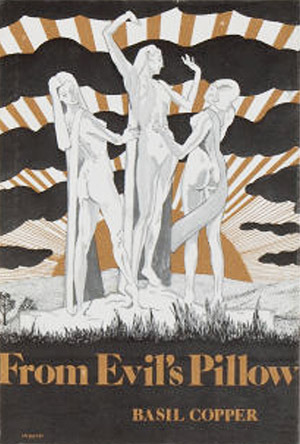
From Evil’s Pillow is my third Basil Copper Arkham House book, but his first published by them. I already have And Afterward, the Dark (1977) and The House of the Wolf (1983), but when I saw this book listed for less than $12 I went for it without hesitation. There are a few scrapes or smudges on the back cover, but all in all the condition is quite good for a book published in 1973 and listed at $11.75. This book also originally was listed at the low cover price of $6.00, which makes me somewhat nostalgic for the 1970s.

Books like this in the current age would fetch $25 of more, given inflation and other related changes based on small press publishers. Of course, these days such books would have multiple states, such as signed/limited copies, vs. just published in an announced number of copies (3,500) in this case. It collects five short stories, with a cover by Frank Utpatel, who illustrated many Arkham House books.

This year I’ve been on an Arkham House bender, after many years of not looking for their books. I think that most of my AH purchases prior to 2025 were in-person acquisitions, but now I’m tossing my hat more in the online world. In many cases, at least where there are auctions involved, I’m losing out on books. So, instead, I’ve turned to fixed price options from resellers elsewhere. This means I’ll probably stall in terms of adding more books, as I do have an upper limit in terms of what I want to spend, and most fixed-price AH books from earlier than 1970 are well beyond my price range.

Lin Carter’s poetry

I mostly know of Lin Carter (1930-1988) as an editor of fantasy anthologies (such as the Years Best Fantasy books from DAW, as well as the Ballantine Adult Fantasy series), plus so-called pastiches of earlier tales (H.P. Lovecraft, Robert E. Howard, and other sword and sorcery writers).

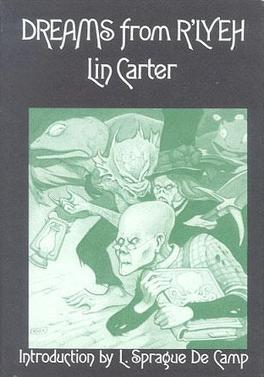
Dreams from R’lyeh is a collection of some of Carter’s poems, published in 1975 by Arkham House. It’s a slim volume, originally priced at $5, with a fantastic cover by Tim Kirk. I recently obtained a copy, in my effort to try to broaden my Arkham House collection, an effort that remains ongoing, at least to some slight degree.

It’s strange—at least I think so—to read L. Sprague de Camp’s introduction and Lin Carter’s afterword in 2025, as these were written more than 50 years ago. Both de Camp and Carter are now long gone. I met de Camp many years ago (1989? 1990?) at a convention in Austin. I shook his hand, and he remarked that he had shaken the hand of someone who once had shaken the hand of Charles Darwin. It’s almost eerie, as I start to read Carter’s poems (at least those he wanted preserved), to think that by the time I shook de Camp’s hand, Carter was already dead, and yet at that time I was just starting to look for books written and edited by Carter.

There are less than 100 pages between the covers of Dreams from R’lyeh, and yet I sense a great deal of presence in this book.

Jacobi’s Disclosures

It’s almost funny to see bid after bid that I make for Arkham House books on a noted auction internet site take hit after hit and fall by the wayside. Since I’ve imposed a hard limit on any book, once that limit is reached I bow out, and thus miss out on countless books that I want.

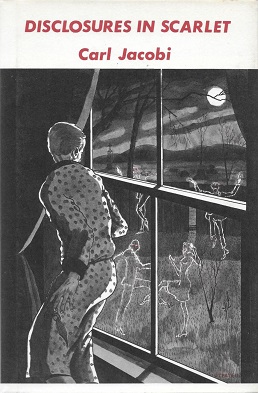
In this case, by some strange surprise, I managed to secure Carl Jacobi’s 1972 Arkham House book, Disclosures in Scarlett. Apparently the people I’m bidding against on a slew of other AH books already have this one. I think I’ve managed to get three out of 30+ books so far this way, which means that if I want any of those other titles I’ll need to go the set price route, and find dealers with acceptable prices, vs. going against ardent collectors.

Bond. Nelson Bond

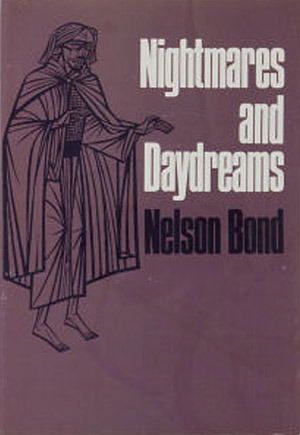
Until recently I don’t think I’d heard of Nelson Bond. Last month I bid on a few Arkham House books. As I have a hard limit, I was outbid on around 20 or 30 of them, but, by some strange twist of fate I managed to secure two or three books at reasonable prices. One of the books that I acquired was Bond’s Nightmares and Daydreams, published in 1968 for the low price of $5 (though by 1968 standards, that may have seemed like a pretty penny), collecting within its pages 14 short stories and one poem. Apparently Bond was a major writer of fantastic tales from the late 1930s through the 1950s. He then took a long break before writing fiction once more.

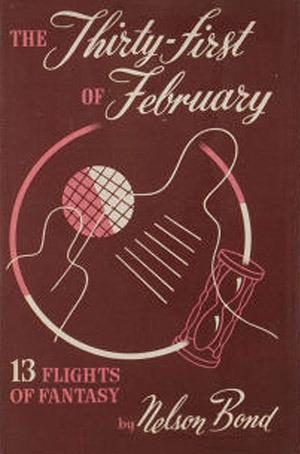
Fast forward a few weeks, and I’m in Bookmans, a used bookstore (and exchange of all sorts of things, from ceramic figurines to guitars) in Phoenix, Arizona. The store is vast, with shelves of books in various genres, all used, but few that I wanted. By chance, question about collectible fiction resulted in a store clerk directing me to an area near the check-out counters. There, a handful of sad looking “collectible books” leaned against each other in a tiny glass bookshelf. And I mean tiny. But, tucked in between what appeared to be some book club editions (but probably weren’t), stood another Nelson Bond book: The Thirty-first of February. This Gnome Press edition was published in 1949, and for a book going on 76 years, it wasn’t in bad shape, and for $20 it seemed a steal.

Arkham House: Into the 40s

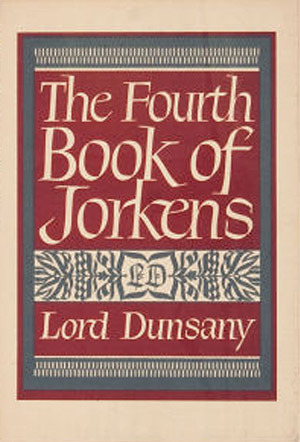
Perhaps it’s only fitting that the first Arkham House book from the 1940s that I own is called The Fourth Book of Jorkens. Despite being nearly 80 years old, this book, published in 1948, is in pretty decent shape. There are a few tiny bumps in the dust jacket, at the top and bottom, and the book has a dusty, antiquarian smell. Yet otherwise the pages are clean, and the binding tight.

Written by Lord Dunsany, heir to one of the oldest Irish peerages, and one of the greatest fantasy writers of the 20th century, The Fourth Book of Jorkens contains a slew of short (tall) tales. It was first published by Jarrolds in the UK in 1947, and by Arkham House the following year.

It’s amazing to see a publication price of only $3, and yet, on the back page there are advertised books from the publisher for $1.50 and $2.00, with most the others listed for $3. Today, a hardcover book, even as slim as this one, would not be listed for less than $25. And yet, there you have legends in the field with their books for sale at such a low price. At least, one thinks so, but $3 in 1948, right after WWII might have seemed like a fortune to many people.

Books added: A quartet from Arkham House

To be accurate, three of the books recently acquired are under the Arkham House imprint, and one under their mystery books imprint, Mycroft & Moran (even though the dust jacket has Arkham House on the spine).

Recently I’ve turned my eye toward trying to collect more Arkham House books, although I know there are a few that probably will remain out of reach, including the ones from the 1940s, plus some of H. P. Lovecraft’s books (which I may well skip, anyway). I don’t have the exact number of books they published, but I believe that it’s close to 200 (this may include pamphlets and other association material). Despite the value of the name, Arkham House, the owners of this brand have failed it, given that nothing’s been published since 2008, and less than 10 books have appeared since 2000.

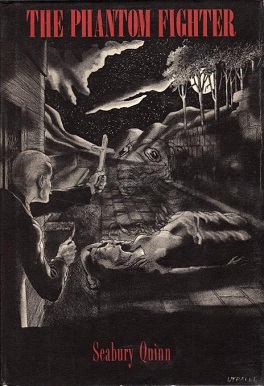
First published in 1966, Seabury Quinn’s The Phantom Fighter collects ten of his Jules de Grandin stories. This is the first time I’ve bought a Quinn book, or read any of his stories. Apparently he was quite popular among Weird Tales readers, but has faded somewhat in modern times, at least compared to Lovecraft or Robert E. Howard.

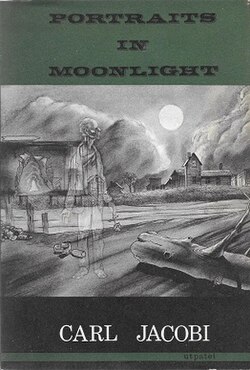
Portraits in Moonlight, by Carl Jacobi. Published in 1964, and along with the next book mentioned below, the oldest of my Arkham House books. Collects 14 stories, many of which originally appeared in Weird Tales magazine. My first Jacobi book, although I’d tried for years to find his Fedogan & Bremer book, Smoke of the Snake, to no avail.

Tales of Science and Sorcery, by Clark Ashton Smith. Also published in 1964, this book contains 14 short stories, and a memoir by E. Hoffmann Price. Perhaps I’ve already read these stories elsewhere, as I own a fair amount of non-Arkham House CAS books. This is only my third Arkham House book, the other two being a collection of letters and a book published in 1988. Most of his other AH books date back much further than what I have.

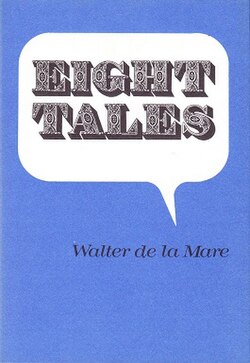
Eight Tales, by Walter de la Mare. Another book from an earlier era, published in 1971. A slim volume of never collected early tales. This book also includes an interesting introduction by Edward Wagenknecht, where he discusses different writers and their thoughts on their early fiction. Some writers want to forget, hide, or revise their early works, as, looking backward with what they’ve learned they see the embarrassment of their earlier attempts at writing. I’ve never read anything by de la Mare (much like Quinn and Jacobi), so this will be an interesting dip into the past. It does appear, at least from an initial glance, that de la Mare at least allowed his earlier works to once more see the light of day. It would be interesting to compare these to more mature tales.

With these four titles, I now own 40 Arkham House books and two Mycroft & Moran books. That’s a decent number, but still less than 25% of their published works. I think that I might be able to acquire another 30 or 40 or so books, before I encounter those volumes that are insanely rare or expensive. If I’m able to collect all of the books published since 1970, or maybe 1960, I think that I’ll stop there (though now that I have a few from the 1960s, it tempting to add that decade to my goal). I really wish that they had made an effort to continue to publish books under their name. What a waste of a great imprint.

Books added: Four Arkham House books.

I know that I’ll never collect them all, but I do like to pick up Arkham House books when I come across them. In this case, I recently acquired a group of four books by quite disparate authors. When I looked for information about the authors and when their books were published, I turned to Sixty Years of Arkham House by S. T. Joshi. The index in this book isn’t entirely accurate, and each entry is relatively short, covering publication date, number of copies, and a little more. Sometimes there’s an listing of contents for poems and short stories in the volume, but I guess that when covering 200 books there’s not too much room for anything else.

Joshi’s book lists 193 items published by Arkham House; I now own a mere 35 of them. This number is just under 20%, an almost insignificant percentage. I’m quite happy with the ones that I have, though, and I’ll only look for others if a) they’re within my budget and b) the condition looks decent.

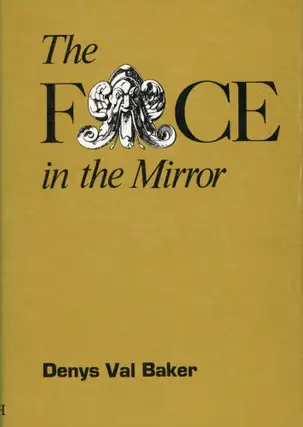
The Face in the Mirror, Denys Val Baker
Published in 1971, and now the earliest of my Arkham House books; 2045 copies printed. A slim volume of tales set in the author’s native Cornwall. Prior to this book the earliest Arkham House book that I owned was published in 1975. Having now come close to the magic decade of the 1960s, it makes me quite excited to have a copy of this book.

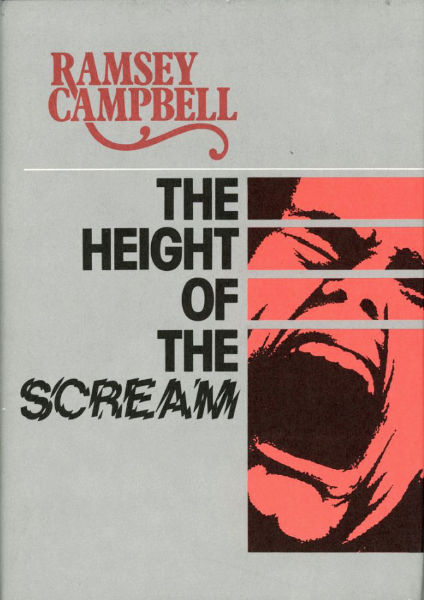
The Height of the Scream, Ramsey Campbell
Published in 1976; 4348 copies printed. Campbells third Arkham House collection. I own just a couple of Campbell books. One is part of Borderlands Press “Little Book” series. The other is a collection from Dark Harvest with both Campbell and Charles Grant stories (Dark Harvest’s Black Wine). Aside from that, I may have a few anthologies where Campbell has contributed a story.

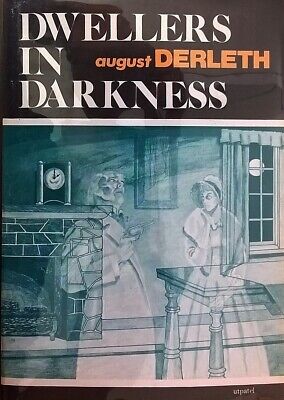
Dwellers in Darkness, August Derleth
Also published in 1976; 3926 copies printed. The eighth and last Arkham House collection of Derleth stories. Derleth was one of the founders of Arkham House. To acquire the prior seven of his collection likely would bust a few budgets.

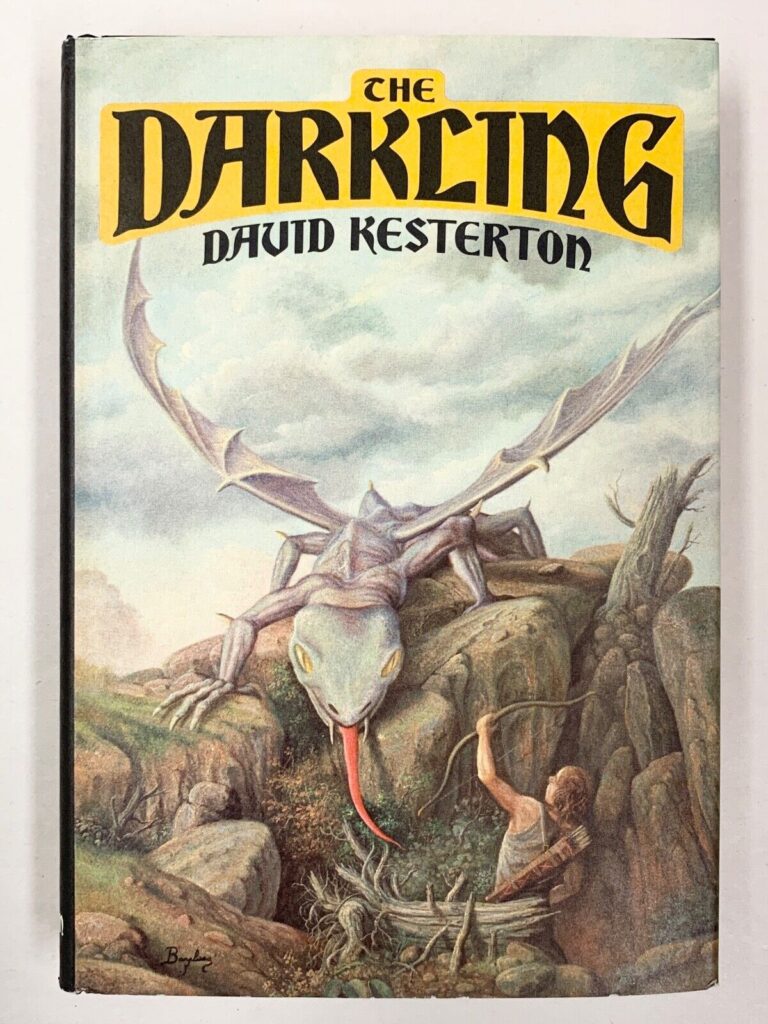
The Darkling, David Kesterton
Published in 1982; 3126 copies printed. Kesterton’s name doesn’t appear in the index of Joshi’s 1999 book, and the book title’s page number listed in the index is incorrect. Joshi’s also quite dismissive of the book and author in his note, calling it a “‘Slushpile’ submission that made it’s way to publication.”

It’s such a shame that this major publisher of weird fiction fizzled into almost nothing when it had the major IP of the “Arkham House” name behind it. They’ve hardly published anything in the past two decades. Most of their books published prior to 1970 are hard to find or quite expensive. This is as expected, given the name, as well some of the authors works in that group. Arkham House released N copies for each of their books, no special editions. Golden Gryphon did the same. Most other small current presses will have two or three states: trade hardcover, limited, and/or ultra-limited. Trade books in these states don’t list how many are printed. Limited will list the number of copies in this state, while the ultra-limited usually are lettered books limited to 26 copies.

I’m by no means a Lovecraft fan, but recently saw a bidding war online for the first two collections of his letters rise from $0.99 to nearly $150. That’s a pittance if you interested in early Clark Ashton Smith, or Ray Bradbury’s Dark Carnival (I’ve seen these listed upwards of $6,500), or even William Hope Hodgson’s House on the Borderlands book (close to $1,000). Basically, all the early books fetch prices only the serious collector would pay.

« Older posts

© 2026 Anders Monsen

Theme by Anders NorenUp ↑

css.php