This weekend, while traveling, I learned that writer Dan Simmons died on February 21. Vita, brevis; ars, longa – life is short, art is long.
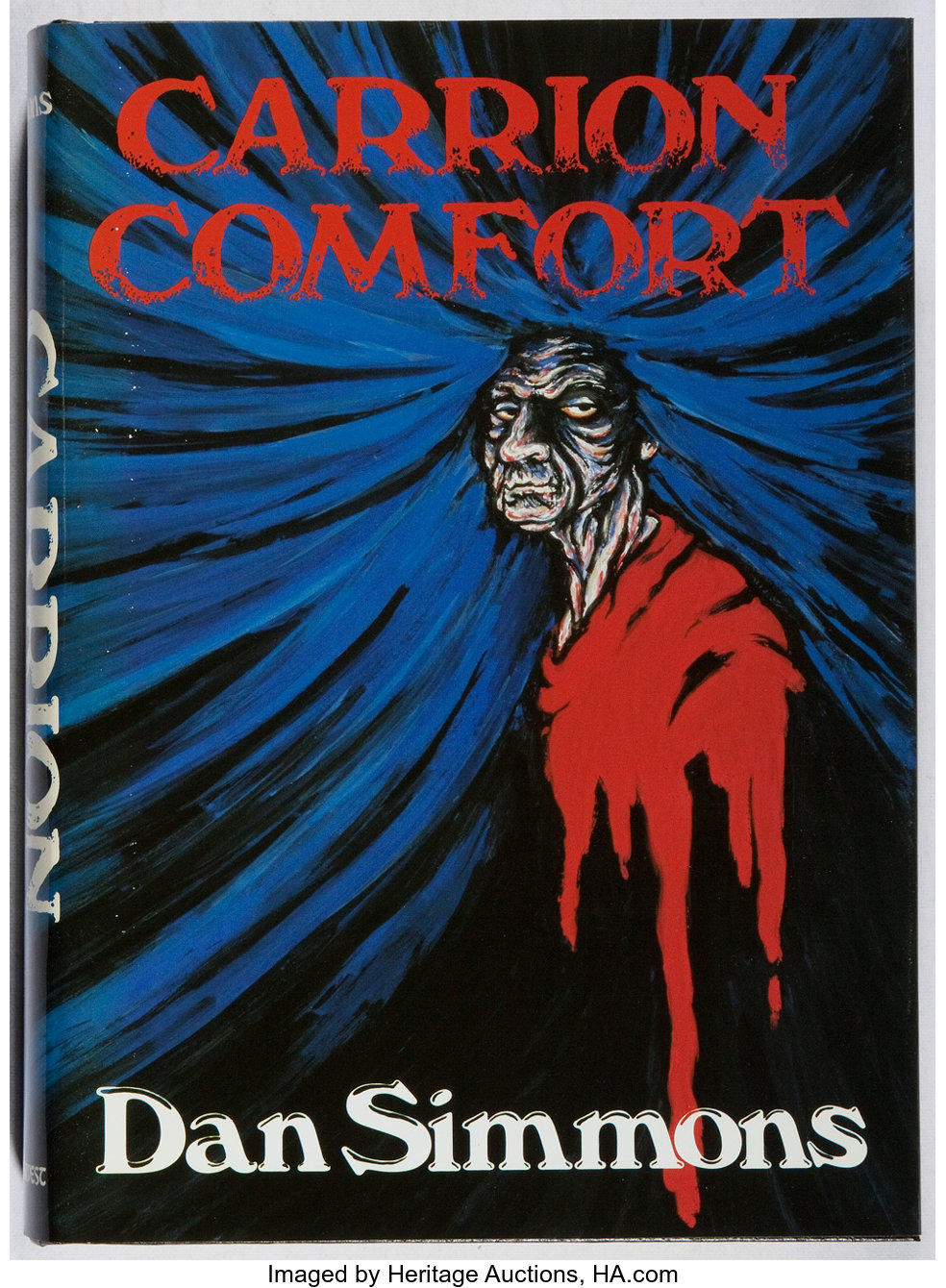
The first Simmons book I read was his debut novel Song of Kali, the first edition of which I found in 1989 in a used book store in Austin for $5.95. He could have kept writing horror, but in 1989 he published his landmark science fiction novel, Hyperion. I missed out on the hardcover edition, but with The Fall of Hyperion and onward, I bought all his books, in hardcover if I could find them, in paperback on a couple of occasions: Carrion Comfort I read as a paperback book (only decades later was I finally able to buy the oversized Dark Harvest hardcover edition); Phases of Gravity also came out first in paperback, and when I found a copy of the UK hardcover edition, I bought that book with no hesitation. (I even had to buy Ilium and Olympus twice. I foolishly lent my first copies to some friends, with whom I lost contact with a year or two later. So, when I came across another pair I bought those as well. Twenty years later I still don’t have the first books that I bought, and I doubt I’ll ever see those copies again.)
I met Dan Simmons just twice, in 1990 and 2000. The first time was at an SF convention, where he signed my Song of Kali copy. Then, a decade later he was on a book tour for The Crook Factory. He happened to stop at Adventures in Crime and Space, genre bookstore in Austin, Texas. I spent several minutes talking to him at this book store. He was gracious enough to sign a stack of my books at that occasion, as I brought along all of his books I’d bought since 1990. On both occasions, he came across as the kind of guy you want to sit across the dinner table. Listening to him talk was just as captivating as his fiction.
For many years, news about a new Simmons books virtually disappeared. His last novel, Omega Canyon, has been announced for publication several times, but nothing has materialized. A few years ago he suffered a head injury, which may have affected his meticulous approach to research and writing. What a shame.
His over 30 books stand as superb entries in such varied genres as horror, science fiction, historical/parallel fiction, and mystery/crime fiction. Song of Kali, published by Bluejay Books in 1985. It bore a blurb from F. Paul Wilson on the back cover, and that was enough for me. Plus, when I found the book on a shelf in 1989, I’d already heard rumblings that Simmons was an up-and-coming writer. For a poor college student working a part-time minumum wage job, who then usually only bought cheap paperbacks, spending $6 for a book was a big deal back then, but I think I read the book in one sitting. Thanks to my brother-in-law, at that time a book dealer, I was able to get a great price on another hardcover book, the Dark Harvest horror anthology, Night Visions 5. This book contained stories by Stephen King, George R. R. Martin, and Simmons. When Hyperion was published, I could not get a hardcover copy, so I bought and read the paperback book. Little did I know then that the hardcover would later prove next to impossible to buy, unless you were willing to shell out hundreds of dollars. From then on, I bought every Simmons book I could find (and afford). In some cases, this meant haunting used books stores. In other cases, buying them the moment I found a new copy.
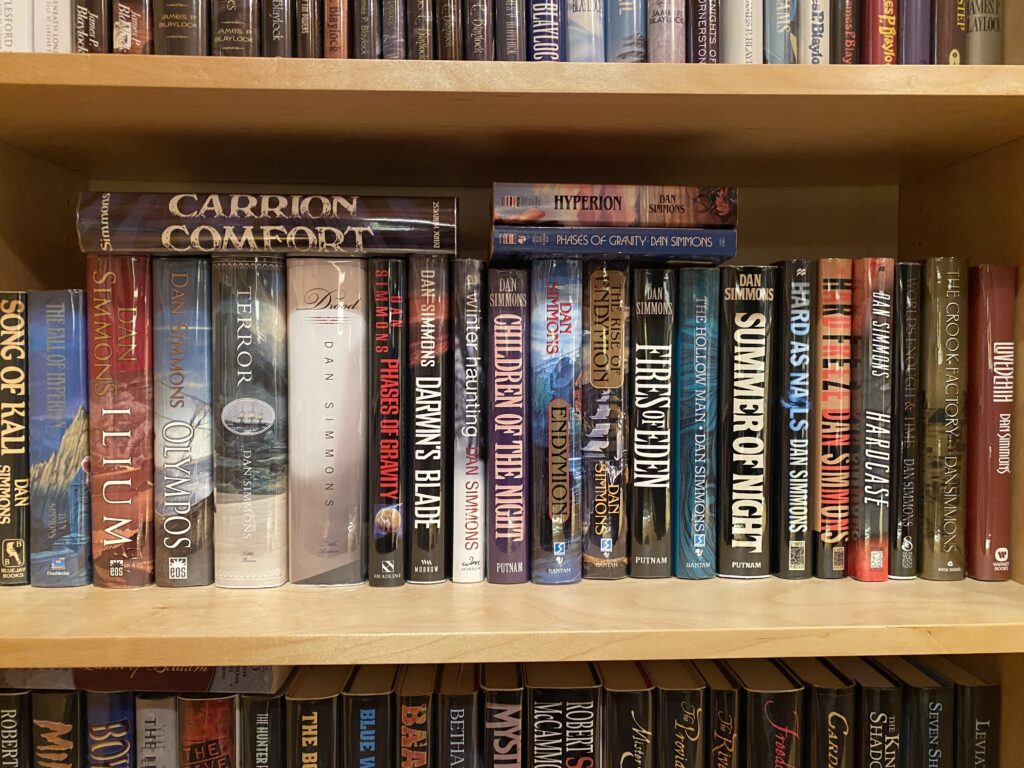
A shelf of books by Dan Simmons (Not pictured as they’re on another shelf: Prayers to Broken Stones, Flashback, The Abominable, Black Hills, The Fifth Heart, Night Visions 5, the Lord John Press edition of “Entropy’s Bed at Midnight” and Summer Sketches)
In terms of science fiction, he has writing such standout novels as Hyperion, Fall of Hyperion, Iluim, Olympos, Phases of Gravity. For horror, there’s Carrion Comfort, A Winter Haunting, Summer of Night, Children of the Night, and Fires of Eden. He wrote three hardboiled mystery/suspense novels: Hardcase, Hard Freeze, and Hard as Nails. Meanwhile, Darwin’s Blade is a pure suspense novel, as is The Hollow Man. He could have stuck to writing books in any genre, but Simmons was never one to be limited by success or genres.
His stort stories were collected in Lovedeath, Prayers to Broken Stones, and Worlds Enough & Time. One of his short stories appears in The Last Dangerous Visions, edited by Harlan Ellison and J. Michael Straczynski. His novella, Muse of Fire, is an SF classic. He wrote a Jack Vance appreciation story, “The Guiding Nose of Ulfänt Banderōz,” which first appeared in a collection of new fiction in the style of Vance, and later as a novella from Subterranean Press. Several of his short fiction remains uncollected, as do many of his non-fiction essays. See here for a bibliography.
He even wrote several books with a theme of parallel history, books that drew in real-live people with a twist of fiction. The Crook Factory featured Ernest Hemingway during his Cuba years; Simmons went mountain climbing on Everest with The Abominable, ventured into the icy wilderness with Franklin’s failed Northwest Passage expedition in The Terror, shadowed Charles Dickens last and unfinished novel with Drood, then delved into the history of Mount Rushmore with Black Hills. Lastly, he gave us a mix of fiction and metafiction with The Fifth Heart, possibly the last book published in his lifetime, back in 2015. For years after than book came out, I kept looking for new fiction from Simmons, but to no avail. Now, one more of the great genre writers has fallen silent.
Tempus edax rerum – time, the devourer of all things. Another giant in my golden age of SF (and other fiction) has fallen silent. Rest in peace, Dan Simmons.