There’s a special circle in cell for people who stamp their ownership in books, and then don’t destroy those books before passing them on…
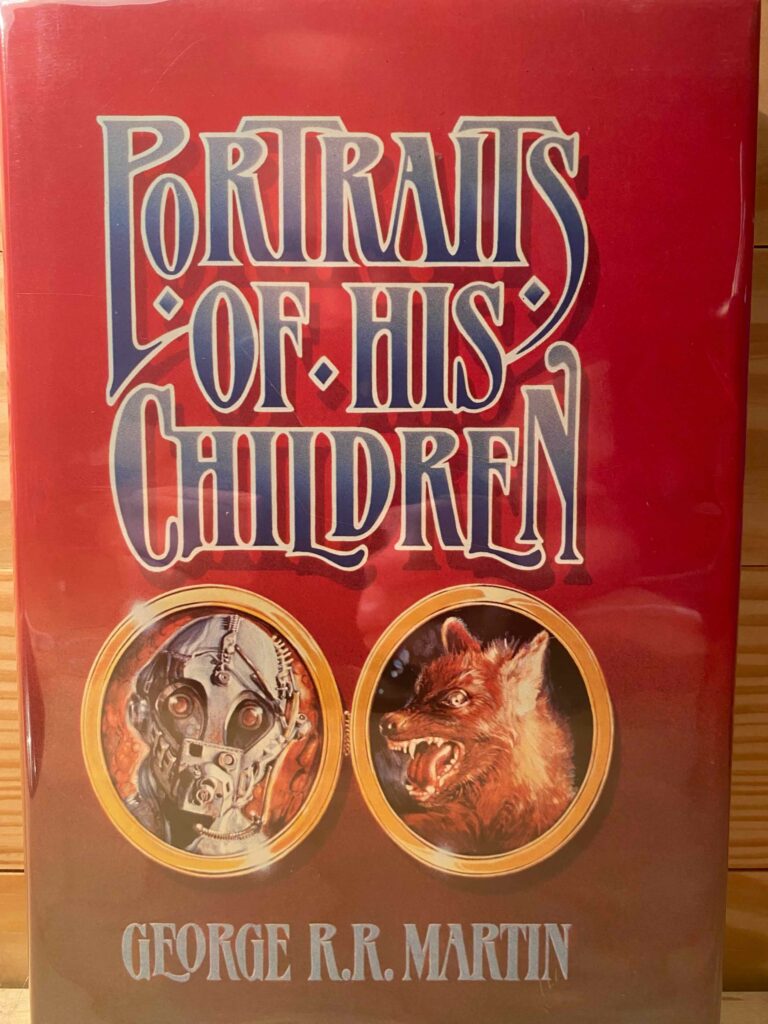
In February, 2026 I acquired a copy of the trade edition of George R. R Martin’s 1987 collection, Portraits of His Children. The book was in pristine condition, but on the first page inside the book some had stamped their name in a way that never can be undone: “Library of [name removed] M.D.” How nice of you, Dr. X, to have your own personal stamp to mar the books that you own. Has Dr. X now shuffled off his mortal coil, and his book then passed to some dealer/seller to push the book along? Possibly so. I’m almost tempted to tear out that page. Instead, I may look for another copy without such a stamp, then foist this book off to someone less finicky.
All grumbling aside, this book collects 11 stories from Martin’s early years as a writer, when he wrote SF stories, and before he ventured into fantasy with the Game of Thrones series of books and TV shows. These were stories published in Analog and Asimov, as well as anthologies. The introduction is from Roger Zelazny, an SF/fantasy writer. The publisher: Dark Harvest—whose first book was by Martin, a book apparently only published in a limited edition (no additional trade edition), and it’s quite expensive on the current used book market. I used to own a couple of Martin novels years ago, and gave them away. I never got into Game of Thrones, so I only have this book because I’m trying to collect all books published by Dark Harvest, a small publisher that existed between 1983 and 1993. Martin’s novella, “The Skin Trade,” is one of the best stories in the Night Vision anthologies.
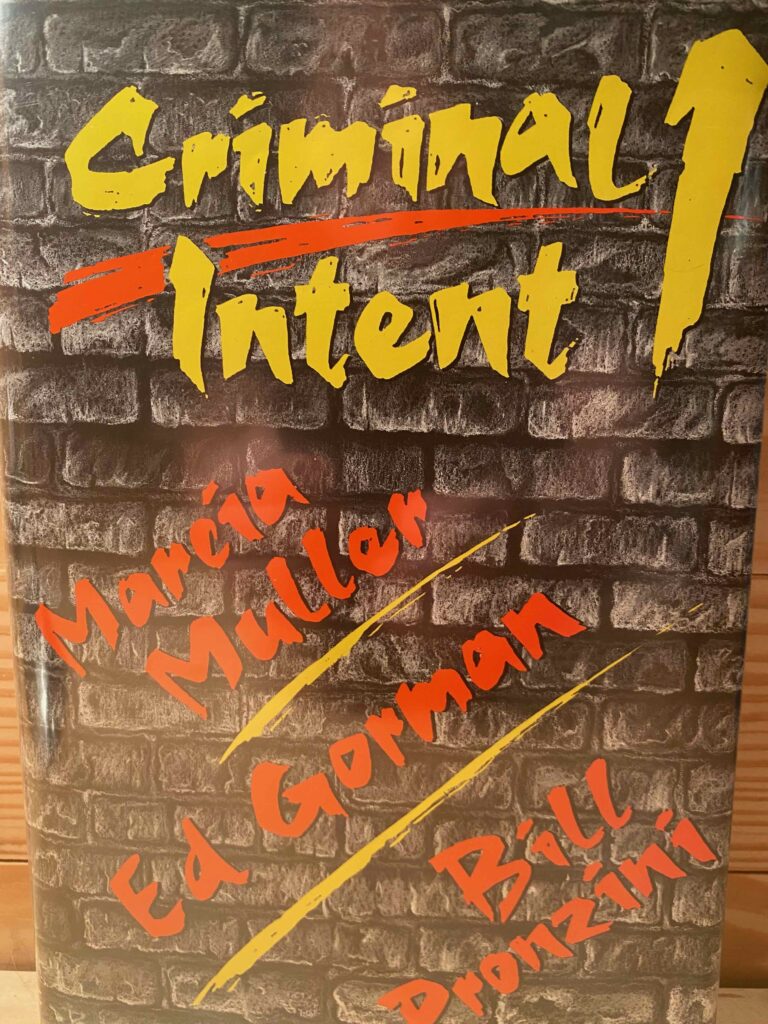
Dark Harvest’s Night Vision series was a masterpiece in horror anthologies from 1984 to 1991. When the publisher switched focus to mystery fiction in the early 1990s, they apparently tried to recreate the magic (and format) with Criminal Intent 1 (1993). Boldly flagged with the number “1,” the venture sadly failed, and Dark Harvest produced no more books after 1993, and thus, no additional anthologies that received the addition of a number after the title.
The format: three writers would submit 100 words of original fiction. Some writers would be established names in the field, others would be new, talented voices. Criminal Intent 1 includes one story each from Ed Gorman, Bill Pronzini, and Maria Muller. All three name, by that time, appear to be established writers. It’s a great concept. Too bad it never went further.
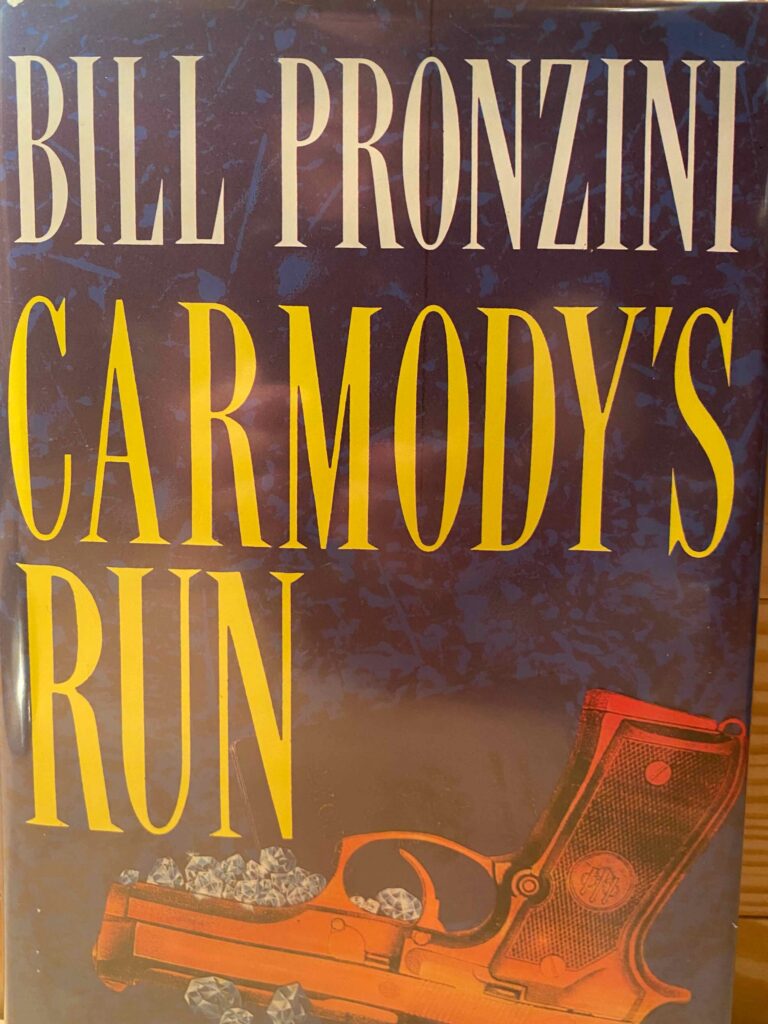
Bill Pronzini contributed another book for Dark Harvest in 1993: Carmody’s Run. This book contains four stories featuring his character, Carmody. All the stories were originally written and published in the 1970s, and there’s an introduction about the character that appears to be written specially for this book.
Sadly, my copy has two tears in the dust jacket, one in the front, and one in the back. That’s what happens sometimes when you buy things online, and actual photographs are not included. Still, for $15 it’s not a bad deal.
According to ISFDB, these were the last two Dark Harvest books published. However, I’ve seen a pair of Lawrence Block books from Dark Harvest listed online, not in the list from that reference site. Ironically, just as the first Dark Harvest book—by George R. R. Martin—generally starts above $200 from current dealers, one of those Block books also appears to fetch a high price. So, the modern collector gets to bookend the cost of acquiring a complete set of Dark Harvest books with a pair that cost more than 10x the price of some books.
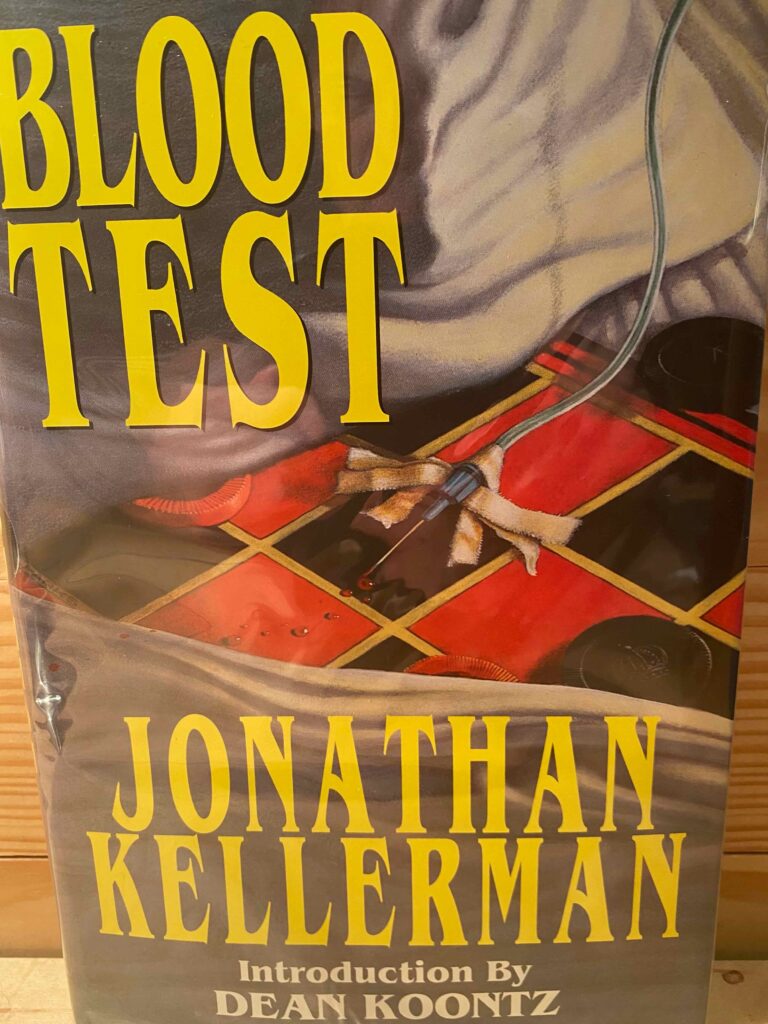
Jonathan Kellerman’s novel, Blood Ties, was originally published in hardcover in 1986. There’s an interest note in his foreword the Dark Harvest “First Expanded Edition” from 1993, where he states this his publisher of the 1986 book lost all copies, only to find them a few months later. Due to this, sales fell off from his first novel, and that edition become somewhat difficult to find.
Kellerman has a background in child psychology, which he weaves into his fiction. Blood Ties was another book in Dark Harvest’s early 1990s move from horror fiction to mystery fiction. Why this venture failed is up to someone much closer to the publishers, but one could guess that either there was no market for small press mystery editions, or the publishers decided for other reasons just to call it quits. Dark Harvest is far from the first small press publisher with a limited life-span, although their bibliography is quite remarkable.
I acquired a copy of the signed/limited edition in February, 2026. My book is numbered #41 of the 400 limited copies, signed by both Kellerman and Dean Koontz, who wrote a weird introduction. The illustrations are by Phil Parks, who did many Dark Harvest covers (at least nine, as far as I can tell).
Recently I picked up three mystery books by small press publisher, Dark Harvest. This publisher was active from the late 1980s to the early 1990s. I now have 40 books by this publishers, with maybe a dozen more left in order to collect all of their books. Most of these I have as their “trade” editions, with a handful of the “signed/limited” variety.
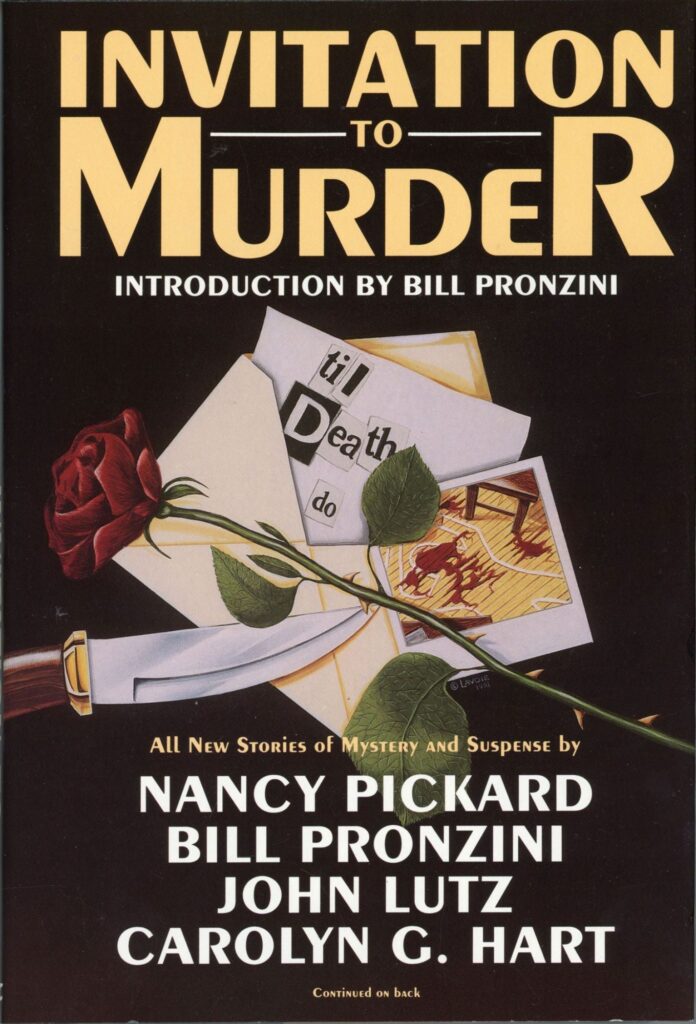
Invitation to Murder (1991). This is anthology or mystery stories, all with the same premise: a young woman is found dead in a room. Around this time (early 1990s), Dark Harvest appeared to switch from horror/dark fantasy to mystery. It didn’t work, and a couple of years later they closed shop. This anthology collects a few stories with noted mystery writers (as well as writers from other genres). I bought the trade edition, and have just started reading the stories, starting with the first one, by Nancy Pickard; I’ll admit that I didn’t expect the ending on this one. I guess the market for limed edition mystery books is not as sustainable as horror/sf/fantasy books, since a year or so later Dark Harvest stopped publishing anything at all.
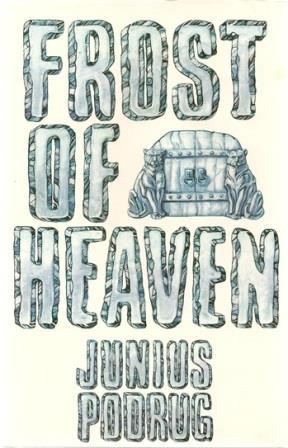
Junius Podrug’s Frost of Heaven (1992). I have not yet read this book, nor have I seen any other books by Podrug. I was able to get this book as a limited edition, and my copy is number 4 of 250 signed and numbered copies. The cover is boring, though it does have a nice endorsement by Nancy Pickard. It’s on my To Read list, but I know nothing about it.
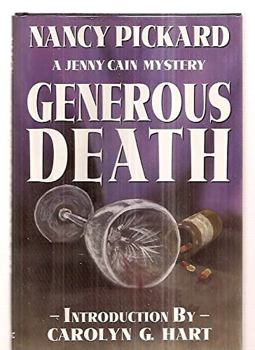
Nancy Pickard’s Generous Death is not listed as one of the books from Dark Harvest on ISFDB. It was reprinted by Dark Harvest in 1992, possibly as part of their failed foray into the mystery genre; after they abandoned the horror/dark fantasy books that made their name, they ceased to exist shortly thereafter. Maybe that switch wasn’t the direct cause of their demise, but it’s hard not to associate the switch to them stopping all books.
Generous Death is the first in a series of books about the main character, Jenny Cain. Packard had a significant career in the mystery/crime genre, but this is the first time I’ve encountered any of her books. My copy is signed and numbered 268 of 300 copies. After I bought this book I looked for her books elsewhere, but so far have not found any. Maybe that will chance, as now her books are on my radar.
Out of the ca. 52 books from Dark Harvest’s publication history, I now only need 12 (or so) more. Some of these might be tough to track down at acceptable prices (to me), and as evidenced by the Pickard books, there might be one or two not listed in the publication history. Althought I have a handful of the signed/limited variety of their books, I’ll probably look for the others in trade editions. If I manage to collect them all, that would be quite a feat, at least in my eyes.
Between 1983 and 1993, a small press from Arlington Heights, Illinois called Dark Harvest published close to 50 books. In that decade they released nine volumes in the seminal anthology, Night Visions, along with novels and story collections by such giants in the horror and SF field such as Fritz Leiber, Isaac Asimov, George R. R. Martin, Dean R. Koontz, Ray Garton, F. Paul Wilson, Dan Simmons, Robert R. McCammon, and many more. Toward the end of Dark Harvest’s run, they made a foray into the mystery genre. An anthology called Criminal Intent 1 appears to have been the last book they published. Perhaps the limited edition market collapsed in the early 1990s, or mystery readers didn’t care for small press editions as much as SF and horror readers. Or, maybe the publishers just decided to call it quits. At any rate, it’s a shame that Dark Harvest stopped publishing books.
I think I started buying Dark Harvest books with F. Paul Wilson’s books, then some of the Night Visions books and other anthologies, plus a few others here and there. Although I’m not aiming for a complete collection of Dark Harvest books, I recently picked up three books by this publisher from various locations.
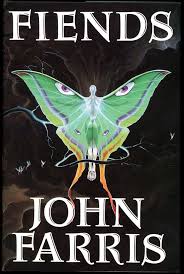
Fiends, by John Farris (1990). A horror novel by an author of whom I know next to nothing. I’ve started reading this book, and it looks intriguing.
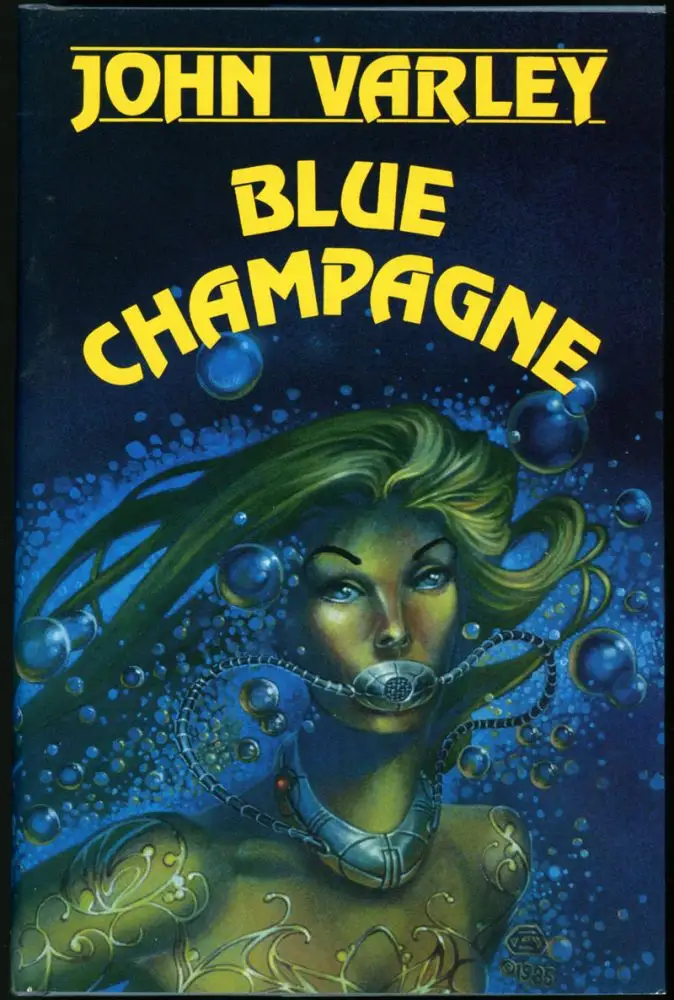
Blue Champagne, by John Varley (1986). A collection of short stories by this master of science fiction. I still have a vivid memory of seeing this book in the shelves at Austin Books on North Lamar in the late 1980s/early 1990s. I really wanted it, but back then was unable to afford the cover price. This year I paid a little bit more than cover price for this copy, but it’s in pristine condition and well-worth the price. Dark Harvest switching to SF is almost like Arkham House releasing SF books (oh, wait — they did release a few SF books), but the first story in the collection did make me a little nervous, almost like a horror story.
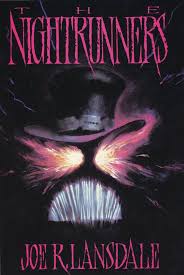
The Nightrunners, by Joe R. Lansdale (1987). An interesting book, and probably the only book that I’ve seen with this warning: “WARNING: Extreme violence, language and sexual situations may offend some readers.” Of course, that’s almost every Lansdale book, but it was strange to see this from one published back in 1987. I guess those were different times. Some of the pieces that make up this novel have appeared elsewhere as short stories or vignettes. One such episode I recently read, but I cannot remember where. I’m not about to hunt through all my books with Lansdale stories to find where I read it, but I do remember it was a disturbing piece, well worth that warning from the Dark Harvest edition.
There’s now a dozen of the 50 or so Dark Harvest books that I don’t own. I’m really only interested in six of these, but I won’t be surprised if I start looking for the rest. After all, they’re all a piece of history, at least in terms of genre fiction.
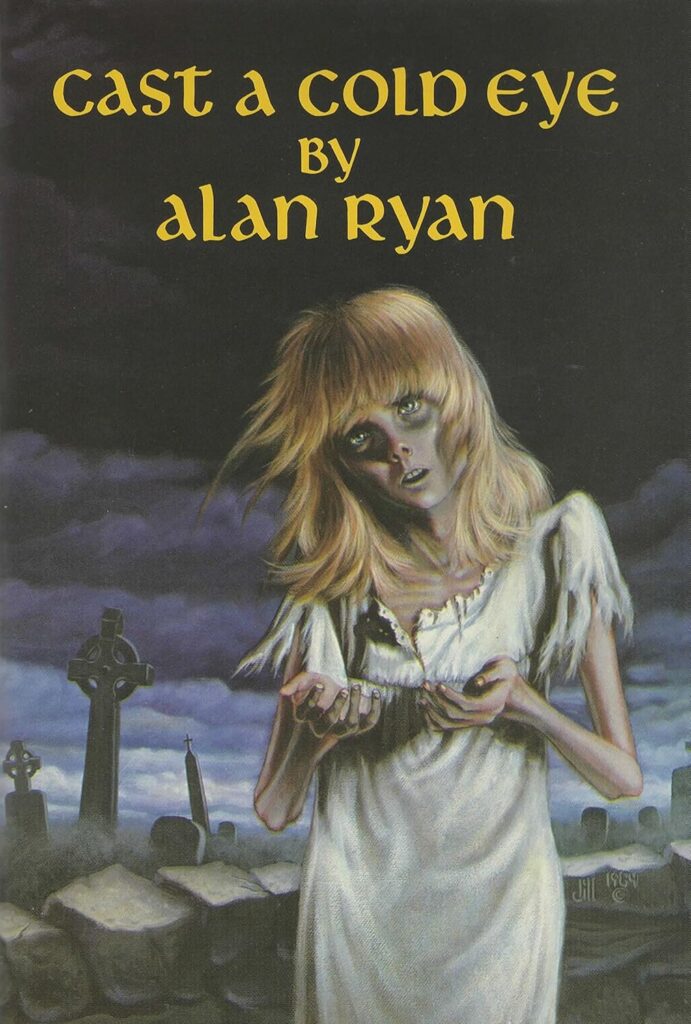
Back in the 1980s and 1990, small press publisher Dark Harvest published a fair amount of horror fiction, from novels, to anthologies and collections. At the time I bought a handful of these, but back then hardcovers were a premium in my eyes. I’ve recently started to look for their books that I failed to get, with Alan Ryan’s novel, Cast a Cold Eye the latest find. Originally published in 1984, this is a horror novel set in western Ireland.
I don’t often bid for books on eBay, but recently I’d seen several books there listed a low starting prices, and tossed my hat in for a few of them. In most cases the subsequent bidding exceeded my budget for any book, and I bowed out when that limit was reached. Cast a Cold Eye, to my surprise, was one that I ended up winning (alas, I missed out on another Dark Harvest book, not to mention many, many Arkham House books…).
My copy arrived today, and to my second surprise, this copy was not the trade edition, but the signed/limited edition in a slipcase. My copy is #92 of 200, signed by Alan Ryan, as well as illustrator Jill Bauman. For $15 plus tax and shipping, that’s probably the third surprise. (I will note, to my annoyance, that the copy-reader missed Brain for Brian on the second page, which does not bode well.)
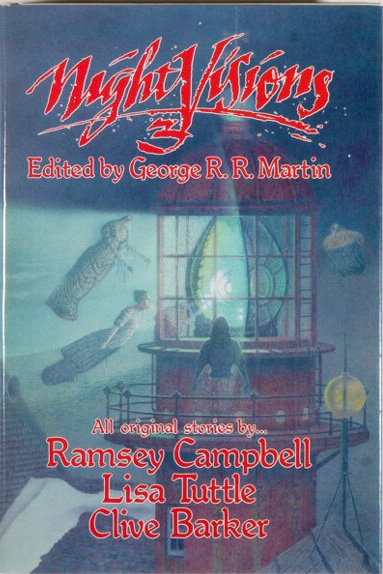
Published in 1986 by Dark Harvest, this anthology contains stories from Ramsey Campbell, Lisa Tuttle, and Clive Barker, and edited by George R. R. Martin (Martin would later have stories in Night Visions 5).
The sole remaining book in the “Night Visions” anthology series from Dark Harvest (1984 through 1991) that I did not own, and long on my want list. Purchased for $42 on the very last day of 2024. Though it’s not pristine, the book is in great condition. As a bonus, it’s signed by Lisa Tuttle, though this copy is the trade edition. Seven stories by Campbell, three by Tuttle, and the first appearance of Barker’s “The Hellbound Heart.”
For a while, I thought this was a lost/cursed book that I would never add to my library. Earlier this year I was in Atlanta, where I hiked part of the Appalachian Trail and attended a work conference. On the way to the trail, I stopped by a used bookstore. The sole reason for the side trip to this bookstore? On their web site they had listed this book, published by Dark Harvest Press in 1989, for sale for $50. When I arrived there, and asked for the book, they were unable to find the copy. Someone apparently had already bought it, and they never removed the listing. I looked around the store, and although they had a few other interesting books, I walked away without purchasing anything, as my mind was on that book, and that book alone.
Since that failed opportunity I occasionally checked online sites, such as Abebooks and eBay, but prices for decent copies exceeded what I cared to pay, or the books looked in debatable shape. Then, in August, I found a copy listed at the starting bid of $24.99. I placed a bid for the book for $25, expecting someone to swoop in shortly before the end of the auction and outbid me, as has happened in the past. This time it didn’t happen. The auction ended with my bid as the highest one. However, for several days there was no announcement, just a “sold” notice on the listing page. I figured that the seller had been disappointed that there only was a single bid, and that one bid was just one cent above the initial listing. On the third day, a notice that I was the winning bid. I paid the amount listed, plus shipping, and sat back to wait to see what would happen.
After I paid the bid amount, plus the shipping charge, I heard nothing. Usually there’s an email that the item is about to ship, and then it had shipped. In this case: silence. Then, a week later, a notice that the book shipped. Another week passed, and the book arrived. It’s not perfect, not by a long shot. There’s a strange smell to it, the edges of the papers are dirty, and there’s a slight wobble to the book. But, the worst part is that the protective cover had been glued to the book. I only noticed this when I tried to remove the dust jacket, and heard the tear as the glue pulled off part of the book. This sound made me cringe, as it felt like the book was being destroyed. I do not understand people who ruin books like this: gluing the cover to the book, stamping or writing in books, gluing anything inside the book. For a brief moment I placed this book next to my other oversized Dark Harvest books. Then, worried the smell would infect those books, I moved it elsewhere. I guess for $25 in this day and age, you can’t expect perfection. So, a reading copy this will remain.
I already owned 31 other Dark Harvest books, though this is not a complete collection. Dark Harvest was a small press active from the mid-1980s to the late 1990s. Initially they published mostly horror and SF books, a mix of novels, collections, and anthologies (including nine books in the series of anthologies under the name, “Night Visions”). The Night Visions books usually included two well-known writers, plus one new writer. Authors featured in this series include Stephen King, Clive Barker, George R. R. Martin, F. Paul Wilson, Dan Simmons, and others. Most of the books are in a regular size format, but they also published a novel and two major collections in an oversized format. The novel: Dan Simmons’ Carrion Comfort; the two collections: 50-year retrospectives on the works of Fritz Leiber and Isaac Asimov. Call it fantasy vs. science fiction. Many years ago I acquired the Fritz Leiber collection, shortly after it was published. A year ago I picked up Carrion Comfort, and only the Asimov collection remained from these oversized editions. Why the long gaps? Leiber is a favorite author of mine, and I’m fairly certain I bought this book at cover price. I already owned the Simmons book in paperback, and for years debated whether or not I really needed to spend the money for the Dark Harvest book, until I finally caved. And the Asimov? Well, perhaps I’m slowly becoming a completist, and feel the need or desire to have all the Dark Harvest books…
There are still still a few Dark Harvest books that I haven’t yet added to my collection: a Dean Koontz novel, collections of stories by David Brin, George R. R. Martin, John Varley, the third (and rarest) Night Visions anthology, and a handful others. It’s been a while since I read anything by Asimov, but now I have the opportunity to go discover (again) an overview of his work. Given the issues with this book—the glued cover—I likely will need to look for a better copy at some point.
Here I go again, trying to fill in some gaps in my collection decades after I stopped collecting certain books…
Back in the 1990s I picked up several books published by Dark Harvest. This was a small press that started with some great original collections, new horror novels, and reprints. Then the small press/collector’s market, suffered major contractions. Dark Harvest as a publisher ceased to exist. This is the story of many small press publishers; they forget their primary market, or the people in charge change or leave, and then they cease to exist. The same seemed to happen with Arkham House, Golden Gryphon, Carcosa, and many more.
Although there’s one elusive Dark Harvest book that I keep trying to track down, without much success, I had picked up a few others recently.
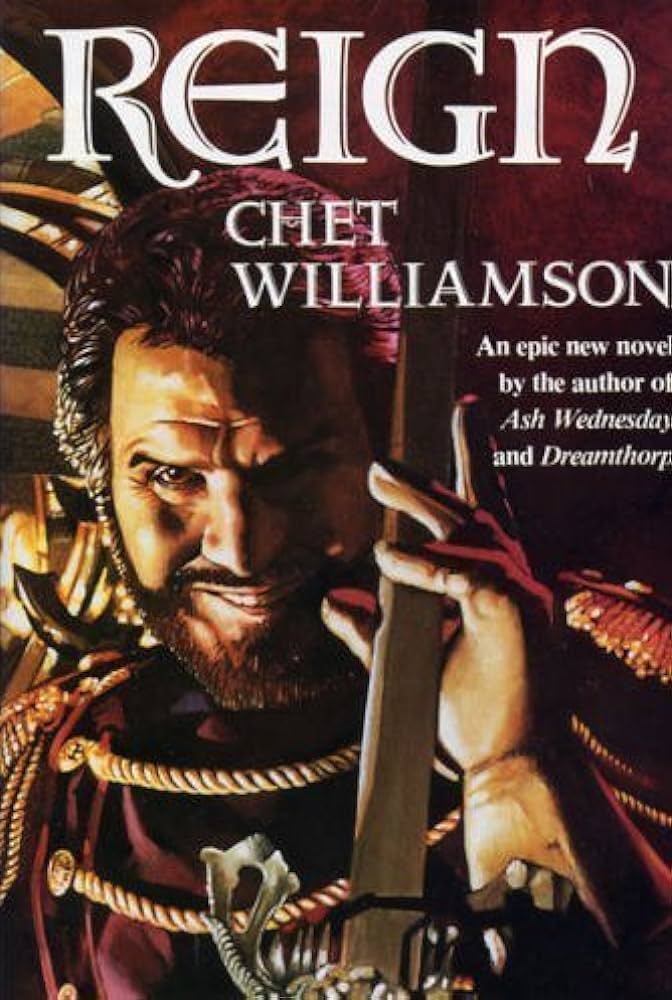
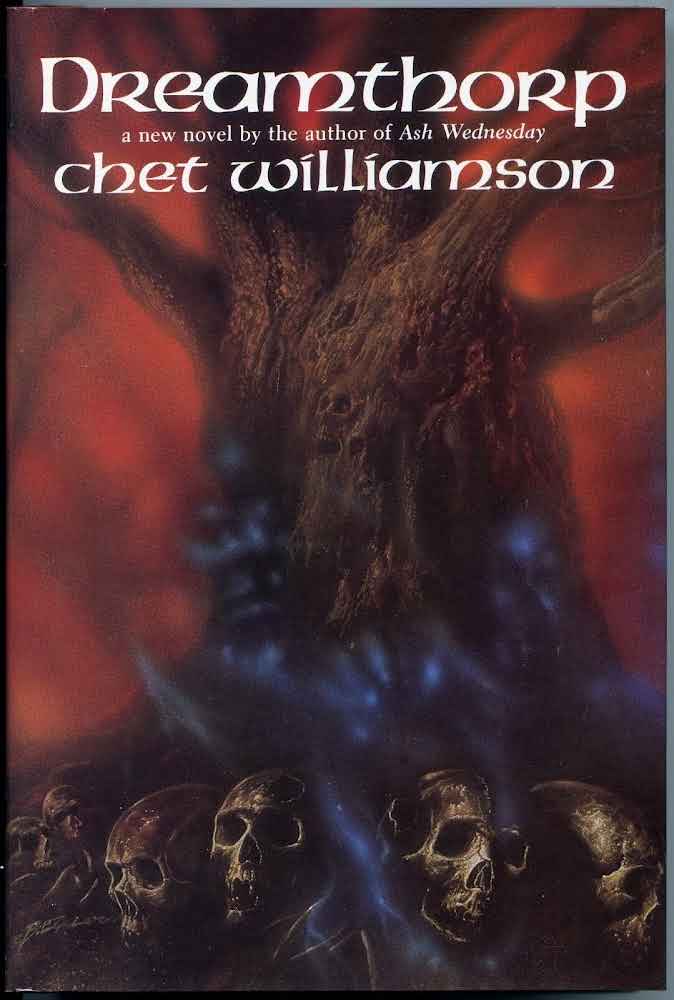
I read Chet Williamson’s novel, Dreamthorp, recently. Not having read anything by Williamson, I probably missed this book and Reign, both published by Dark Harvest. I bought Reign in a limited, signed edition from a dealer who also listed some Dean Koontz editions.
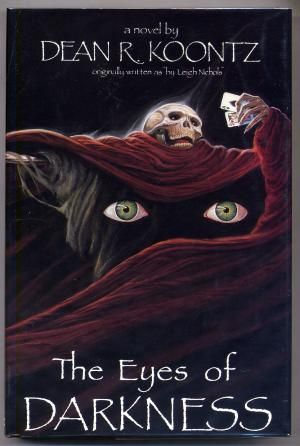
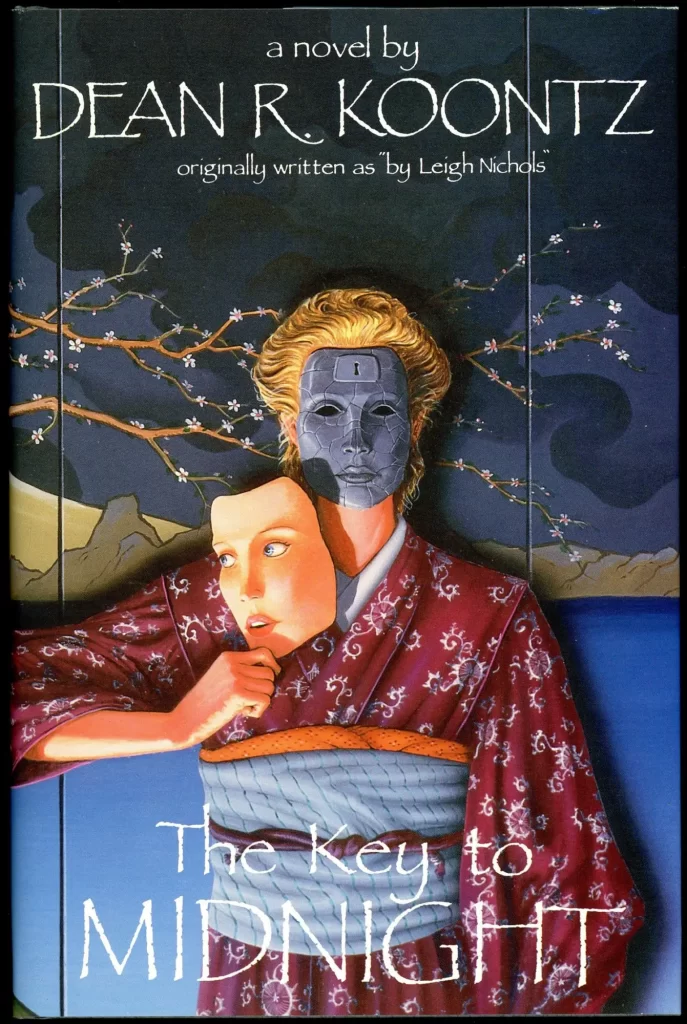
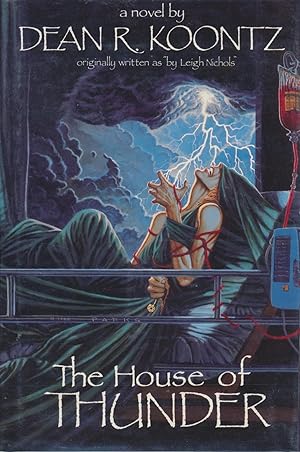
All three of the Koontz book are unsigned trade editions. To me they form a sort of trilogy, at least in the titles—The House of Thunder, The Key to Midnight, and The Eyes of Darkness. Although they arrived as unopened shrink-wrapped books, possibly due to the age of the books or how they were stored two of the books had some minor spotting on the end papers. I had a copy of another Koontz book from Dark Harvest—Shadowfires—but at some point moving books around, or double-stacking them due to lack of space, the dust jacket developed a tear. Still, it will be interesting to read these books, as it’s been many a year since I last read anything by Dean Koontz. I believe there’s still one more Dark Harvestbook by Koontz out there, so maybe one day I will stumble across it.
Arkham House is another interesting publishing house. I own many of their books published after 1975; older books fetch a premium on the collector’s market, and I’m not quite willing to go there yet. Arkham House published two Lucius Shepard books, The Jaguar Hunter and The Ends of the Earth. Again, a case of buying one book years ago, and then finally coming across the other one, and now The Ends of the Earth joins its partner on my shelves.
All these books were ordered online, sight somewhat unseen. That’s not always ideal, especially with the light spotting on two of the books. Still, these are not books you find in your local used book store, given that they are published by small presses and all originally appeared around thirty years ago (or more).
Lately I’ve been able to buy some books from the 1980s and 1990s that I missed when they first appeared. The first of these is Dreamthorp, by Chet Williamson, published by Dark Harvest, which I acquired in a signed/limited edition format. After I read a few Williamson stories from his Borderlands Press little books series, the name stuck. When I came across someone selling a copy I bought it. I haven’t read it yet, but it’s on the to be read stack at the moment, which admittedly is fairly tall.
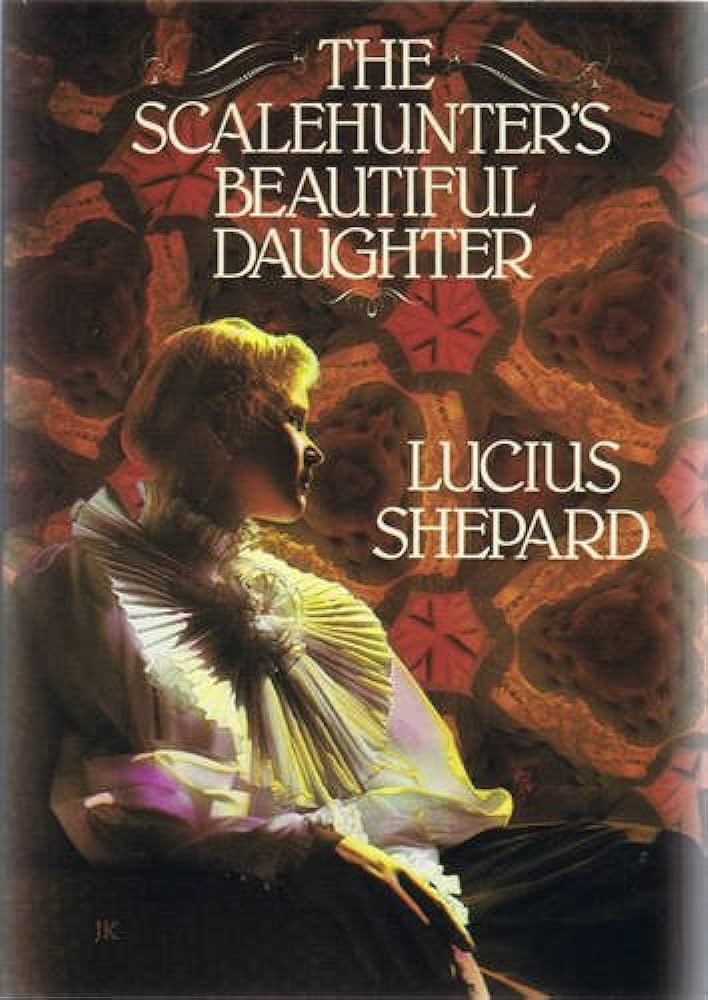
I also picked up a short novel from Lucius Shepard, The Scalehunter’s Beautiful Daughter, published by Mark V. Ziesing. Shepard’s written some great short stories, so I look forward to reading this one.
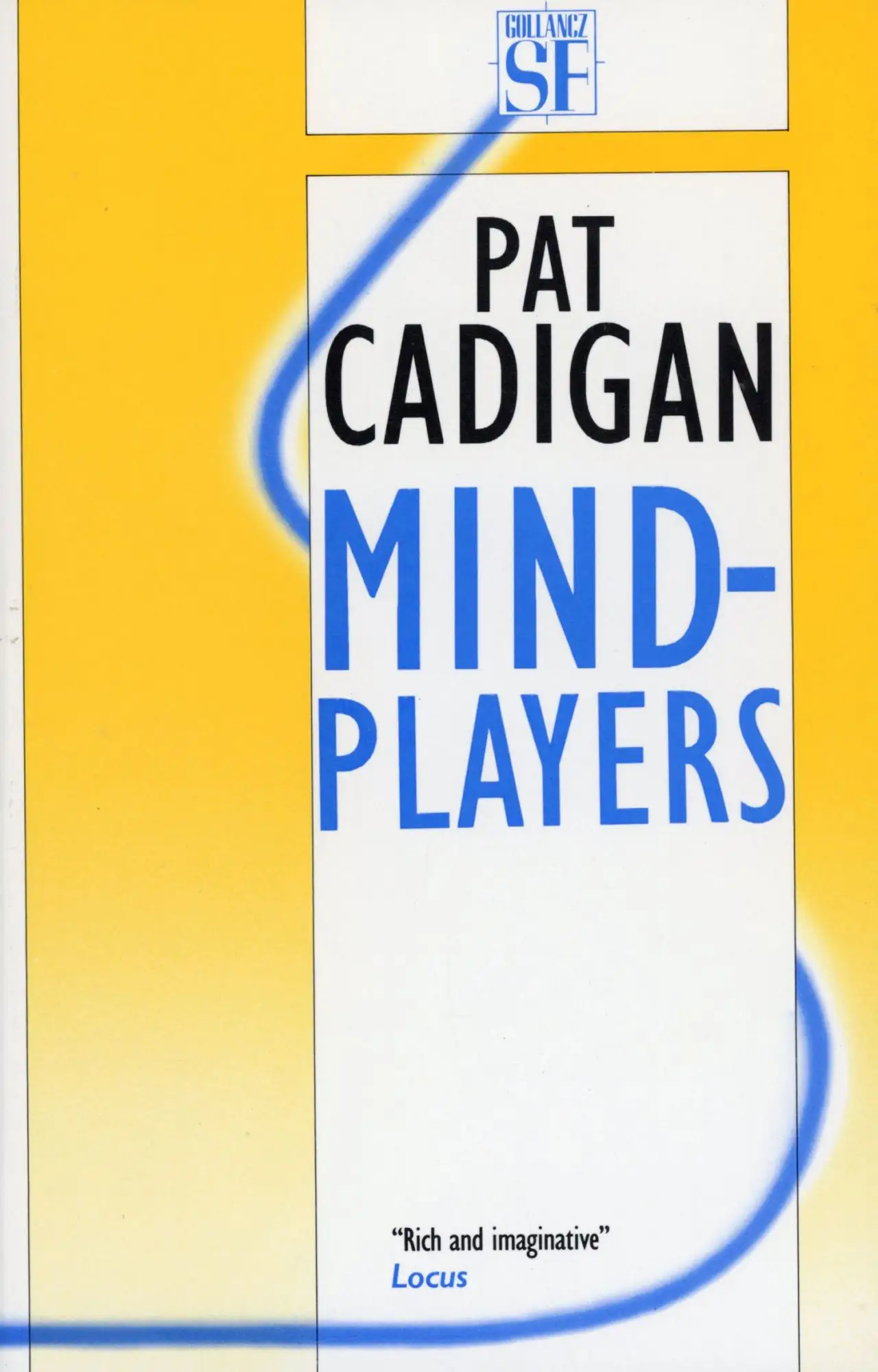
Lastly, I bought a copy of Pat Cadigan’s SF novel, Mindplayers, for under $10. The book is signed, which doesn’t mean as much to me, but having read several or her stories, I look forward to visiting the past and reading this novel.
At the same time I also picked up a bunch of books in a short-lived series that I’m still putting together. Only 29 books were published in this series, which ran from October 1989 to June 1992. I firmly believe that I’ll run into the issue of the last few being out of my price range, but I’ll do what I can, as once I have the bug I’ll put it to my self-defined limit as much as possible.
There are many other books from those two decades that I wish I had, and maybe I’ll start filling in those gaps more, as I rarely read any of the current stuff these days.