Lost worlds and ports of call

Month: May 2026

Clark Ashton Smith’s The Dark Eidolon

I’m a huge fan of Clark Ashton Smith. I arrived there via Jack Vance, having once read that Vance’s fiction was somewhat similar to that of Mr. Smith. In the 1990s I was lucky enough to find some paperbacks with Smith’s fiction. Later, I acquired the Arkham House edition of A Rendezvous in Averoigne, a collection of Smith’s stories. I devoured all his stories, and found his personal history just as fascinating. From there, I bought a book that contained some of Smith’s letters, then a pair of trade paperback reprints: Lost Worlds and Out of Space and Time. After that, the set of books published by Night Shade Books, which collects many of Smith’s stories. Along the way, I looked into trying to find original publications, which meant Arkham House.

Although I own a handful of Arkham House books, much like their other earlier books — that is, anything prior to 1975 — their Smith publications were often far beyond my budget. Other than 1988’s A Rendezvous in Averoigne, I have Tales of Science and Sorcery from 1964, plus a collection of his letters published in 2003. However, I’m not brave enough (or crazy enough) to shell out the money for the earlier Arkham House editions.

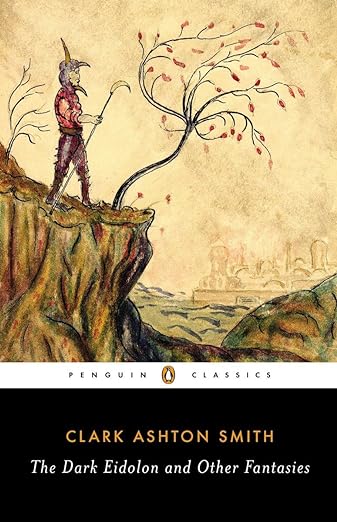
So, to my surprise I recently came across a book called The Dark Eidolon and Other Fantasies, published by Penguin Books in 2014 and edited by S. T. Joshi. I almost put this book back, as I probably have all of Smith’s short stories in various volumes. Then, as I checked the table of contents I found that it contained not just a selection of his short stories, but a long list of poems as well. In all, there are over 40 of Smith’s poems in this volume. Since most of Smith’s Arkham House books (and earlier ones) these days fetch a premium, I’ve read only a fraction of Smith’s poems.

I have an affinity for Smith’s poems; one my of favorite books is Tim Powers’ The Stress of Her Regard, which takes its titles from word within a poem by Clark Ashton Smith. There’s a certain symmetry there, and now I can finally read more than a snippet or two of Smith’s poetry.

Erle Stanley Gardner’s science fiction stories

Now and then I stop by a local used book store chain. There used to be a couple of them nearby, but one closed down a few years ago, and now it’s almost a chore to visit any of them. There are four of them still in San Antonio, but three are somewhat out of my way. The one that’s closest also is in the process of moving. Still, it was on my way as I drove out of town, so I swung over there for a few minutes of browsing. Sometimes in Half Price Books I walk away with nothing, sometimes I end up with with an armful of books (rarer these days), and sometimes I end up with one or two books.

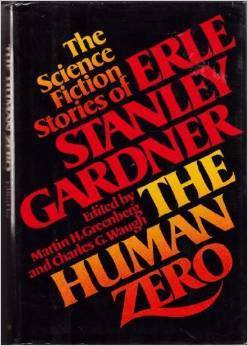
Today, I picked up a usual book: the collected science fiction stories by Erle Stanley Gardner, under the title, The Human Zero. This hardcover book, published by William Morrow in 1981 (edited by Martin H. Greenberg and Charles G. Waugh), bore a sticker with the low price of $5.99. The book, which was published in 1981 and had a mylar cover over the dust jacket. Erle Stanley Gardner wasn’t a name I expected to see in the science fiction section. After all, he’s known for his large body of work in the mystery genre, especially Perry Mason. Yet there it was, and, sucker that I am for SF from the 1980s, I immediately grabbed it from the shelf. As I stood there, I flicked through the pages, and found an interesting paper stuck somewhere in the first third of the book, a receipt from Amazon. It was dated nearly a quarter of a century ago.

I won’t name the person, but he’d ordered the book from Montclair Book Center via Amazon back in 2003 for $20. That same evening, I looked up the name and learned that this person had passed away in 2025, at the age of 88. Strange to think that 23 years ago he’d ordered this book, then at some point stuck the printed receipt amidst its pages, almost like a bookmark. Then, after his passing, it’s likely that his relatives had brought this book — and probably others from his library — to Half Price Books, unloading many of his treasured memories, and gaining a few cents in return.

Ah, yes, I’ve sold some books to HPB in my time; I’ve dropped off boxes of books at their counter, stood there and accepted their low prices, listened as others who stared at them person quoting them their “offers.” Do you take it? Do you walk away? Most people just sigh and say, “Ok.” Then they take their receipt to the front, gather their handful of cash, and forget about those books as they leave the store. It’s been a while since I last sold books there. I’m more inclined these day to give away any extra books, rather than listen to low-ball offers.

Sure, I’ve sold a few books to HPB, but I’ve bought far more. Sometimes, I’ve paid a premium, well above half price. Sometimes, half the cover price. In this case, Gardner’s book, which was published at $12.95 in 1981 — forty-five years ago! — was listed for only $5.99. This was almost at half price, matching the name of the store. Meanwhile, in a glass-fronted shelf, another rare book by a different author was listed for $3,000. In other instances I’ve seen rare books well above what I would, while I’ve also found equally rare books for a fraction of their original cost. It’s a strange business, Half Price Books. And yet, I go back whenever possible. It makes me I wonder, though, will my children one day drop off some of my once-treasured books at a place that pays a few pennies for items that were my treasures?

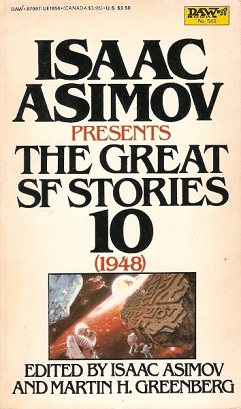
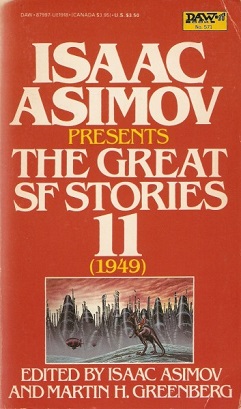
This book also had a stamp with a date, one of those rotating stamps where you set the day, month and year. I could not erase this stamp, like I could the penciled cost from a prior seller, with a regular stamp. Instead I tried a “sand” stamp. It worked too well. Just as I thought I had the ink erased, I rubbed a hole in the paper. It was my first such test of a sand stamp, so I had no idea what to expect. I came across a couple of paperback anthologies at the same time, and bought those. The same stamp, with different dates, appeared in those books as well, so they must have come from the same person. I’m sure there were other books in the shelves from that person, but I didn’t see any other titles I wanted. I think, were I to come across any more with the dates stamped into the books, that I would leave them there.

© 2026 Anders Monsen

Theme by Anders NorenUp ↑

css.php