Lost worlds and ports of call

Author: Anders Monsen (Page 6 of 90)

Cottonwood Lakes Hike

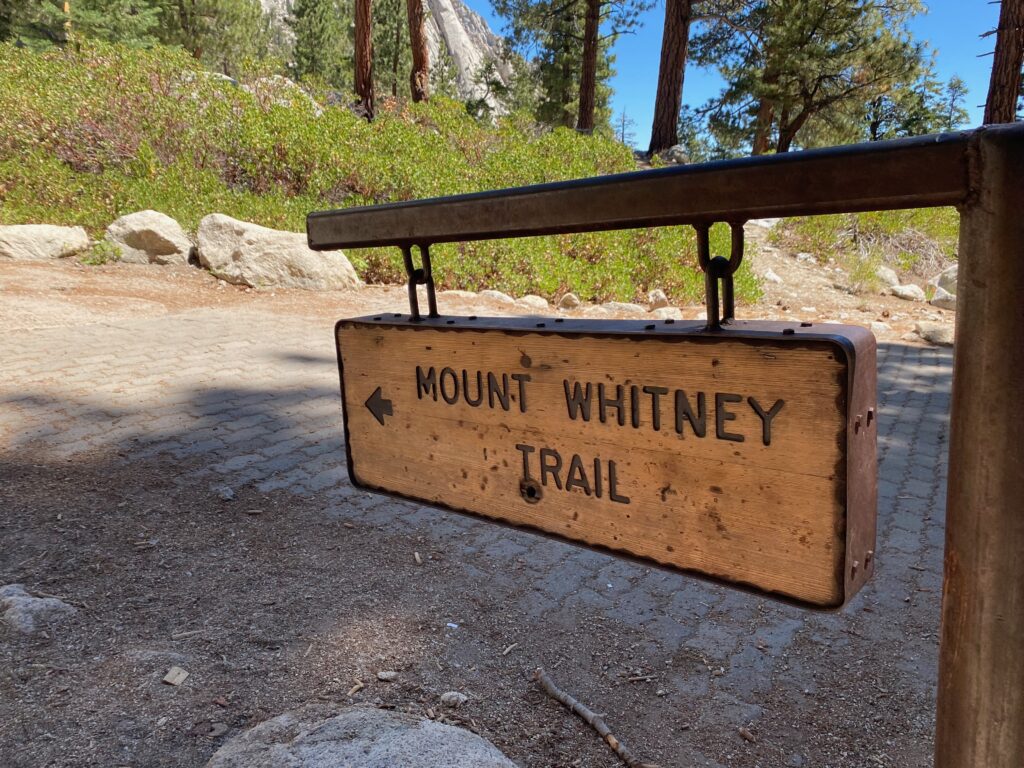
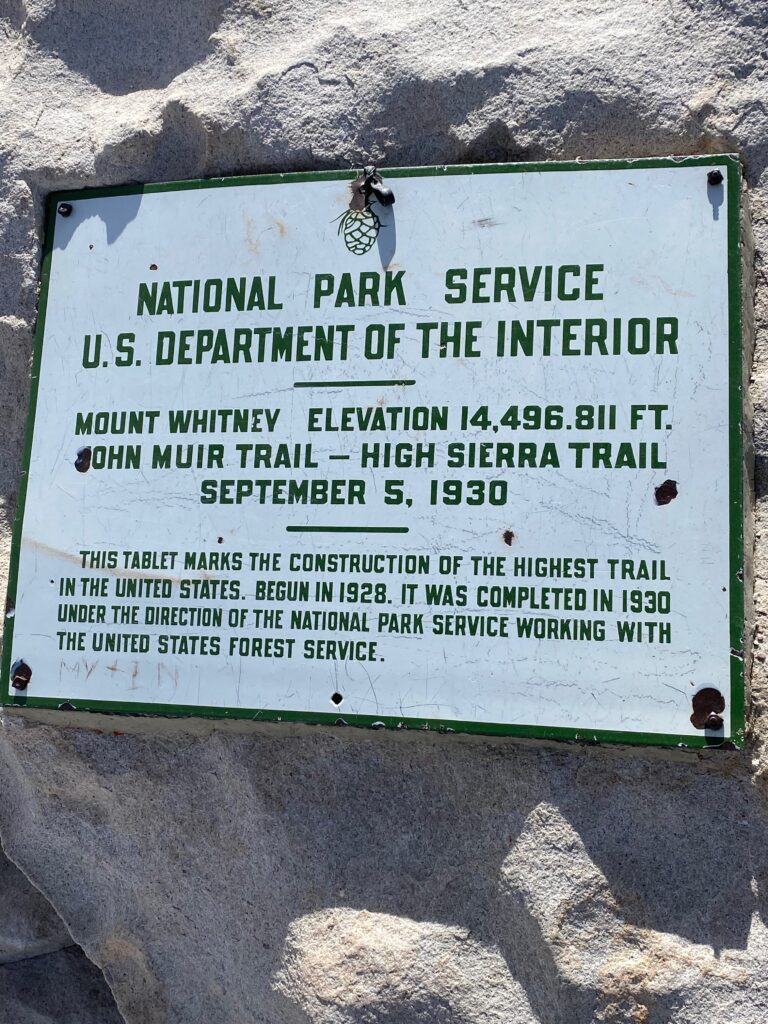
In preparation for a Mount Whitney hike, my son and I hiked from Horseshoe Meadows to Cottonwood Lakes #4 and 5. As an out and back trip, this was close to 13 miles, with around a thousand feet of elevation gain. This doesn’t sound like much, but the trailhead was already at 10,000 or so feet above sea level.

Starting from Lone Pine, the nearest town, most of the elevation gain up to that 10,000 foot level was done via car. From Highway 395, we drove down narrow roads until we began the ascent. The road winds up multiple switchbacks, many of them visible from the highway. After around 40 minutes of driving we reached the campground. Here we found a single parking spot open. There were multiple signs about bear activity. Many of the campsites were taken, but this is also a staging area for people hiking northbound along the John Muir Trail to Mount Whitney (or beyond, though I suspect many hikers on that trail get a shuttle from Lone Pine).

The terrain is mostly flat for the first couple of miles. There are trees, and the ground is dusty, gray. In early August the temperature was already in the 80s F, with almost no cloud cover that day. We started our hike around noon, after getting our Whitney Permit signed and looking around the visitor center (as well as dealing with a battery issue on the nearly brand new rental car). Along the way we passed many people returning from caping or hiking. We also ran into a group that was planning to hike the New Army Pass and then onward to Whitney. They planned to summit the same day as our Whitney Permit, and we left them with a “see you at the top” hail, being then full of confidence.

Slightly after two miles, the ascent begins. It’s only a short one, and we reached the top after a few short breaks, all cut short due to mosquitos. Along the way we marveled at the many meadows and wonderful scenery. Yes, it’s rocky and dusty, but the Eastern Sierras are a marvel to behold. The trail is well-marked and appears quite popular.

At the top of the climb, the trail is fairly flat. We passed the first couple of Cottonwood Lakes, then saw the wonder of Cottonwood Lake #3, the largest of the five such named lakes. At the far end there’s a small waterfall. Near the trail as it approached the lake, we founded a shaded spot and rested for lunch. We saw several people walking back from the lake, or continuing along the trail beyond the waterfall.

After our break we walked over to the waterfall, then walked up a short distance to the final two lakes. The Old Army Pass trail lies between lakes #4 and 5. We stood there and saw no trail, so we wondered how anyone would make it up that pass. On the way back, we did speak to someone who planned to camp near those two lakes and go up the Old Army Pass, so I guess it’s still possible.

Going downhill is so much better, and we quickly passed groups of people that we’d seen leaving half an hour or more before our walk to the last two lakes. We reached the trailhead in daylight, but figured some of the people that we’d passed likely would arrive there after dark, based on their pace. For our first day at altitude, this seemed like a great hike. Mount Whitney lay three days in the future, and as we drove back down the switchbacks we thought it would be just as easy as Cottonwood Lakes. Reality would prove different.

A Fedogan & Bremer book, at last

For many, many years I’ve owned just three Fedogan & Bremer books, all of which I bought in an actual brick and mortar bookstore: Adventures in Crime and Space in Austin, Texas (RIP the book store and owner Willie Siros). This bookstore closed in 2002, so that means over two decades have passed since I last bought a book by this publisher. I don’t think the publisher still is in business, but I’ve not really looked for any of their books online. That may change.

This month I found one of their books listed at a decent price, and picked up Hugh B. Cave’s Death Stalks the Night. This book was meant to be published by Karl Edward Wagner’s Carcosa imprint, but that publishing venture collapsed after four books, and F&B picked up the book many years later. With 17 stories and nearly 600 pages, this book will take some time to read and digest. Published in 1995, I’m surprised I didn’t get this title from Adventures in Crime and Space, but the hesitation might have been due to budget reasons at the time, as I think I was hoping to get F&B Carl Jacobi title first and never found it. Anyway, now I have this one.

Jacobi’s Disclosures

It’s almost funny to see bid after bid that I make for Arkham House books on a noted auction internet site take hit after hit and fall by the wayside. Since I’ve imposed a hard limit on any book, once that limit is reached I bow out, and thus miss out on countless books that I want.

In this case, by some strange surprise, I managed to secure Carl Jacobi’s 1972 Arkham House book, Disclosures in Scarlett. Apparently the people I’m bidding against on a slew of other AH books already have this one. I think I’ve managed to get three out of 30+ books so far this way, which means that if I want any of those other titles I’ll need to go the set price route, and find dealers with acceptable prices, vs. going against ardent collectors.

Bond. Nelson Bond

Until recently I don’t think I’d heard of Nelson Bond. Last month I bid on a few Arkham House books. As I have a hard limit, I was outbid on around 20 or 30 of them, but, by some strange twist of fate I managed to secure two or three books at reasonable prices. One of the books that I acquired was Bond’s Nightmares and Daydreams, published in 1968 for the low price of $5 (though by 1968 standards, that may have seemed like a pretty penny), collecting within its pages 14 short stories and one poem. Apparently Bond was a major writer of fantastic tales from the late 1930s through the 1950s. He then took a long break before writing fiction once more.

Fast forward a few weeks, and I’m in Bookmans, a used bookstore (and exchange of all sorts of things, from ceramic figurines to guitars) in Phoenix, Arizona. The store is vast, with shelves of books in various genres, all used, but few that I wanted. By chance, question about collectible fiction resulted in a store clerk directing me to an area near the check-out counters. There, a handful of sad looking “collectible books” leaned against each other in a tiny glass bookshelf. And I mean tiny. But, tucked in between what appeared to be some book club editions (but probably weren’t), stood another Nelson Bond book: The Thirty-first of February. This Gnome Press edition was published in 1949, and for a book going on 76 years, it wasn’t in bad shape, and for $20 it seemed a steal.

Arkham House: Into the 40s

Perhaps it’s only fitting that the first Arkham House book from the 1940s that I own is called The Fourth Book of Jorkens. Despite being nearly 80 years old, this book, published in 1948, is in pretty decent shape. There are a few tiny bumps in the dust jacket, at the top and bottom, and the book has a dusty, antiquarian smell. Yet otherwise the pages are clean, and the binding tight.

Written by Lord Dunsany, heir to one of the oldest Irish peerages, and one of the greatest fantasy writers of the 20th century, The Fourth Book of Jorkens contains a slew of short (tall) tales. It was first published by Jarrolds in the UK in 1947, and by Arkham House the following year.

It’s amazing to see a publication price of only $3, and yet, on the back page there are advertised books from the publisher for $1.50 and $2.00, with most the others listed for $3. Today, a hardcover book, even as slim as this one, would not be listed for less than $25. And yet, there you have legends in the field with their books for sale at such a low price. At least, one thinks so, but $3 in 1948, right after WWII might have seemed like a fortune to many people.

Book added: K.W. Jeter

According to ISFDB, Morrigan Publications in the UK released 11 titles, most of them in both hardcover and trade paperback editions (plus one chapbook), between 1987 and 1991. I consider myself lucky enough to have the three James P. Blaylock books in hardcover editions; I believe these were published as trade and limited editions, with extra material in the latter, but I only have the trade editions.

One of the tiny minority of book auctions that I recently won included the trade hardcover edition of K.W. Jeter’s In the Land of the Dead. I have the paperback edition by Onyx from back in 1989, but the pages are yellowing in that copy, and a nice clean hardcover edition is always easier to read. It’s been several decades now since I read it for the first time, so I’m sure when I re-read it I won’t remember a single thing. But, that makes it all the more special, I think.

Cast a Cold Eye

Back in the 1980s and 1990, small press publisher Dark Harvest published a fair amount of horror fiction, from novels, to anthologies and collections. At the time I bought a handful of these, but back then hardcovers were a premium in my eyes. I’ve recently started to look for their books that I failed to get, with Alan Ryan’s novel, Cast a Cold Eye the latest find. Originally published in 1984, this is a horror novel set in western Ireland.

I don’t often bid for books on eBay, but recently I’d seen several books there listed a low starting prices, and tossed my hat in for a few of them. In most cases the subsequent bidding exceeded my budget for any book, and I bowed out when that limit was reached. Cast a Cold Eye, to my surprise, was one that I ended up winning (alas, I missed out on another Dark Harvest book, not to mention many, many Arkham House books…).

My copy arrived today, and to my second surprise, this copy was not the trade edition, but the signed/limited edition in a slipcase. My copy is #92 of 200, signed by Alan Ryan, as well as illustrator Jill Bauman. For $15 plus tax and shipping, that’s probably the third surprise. (I will note, to my annoyance, that the copy-reader missed Brain for Brian on the second page, which does not bode well.)

Another Little Book

I picked up the latest copy in the series of Little Books from Borderlands Press. A Little Gray Book of Gloom, by Sabine Baring-Gould. This was another unknown author, at least to me, and collects eight short stories, plus a brief introduction by editor John Maclay, who once authored his own little book in the series.

My copy is signed by Maclay, and there’s a statement inside the cover that it’s number 378, with this edition limited to 350 copies. Either the limitation is a mistake, or this is one of those “extras” that gives a lie to the limitation number. Regardless, it’s a collection of stories by a bygone writer of fantasy, and I look forward to see what he wrote.

Books added: A quartet from Arkham House

To be accurate, three of the books recently acquired are under the Arkham House imprint, and one under their mystery books imprint, Mycroft & Moran (even though the dust jacket has Arkham House on the spine).

Recently I’ve turned my eye toward trying to collect more Arkham House books, although I know there are a few that probably will remain out of reach, including the ones from the 1940s, plus some of H. P. Lovecraft’s books (which I may well skip, anyway). I don’t have the exact number of books they published, but I believe that it’s close to 200 (this may include pamphlets and other association material). Despite the value of the name, Arkham House, the owners of this brand have failed it, given that nothing’s been published since 2008, and less than 10 books have appeared since 2000.

First published in 1966, Seabury Quinn’s The Phantom Fighter collects ten of his Jules de Grandin stories. This is the first time I’ve bought a Quinn book, or read any of his stories. Apparently he was quite popular among Weird Tales readers, but has faded somewhat in modern times, at least compared to Lovecraft or Robert E. Howard.

Portraits in Moonlight, by Carl Jacobi. Published in 1964, and along with the next book mentioned below, the oldest of my Arkham House books. Collects 14 stories, many of which originally appeared in Weird Tales magazine. My first Jacobi book, although I’d tried for years to find his Fedogan & Bremer book, Smoke of the Snake, to no avail.

Tales of Science and Sorcery, by Clark Ashton Smith. Also published in 1964, this book contains 14 short stories, and a memoir by E. Hoffmann Price. Perhaps I’ve already read these stories elsewhere, as I own a fair amount of non-Arkham House CAS books. This is only my third Arkham House book, the other two being a collection of letters and a book published in 1988. Most of his other AH books date back much further than what I have.

Eight Tales, by Walter de la Mare. Another book from an earlier era, published in 1971. A slim volume of never collected early tales. This book also includes an interesting introduction by Edward Wagenknecht, where he discusses different writers and their thoughts on their early fiction. Some writers want to forget, hide, or revise their early works, as, looking backward with what they’ve learned they see the embarrassment of their earlier attempts at writing. I’ve never read anything by de la Mare (much like Quinn and Jacobi), so this will be an interesting dip into the past. It does appear, at least from an initial glance, that de la Mare at least allowed his earlier works to once more see the light of day. It would be interesting to compare these to more mature tales.

With these four titles, I now own 40 Arkham House books and two Mycroft & Moran books. That’s a decent number, but still less than 25% of their published works. I think that I might be able to acquire another 30 or 40 or so books, before I encounter those volumes that are insanely rare or expensive. If I’m able to collect all of the books published since 1970, or maybe 1960, I think that I’ll stop there (though now that I have a few from the 1960s, it tempting to add that decade to my goal). I really wish that they had made an effort to continue to publish books under their name. What a waste of a great imprint.

Books added: FPW’s cozy mysteries

Rx Murder and Rx Mayhem are two books from F. Paul Wilson. Originally they were written under the pseudonym of Nina Abbott. The copies that I have are trade paperback editions published by Gordian Knot Books (an imprint of Crossroad Pass), and state on the cover “F. Paul Wilson writing as Nina Abbott.” The books were published in 2021 and 2022, respectively, and center around a young doctor in a small family medical practice near Baltimore.

Wilson originally wrote Rx Murder back in 2003, coming off a dark Repairman Jack novel. He trunked this book, deciding that it just didn’t work. Then, amidst the Covid-19 lockdown he returned to the book. He’d just retired from his medical practice, and found an angle that he thought now worked with the novel. A supernatural angle, ie. a ghost.

Rx Murder centers around Noreen Marconi, a 32-year old doctor fresh off her residency. She’s returned close to her home town outside Baltimore, and joined a practice with two senior partners. Then she’s visited by the ghost/spirit of her dead father. This happens after she’s forced to move back to her childhood home after a flooding in her condo. She ends up in the middle of a murder investigation when one of patients dies from a peanut allergy, and in the course of the investigation meets up with a former high school crush who’s now a local cop. Together they try to investigate the death of her patient, while she also gets roped into a quest from the ghost. Although the murder is dealt with in the first book, the mystery of the ghost lingers through the second book.

Rx Mayhem takes place immediately following the events of Rx Murder, but focuses more on the quest imposed on her by this ghost: find out what happened to her father’s best friend, who vanished one night, abandoning his wife and daughter. The sequel gets darker and darker, and all is not what it seems. Noreen, aka Norrie, also has to deal with one of the senior partners going to through a cancer diagnosis, the other partner’s penny-pinching ways, a weight-loss drug and it’s odd side-effects, and a stripper neighbor who keeps hinting that Norrie would make a great older stripper, plus more. At times it seems that Wilson is trying to include quite a few stories from his own medical practice, with one weird patient after another.

Overall, I’m not sure I bought the stories. The books are told from Noreen’s point of view. The involve a lot of medical practice material, likely pulled from Wilson’s own experience. There are several loose ends still dangling after the second book, almost as if Wilson planned a third novel. As both books are told from Norrie’s first person perspective, and it gets annoying at times.

In terms of cozy mysteries, or romantasies (a genre I saw advertised at a local chain bookstore this past weekend), maybe I’m not the target audience for these books. The clues are at times heavy-handed, the sexual tension between Norrie and her childhood friend-now cop simmers perhaps too long. The penny-pinching partner story fizzles out, and the ghost almost too easy to deal with. Maybe—I kept thinking as I read the books—these really aren’t Wilson’s genres either. He’s been great with darker books, and these were almost too whimsical. Anyway, as a huge fan of his fiction, I still think it’s a tough situation that he no longer is writing, due to his recent stroke. I know he has more ideas, but the type of stroke he’s dealing with makes writing next to impossible.

Have I now read all of FPW’s books? Aside from a pair of collaborations, I think so (and this doesn’t count the first two volumes of the Compendium of F, as I have those short stories in other collections).

The first F. Paul Wilson book that I read, An Enemy of the State, was an eye-opener when I read the paperback back in 1986. Now, almost 40 years later, it’s been a wild ride. My bookshelf if stacked with his books, including all the Repairman Jack Gauntlet editions (whoa there, I’m missing one Young Jack book in that format…). From SF to horror to thriller, mysteries, and other weird tales, it’s been a great experience to read his books (Yes, I even have the Weird Tales magazine special FPW edition). I remember many a night spent hidden in a room until past 2am just to finish a book, my wife thinking I was crazy for staying up late for that reason.

I also remember meeting Wilson and having him sign some books in person. We’ve disagreed on movies, corresponded via email at times, but I wish I’d made more of an effort to get to know him in person; it’s hard to talk to your heroes. So many of the literary heroes of mine that I used to know in person are now gone—it’s tough, it’s demoralizing, and almost none of them are left now. But, such is life, alas. I know he’ll never read this, but F. Paul Wilson – thank you for everything.

« Older posts Newer posts »

© 2026 Anders Monsen

Theme by Anders NorenUp ↑

css.php