Lost worlds and ports of call

Category: books (Page 6 of 25)

Books added: A quartet from Arkham House

To be accurate, three of the books recently acquired are under the Arkham House imprint, and one under their mystery books imprint, Mycroft & Moran (even though the dust jacket has Arkham House on the spine).

Recently I’ve turned my eye toward trying to collect more Arkham House books, although I know there are a few that probably will remain out of reach, including the ones from the 1940s, plus some of H. P. Lovecraft’s books (which I may well skip, anyway). I don’t have the exact number of books they published, but I believe that it’s close to 200 (this may include pamphlets and other association material). Despite the value of the name, Arkham House, the owners of this brand have failed it, given that nothing’s been published since 2008, and less than 10 books have appeared since 2000.

First published in 1966, Seabury Quinn’s The Phantom Fighter collects ten of his Jules de Grandin stories. This is the first time I’ve bought a Quinn book, or read any of his stories. Apparently he was quite popular among Weird Tales readers, but has faded somewhat in modern times, at least compared to Lovecraft or Robert E. Howard.

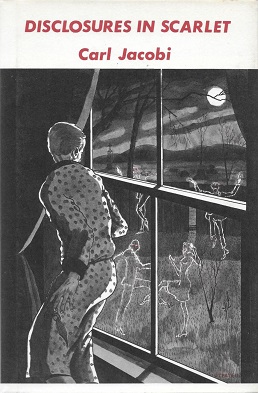
Portraits in Moonlight, by Carl Jacobi. Published in 1964, and along with the next book mentioned below, the oldest of my Arkham House books. Collects 14 stories, many of which originally appeared in Weird Tales magazine. My first Jacobi book, although I’d tried for years to find his Fedogan & Bremer book, Smoke of the Snake, to no avail.

Tales of Science and Sorcery, by Clark Ashton Smith. Also published in 1964, this book contains 14 short stories, and a memoir by E. Hoffmann Price. Perhaps I’ve already read these stories elsewhere, as I own a fair amount of non-Arkham House CAS books. This is only my third Arkham House book, the other two being a collection of letters and a book published in 1988. Most of his other AH books date back much further than what I have.

Eight Tales, by Walter de la Mare. Another book from an earlier era, published in 1971. A slim volume of never collected early tales. This book also includes an interesting introduction by Edward Wagenknecht, where he discusses different writers and their thoughts on their early fiction. Some writers want to forget, hide, or revise their early works, as, looking backward with what they’ve learned they see the embarrassment of their earlier attempts at writing. I’ve never read anything by de la Mare (much like Quinn and Jacobi), so this will be an interesting dip into the past. It does appear, at least from an initial glance, that de la Mare at least allowed his earlier works to once more see the light of day. It would be interesting to compare these to more mature tales.

With these four titles, I now own 40 Arkham House books and two Mycroft & Moran books. That’s a decent number, but still less than 25% of their published works. I think that I might be able to acquire another 30 or 40 or so books, before I encounter those volumes that are insanely rare or expensive. If I’m able to collect all of the books published since 1970, or maybe 1960, I think that I’ll stop there (though now that I have a few from the 1960s, it tempting to add that decade to my goal). I really wish that they had made an effort to continue to publish books under their name. What a waste of a great imprint.

Books added: FPW’s cozy mysteries

Rx Murder and Rx Mayhem are two books from F. Paul Wilson. Originally they were written under the pseudonym of Nina Abbott. The copies that I have are trade paperback editions published by Gordian Knot Books (an imprint of Crossroad Pass), and state on the cover “F. Paul Wilson writing as Nina Abbott.” The books were published in 2021 and 2022, respectively, and center around a young doctor in a small family medical practice near Baltimore.

Wilson originally wrote Rx Murder back in 2003, coming off a dark Repairman Jack novel. He trunked this book, deciding that it just didn’t work. Then, amidst the Covid-19 lockdown he returned to the book. He’d just retired from his medical practice, and found an angle that he thought now worked with the novel. A supernatural angle, ie. a ghost.

Rx Murder centers around Noreen Marconi, a 32-year old doctor fresh off her residency. She’s returned close to her home town outside Baltimore, and joined a practice with two senior partners. Then she’s visited by the ghost/spirit of her dead father. This happens after she’s forced to move back to her childhood home after a flooding in her condo. She ends up in the middle of a murder investigation when one of patients dies from a peanut allergy, and in the course of the investigation meets up with a former high school crush who’s now a local cop. Together they try to investigate the death of her patient, while she also gets roped into a quest from the ghost. Although the murder is dealt with in the first book, the mystery of the ghost lingers through the second book.

Rx Mayhem takes place immediately following the events of Rx Murder, but focuses more on the quest imposed on her by this ghost: find out what happened to her father’s best friend, who vanished one night, abandoning his wife and daughter. The sequel gets darker and darker, and all is not what it seems. Noreen, aka Norrie, also has to deal with one of the senior partners going to through a cancer diagnosis, the other partner’s penny-pinching ways, a weight-loss drug and it’s odd side-effects, and a stripper neighbor who keeps hinting that Norrie would make a great older stripper, plus more. At times it seems that Wilson is trying to include quite a few stories from his own medical practice, with one weird patient after another.

Overall, I’m not sure I bought the stories. The books are told from Noreen’s point of view. The involve a lot of medical practice material, likely pulled from Wilson’s own experience. There are several loose ends still dangling after the second book, almost as if Wilson planned a third novel. As both books are told from Norrie’s first person perspective, and it gets annoying at times.

In terms of cozy mysteries, or romantasies (a genre I saw advertised at a local chain bookstore this past weekend), maybe I’m not the target audience for these books. The clues are at times heavy-handed, the sexual tension between Norrie and her childhood friend-now cop simmers perhaps too long. The penny-pinching partner story fizzles out, and the ghost almost too easy to deal with. Maybe—I kept thinking as I read the books—these really aren’t Wilson’s genres either. He’s been great with darker books, and these were almost too whimsical. Anyway, as a huge fan of his fiction, I still think it’s a tough situation that he no longer is writing, due to his recent stroke. I know he has more ideas, but the type of stroke he’s dealing with makes writing next to impossible.

Have I now read all of FPW’s books? Aside from a pair of collaborations, I think so (and this doesn’t count the first two volumes of the Compendium of F, as I have those short stories in other collections).

The first F. Paul Wilson book that I read, An Enemy of the State, was an eye-opener when I read the paperback back in 1986. Now, almost 40 years later, it’s been a wild ride. My bookshelf if stacked with his books, including all the Repairman Jack Gauntlet editions (whoa there, I’m missing one Young Jack book in that format…). From SF to horror to thriller, mysteries, and other weird tales, it’s been a great experience to read his books (Yes, I even have the Weird Tales magazine special FPW edition). I remember many a night spent hidden in a room until past 2am just to finish a book, my wife thinking I was crazy for staying up late for that reason.

I also remember meeting Wilson and having him sign some books in person. We’ve disagreed on movies, corresponded via email at times, but I wish I’d made more of an effort to get to know him in person; it’s hard to talk to your heroes. So many of the literary heroes of mine that I used to know in person are now gone—it’s tough, it’s demoralizing, and almost none of them are left now. But, such is life, alas. I know he’ll never read this, but F. Paul Wilson – thank you for everything.

Book added: Pamela Sargent

I’m usually more focused on specific authors (aside from a few exceptions, i.e. all books by Golden Gryphon Press, two Pulphouse Publishing series, and an attempt to find all Dark Harvest books, the last effort which is as yet unrealized), rather than anthologies or series. When Centipede Press announced a special price for the latest book in their series, Masters of Science Fiction, by Pamela Sargent, I hesitated—but only for one day.

This series has been around for a few years, and I don’t have any of the previous Masters of Science Fiction titles. Still, I’ve read (and enjoyed) some of Sargent’s stories in her Golden Gryphon collection, Thumbprints, and the price was attractive enough not to pass up. Also, Centipede Press to me, means Quality with a capital Q.

With this copy I now have 17 books from Centipede Press. This is a fraction of their output, I know, but so it goes. Based on their list of forthcoming books, I hope to add a few more, if the opportunity presents itself. Until 2017 I only owned one Centipede Press book (Michael Shea’s The Autopsy and Other Tales, published and bought way back in 2008—a much treasured volume that now fetches many times more online than I paid for it back in 2008). From 2017 through 2021 I only bought books from them by a single author (Fritz Leiber). Onlyl recently did I branch out and buy some of their other books, and then just one in their long-running series of “weird fiction” and science fiction. I kick myself these days regarding the decision to ignore their other publications.

All the prior books in this series of Masters in Science Fiction are long out of print. If you search online for copies, the prices escalate into the hundreds and beyond. The further you go back in terms of the publication date, the higher the price. In order words, I probably won’t be collecting any of the earlier books in the series. They do have a Howard Waldrop book scheduled, and despite having all of Waldrop’s books, that’s one that will sell out quickly.

My copy is #350 of 500 signed and numbered copies. It’s signed by Sargent, artists Bob Eggleton, and Pat Cadigan, who wrote the introduction. Clocking in at 846 pages, and collecting 31 stories spanning her career, this is an impressive book. The wrap-around dust-jacket painting by Eggleton is amazing, as the the production quality of the book. Also, for each story, Sargent has written a short afterword. If I have any quibble about this book in terms of the title, it’s the lack of a proper bibliography. It will take some time to go through all 31 stories, but these are moments to savor.

Books added: Two more Lansdales

Joe R. Lansdale has written a vast number of books. Subterranean Press has published a fair number of those books. Recently I picked up just my fourth and fifth copies of Lansdale books published by Sub Press—a minuscule number of those books, for sure. The reasons? First: Most of these were published many years ago, and now fetch prices well above the initial listed price. Second: the initial listed prices tended to start around $40, even for copies available in the thousands, vs. hundreds, in terms of “limited editions.” Therefore, I went with the more mass-market publishers when it came to Lansdale’s books. But, if I’m lucky enough to find any within my narrow price range, then why not?

For a Few Stories More, Volume 4 in the Lost Lansdale series, Subterranean Press, 2002.

Initially listed at $40, I paid $22 for this book. Used. Online. From a dealer. Apologies to Mr. Lansdale, who didn’t get a penny from me on this one; I have bought many of your books retail, however, but sometimes there are books offered at prices beyond what I can pay. And, I came late to the party on this one, 23 years late, to be exact.

For a Few Stories More, is the fourth (and last) in a series of “Lost Lansdale” books and short stories. So far I’ve only read the introduction, which is a good one. After I got this book, I looked for books one through three, but those are listed at well beyond what I paid for this one, so I’ll stick with this book for now. My copy is #373 of 1000 signed and numbered copies. I plan on reading these stories shortly. Lansdale’s short fiction packs a punch, and I expect that even his early stories have some weight behind them.


Next up, a book that kept showing up everywhere when I was scrolling through online catalogs and offerings. This copy popped up at a surprisingly low price, so I went for it.

Jane Goes North, Subterranean Press, 2020

Jane Goes North is an amusing road trip of a book. Also originally listed at $40, I was able to get this one for $20. My copy is #88 of 2000 signed and numbered copies. The protagonist, Jane, lives in East Texas. She’s just been fired from a low-paying job, and gets invited to a sister’s wedding just outside Boston. Determined to make it to the wedding despite being almost broke, she teams up with a stranger, Henrietta aka Henry, an anti-social woman with a wandering eye. Henry has a working car, and Jane is willing to drive.

Along the way they meet up with a collection of bizarre people, including a pair of dollar store thieves, some back-woods slavers, and a country musician who now makes her living playing in bars along the east coast, while fighting off sexism and owners reluctant to pay her anything. In typical Lansdale fashion, characters over-share information, but Jane preservers. She has grit, determination, and I ended up rooting for her despite all her dubious decisions. The ending surprised me somewhat, and perhaps there’s a sequel in there somewhere.

Books added: a pair of early Repairman Jack novels

The Early RJ trilogy, consisting of Secret Histories, Secret Circles, and Secret Vengeance, were books I bought in the Tor hard cover editions a year or two after the last book in the series appeared—the books were published between 2008 and 2011. After some research, I see that I bought my copies some time in 2012. For some reason, after the first book in the series, Tor’s marketing department changed the cover designs for the next two books; while the latter two bear similar designs, these differ wildly from the first one.

I didn’t plan to buy the limited editions of these books. These were published by Gauntlet Press, which usually price their FPW books at $60. Then again, I’d recently bought the other RJ trilogy covering his first years in New York in their limited editions, even though I had the Tor books, and the same for the ICE-trilogy (how irony, given the current ICE acronym as a government agency).

Still, when I came across the first in the series listed online for far less then $60, I pulled the trigger and bought it. My copy of Gauntlet Press’s edition of Secret Histories is signed and numbered as #9 of the 500 limited copies. This book came with a slipcase, which I thought was only meant for the lettered editions.

A few months later, I saw a copy of the second book, Secret Circles, listed for around the same price, and went ahead and bought it as well. This copy is numbered 202 of 500 copies, but didn’t come with a slipcase. At least Gauntlet Press didn’t go all wonky again and change the numbers in the editions, as they’ve done with other series—good luck collecting all books if they are in editions of 500, 450, some random number, vis-a-vis the “City” trilogy, or even the Nocturnia trilogy.

The covers in the Gauntlet editions are far better than the Tor editions, that’s for sure. The spines are almost identical in design, thought the covers use different fonts and placements of the subtitles and Wilson’s name. “Arg!” I said when I saw this. Can we have some consistency in design?

Now, if I can just find the last book at a reasonable price, it will complete the set. Then I’ll have to find a way to buy FPW’s last two novels, as Gauntlet released the first of these just recently, and will release the second shortly. It’s madness, I know. I’ve already read them, as I bought the trade editions, which I thought would be the only editions. So it goes.

Book added: Jules Verne’s Little Blue Book of Icy Perils

Jules Verne (1828 – 1905) was a French writer. His most famous stories are Journey to the Center of the Earth (1864), Twenty Thousand Leagues Under the Seas (1870), and Around the World in Eighty Days (1872), all classic “science fiction” books. Back then, the term science fiction didn’t exist, but he’s since been hailed as one of the first science fiction writers. I’m not sure if I’ve ever read the orignal books, though I know the stories well. Somehere in my library I do have a copy of A Journey to the Center of the Earth.

Borderlands Press, continuing it’s mission to publish stories from past masters of horror, fantasy, and science fiction, recently published A Little Blue Book of Icy Perils, which collects three of Verne’s stories, plus a (bonus) sonnet. Edited by Tom Connair, and limited to 500 signed and numbered copies, it joins the ever-growing stack of such books in my library. The copyright date states 2024, but I believe it was offered for sale in early 2025. At least, that’s when I saw it offered for sale, and then bought a copy.

I much prefer the rougher cloth bound versions of these books, at least compared to the smooth bindings. The various bindings and sizes means that these books aren’t 100% uniform, but it is what it is. The series continues, at least for now. If I were the editor in charge, I might pick other writers, but the fact that I’m not the editor in charge means that I’m always surprised, and that’s a good thing!

I also learned from the introduction, that there was no balloon ride in Around the World in Eight Days. My perception of this book had been clouded by various movie versions, where balloon rides were de rigeur. It was strange, then, to read in the first paragraph of the first story about balloon rides. C’est la vie. Verne these days, then, is more well known for cinematic interpretations than his actual words. Quelle surprise.

Book added: Swords Against the Shadowland

As a long-time fan of Fritz Leiber’s Fafhrd and the Gray Mouser books, when Centipede Press started re-releasing the books in hardcover, I had to have them. Leiber published seven books in the series, starting with Swords and Deviltry and ending with The Knight and Knave of Swords. As Leiber aged, so did his heroes. They endured loss, hardship, delight, love, pain, and injuries along their adventurous lives.

Robin Wayne Bailey, an accomplished writer in his own right, was asked by Leiber to write a book with these two characters. He finished one of three contracted books, but various publishers involved with the books folded, and so there’s only one completed book. Swords Against the Shadowland was published in April 2025 by Centipede Press in a signed an unsigned version. As all my copies are unsigned, as is this one. The book comes with a gorgeous wrap-around cover. After a brief introduction from the author, we dive right into the story. Interestingly, it’s a sequel of sorts to the first book in the series, Swords and Deviltry. The pair are transported back to Lankhmar, a city they vowed never to re-visit after the tragic events they experienced there in the first book.

Centipede Press publishes a wide variety of books. These books are always professionally done. The exterior, the binding, and the interior are carefully crafted. The contents are comprehensive, and illustrated throughout. The books are virtually works of art, more so than a book you’d read. Most of their books sell out quickly, and subsequently fetch a premium on the secondary market. In my case, I bought the first book direct from the publisher back in 2017. Each year since, I’ve plonked down my coin for the next book. I own the first six in Ace paperback editions, and the seventh as a hardcover, but to have these is a crown jewel sort of feeling.

Book added: A Pair of Lansdales

Joe R. Lansdale has written (and continues to write) a ton of books. I buy them as I find them, which these days isn’t often.

Radiant Apples is a novella published by Subterranean Press in 2021. I found this book online, listed for $20 plus tax and shipping. It’s a slim book—in effect, the kind of book you can read in one sitting. The main character is Nat Love, who previously appeared in the novel, Paradise Sky. My copy is number 301 of 1,500 signed and numbered copies, originally published for $40 in 2021.

Nat Love is now in his 50s, a porter on the Pullman railway in north-east Texas. A train robbery and murder sets him on a quest, and he recruits an old friend as he chases these robbers into Oklahoma from Texas. It appears to be set in 1919, but feels like an old Western from the previous century. Lansdale tones down some of his usual banter, but not by much. Overall it’s a good read, and I think it would be cool to see more stories with Nat Love. That might be tough, however, as between Paradise Sky and this book he got married, had kids, and gave up much of his old life. A glance at Lansdale bibliography told me there were some other Nat Love stories, which led me to the next acquisition.

Fishing for Dinosaurs, also published by Subterranean Press (2020), is a collection of five novellas. It includes “Black Hat Jack,” an earlier Nat Love novella. “Black Hat Jack” previously was published as a separate book (just like Radiant Apples) way back in 2014 by Subterranean Press. It’s cannibalized into this collection (along with another Lansdale novella that also came out by Sub Press), which saved me from having to hunt down the older novella.

Each of the stories is introduced by another writer: Robin Hobb for “Black Hat Jack,” plus Poppy Z. Brite, Richard Chizmar, David J. Schow, and Norman Partridge for the other stories. My copy is number 660 out of 2,500 signed and numbered books, also bought for $20 online, as I’m a few years late from the original publication event, and the book is sold out from the publisher. An edition of 2,500 seems like a lot for a “signed, limited edition,” but, as I care more about the stories than the rarity of the book, I don’t mind. However, I do wish I’d known about it sooner, as I feel guilty that Lansdale isn’t getting a cent from my purchase.

In terms of the other stories, “The Ape Man’s Brother” was published as an eBook and hardcover edition by Subterranean Press. “Prisoner 489″ was published by Dark Regions Press as a lettered edition, a limited edition hardcover, and trade paperback. From what I can tell, the other two stories—”Sixty-Eight Barrels on Treasure Lake,” and the title story—are collected here for the first time, though “Fishing for Dinosaurs” first appeared in 2014 in Limbus Inc. Book II. I may be wrong, as although I own 44 Lansdale books, this is but a fraction of his output.

From the introduction by Lansdale, I learned there are some other Nat Love stories floating around somewhere, and maybe they will turn up in a collection, and maybe I’ll eventually read them.

Books added: Closing out the Nocturnia trilogy

Tom Monteleone and F. Paul Wilson are both noted horror/sf/suspense writers. Between 2013 and 2018 they co-wrote a Young Adult trilogy under the aegis of Nocturnia. These books take place in an alternate reality inhabited by “monsters”—vampires, werewolves, trolls, zombies, and more. In Nocturnia, humans are rare, treated as slaves or food. Into this place are transported two young humans, who get sucked up in an inter-dimensional tornado while looking for their missing older brother. In Nocturnia they meet various monsters (some good and some some decidedly bad), along with other humans, including Amelia Earhart and Ambrose Bierce, both of whom also were transported there from Humania, as our earth is known. Will the siblings make it back to “the real world?” Will they get eaten or killed by the various monsters? You need to read all three books to learn their fate.

I bought the first book some time last year, as part of my ongoing effort to collect of all F. Paul Wilson’s books. This year I went ahead and picked up the second and third books. All three were published as a joint effort by Borderlands Press and Gauntlet Press. The three hardcovers that I have are all signed/limited editions; prices are not listed in the books, but I think I paid a fair price for each one.

Strangely, the three books have different print runs: The first volume was published in 350 copies, the second 300, and the third 500. While my copy of the first volume is #138 of 350, the second and third are both #69 of those respective numbers. Also, while the covers of the second and third books look similar, they diverge wildly from the cover of the first book. Granted, the cover of the first book was somewhat bizarre, almost as if a child had drawn something for a school project. The second and third covers appear somewhat more professional. Family Secrets, the second book in the series, list a final proofreading credit, but this person missed the copyright page, which mentions the first book in the series, Definitely Not Kansas; this was fixed in the third book, The Secret Ones, as it mentions itself (not the only time Borderlands Press has failed in proofreading something, and in one place the writers use “there” instead of “their” which is almost unforgivable). Per a comment in the third book, chapbook was published, called Secret Ingredient. So far I’ve not seen this chapbook listed anywhere. Is it real? I don’t know.

These books are intended as young adult novels, so the protagonists are young kids. To move the plot along, there are side characters who vary in age and act as foils, mentors, antagonists, love interests, etc. Both the first and second books end on cliffhangers, but that’s not unknown for YA series. At times I think I see which writer is at work, but then again, I’ve read a ton of F. Paul Wilson books, and almost nothing by Monteleone, so I have no sense of the latter’s writing voice or style. I do wonder, in this parallel universe, how all the characters speak English, and how the Nocturnians know certain terms than are unique to American culture, and there only are two scientists in the entire culture in this universe that’s almost a parallel version of our own. But, I guess in cases like this one must suspend all disbelief.

Books added: a pair of Knausgaards

Norwegian writer Karl Ove Knausgaard was apparently all the rage a few years ago, with his multi-volume series of novels under the aegis of “My Struggle.” To date, six volumes has been published in this series. He’s also written other books, but is best known for the autobiographical series of books under the heading, My Struggle.

Even as a (former) Norwegian, I hesitated buying/reading his books. He’s too contemporary, too fashionable, I thought, each time I came across his name.

Still, someone I know kept asking me every time we met (not very often, but maybe every two years) whether I’d read his books. I guess that, as a Norwegian, it was somehow assumed that I would have read them. Each time, I replied that, “No, I haven’t read any of his books.” It’s not that I haven’t seen his books in bookstores., or been aware of him. The books were there, though not always in the right order, when I I saw them. Still, I hesitated. Maybe I didn’t like his international success (compared to other Norwegian writers that I thought deserved success). Maybe there were other reasons; the book title hewed too closely to another, more infamous, German title, for one.

Recently, however, I came across two of Knausgaard’s books in a used bookstore, and thought, “Why not?” So, I bought them. One of these books was the first volume in his “My Struggle” series. The other, called Winter, was part of another series based around seasons. Knausgaard’s only a couple of years younger than me, yet he’s a prolific and famous author, while I’ve written only some early-draft crime novels. In other words, there is nothing to compare us, unless you contrast success and nothingness. Winter starts with musings on an unknown and future child (he’s apparently not just prolific, but fertile as well). I set this book aside. I might need to find those other season-related books first.

Meanwhile, the first volume of My Struggle begins with Knausgaard musing on death and dead people. This was unexpected, at least to me, as I thought it would start with his own birth. Then again, after talking about dead people and how we treat them. he transitions into a story about himself at the age of eight, having seen a newscast about a Norwegian fishing vessel capsizing, with those on board drowning. He highlights his own reaction to this event, as well as his interactions with his father. That’s as far as I’ve made it at the moment.

The book begins in 1976. Knausgaard was eight years old at that time. In 1976 I was slightly older, about to leave Norway for a second stint in Zambia. I remember this year vividly. At the of age nine in 1976, this might have been was my “starting” moment in terms of memory, more so than at age eight like Knausgaard. So much happened to me in 1976, a major year in my life. Although I also was in Norway at that time, I don’t recall that same shipwreck incident; in my case there were more personal events that I remember (school, location, a first kiss, the apartment, a so-called friend inviting me somewhere and then eating dinner in front of me, as well as many other things that seared into my memory from that year). Maybe, it’s because we didn’t have a TV, maybe it’s because I saw life differently that time. I certainly didn’t think about death then, not for many years. I thought about life, about where I lived, what I did, and what I saw.

Why is the book called “My Struggle?” I don’t know, at least not yet. He seems to to fear his father at that age, something I don’t think I ever experienced. His father seems to come across as strict, almost tyrannical, despite being a teacher. I think my father at that same age was a little distant, but nowhere near the same as Knausgaard’s father. We’re less than two years apart in age (Knausgaard and I), yet so very different. While I bounced between countries and cultures, he existed only in Norway. Having only sampled a few pages, maybe I’m being too judgmental. Again, what’s the struggle? You had a great life, Karl Ove. You didn’t get dragged to a foreign country. You didn’t change your identity. You’re Norwegian, through and through, not someone split between cultures and continents.

Anyway, I guess I need to read more in that book now, to gain a better insight into why he’s famous. Then again, there are five more volumes to dredge through, if I want to know more. I still don’t get it.

« Older posts Newer posts »

© 2026 Anders Monsen

Theme by Anders NorenUp ↑

css.php