Lost worlds and ports of call

Month: October 2026

A brief sojourn into Salem

These days, apparently, October is the month to visit Salem, Massachussetts. This town, just a short thirty-minute train-ride northeast of Boston, owes its fame to the killing of twenty innocent men and women, plus an additional five who died in the town jail, back in 1692. Accused of witchcraft—although probably a likely excuse to acquire disputed land—in Puritan New England men and women, old and young, were hanged on Gallows Hill (one person, pressed to death, died in a manner more horribly than by the rope). Others were tortured in order to confess their sins, and this stain on the town of Salem has never really left it, even after more than 400 years. Harsh judges, steeped in religious superstition, handed down sentences of death based on dubious evidence. Locals later repented their actions, but for many it was far, far too late.

Today, the town of Salem (at least the economically minded side), makes a killing on its history of those killings. Stroll down Essex Street Mall, and you’ll find a Witch Mansion, Professor Spindlewink’s World of Wizardry, and various haunted house hawkers amid a multitude of touristy shops selling witch-related items short of Harry Potter knock-offs. In a nearby graveyard is the Salem Witch Trials Memorial, and a few blocks away the Salem Witch Museum. There’s even a torture museum, for those so inclined. I was happy to stroll along other places.

Salem’s also home to the massive Peabody Essex Museum (PEM), a venerable institution with wonderful (and mostly not witch-related) exhibits and notable paintings, well worth a visit for anyone interested in art and/or history (also, there is was an exhibit on the people who were accused of witchcraft and killed, which was illuminating). The city of Salem itself is notable for being the birthplace of America’s greatest 19th century writer, Nathaniel Hawthorne.
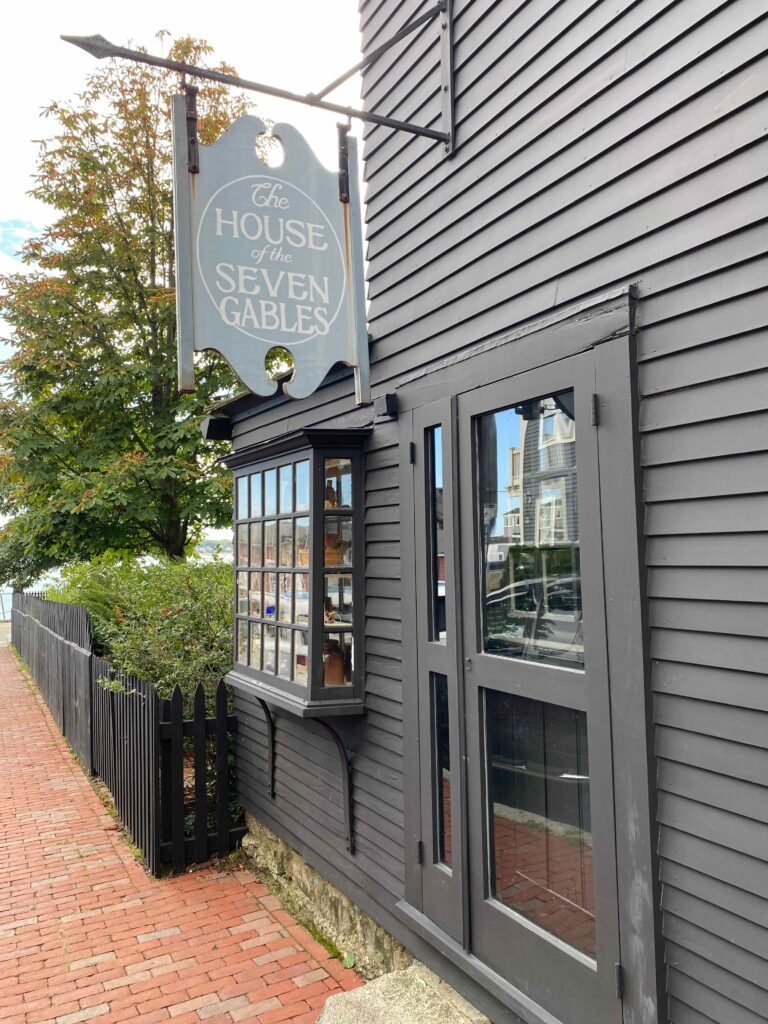
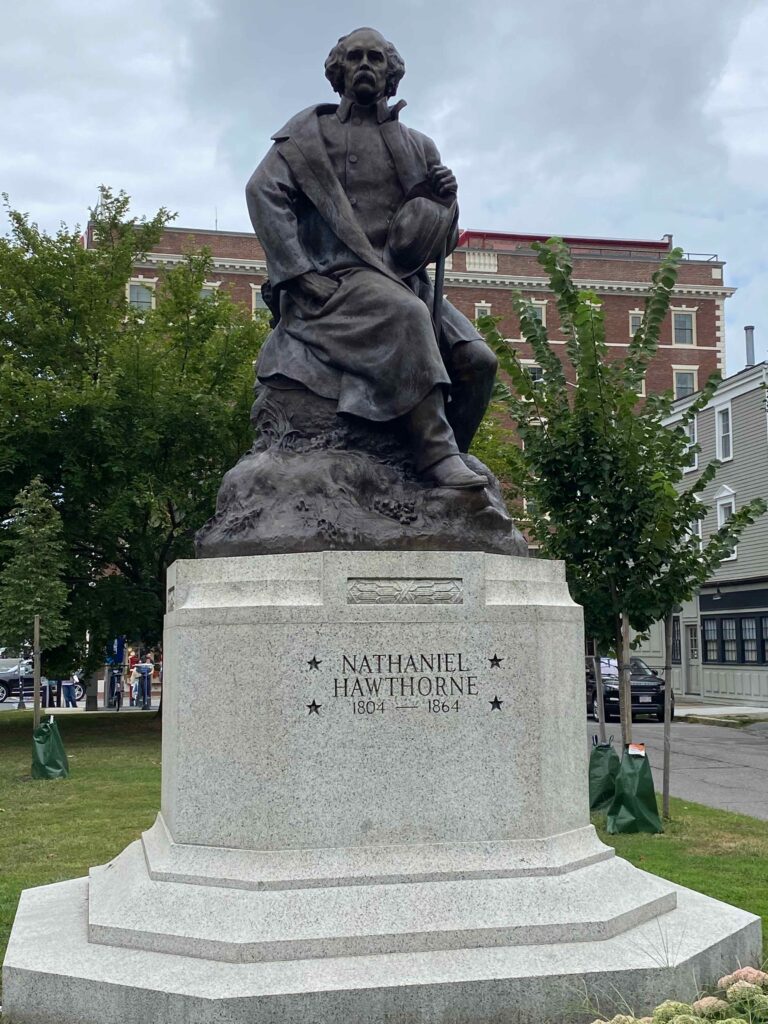
In Salem also sits the actual house of the seven gables, now a museum, but once the subject of Hawthorne’s second novel. Nathaniel Hawthorne, whose venerable ancestor was one of the harsh judges who condemned the so-called witches to death, wrote many tales set in and around Salem, notably The Scarlet Letter, an attack on Puritanism in its many forms. Hawthorne also left the city in disgust after being tossed from his job at the Custom House when a new administration came to power and replaced many individuals from a different political bent. Salem, today recognizes its most famous inhabitant with a street name, a hotel, and a statue in a central location (and probably other nods and recognitions).
In early September this year, rather than in the madness of the Halloween-related month of October, I took the commuter train from Boston to Salem. The atmosphere in North Station in Boston, while waiting for the signal to board the train, likely merits its own long essay. But, I will skip that effort, as I still bear the scars of the mad rush through the doors once the platform was announces, just 10 minutes prior to departure.

Years ago, as an English major in college, I’d read Hawthorne and many of his contemporaries. That middle 19th century period was perhaps my favorite when it came to American writers: Hawthorne, Herman Melville, Ralph Waldo Emerson, Edgar Allan Poe, Henry David Thoreau all made an indelible impression on me, and I read many of their books. Aside from Hawthorne, Salem is the center of early American superstition gone wild, and so a destination-place for anyone in the Boston area. Naive as I am regarding the present, I thought for some reason that Salem was still a somewhat small village, not the enterprising locale attracting visitors goggling at witchcraft and wizardry related stuff.

Leaving the train station, I was surprised at the large crowd rushing up Washington Street. I later found that their likely destination was the Essex Pedestrian Mall, unless it was the cemetery, or maybe Gallows Hill Park (now a baseball field and skate park, it appears). Instead, I took a left turn and walked down Bridge Street. I passed by the old Salem jail lot, made a right turn and ended up near the Salem Witch Museum. There was already a line, and booking were apparently only available online via a QR code. Upon learning it was mostly a video presentation, I skipped it, and walked toward the center of town. I spent an hour in the PEM, perusing various exhibits, then wandered about town, shuddering as I walked along the Essex Pedestrian Mall. Looking for lunch, a decision was made to find something near the wharf. A walk along Derby Street took me to Pickering Wharf, and then Finz Salem, a seafood restaurant, where I enjoyed a decent plate of fish and chips and local lager.

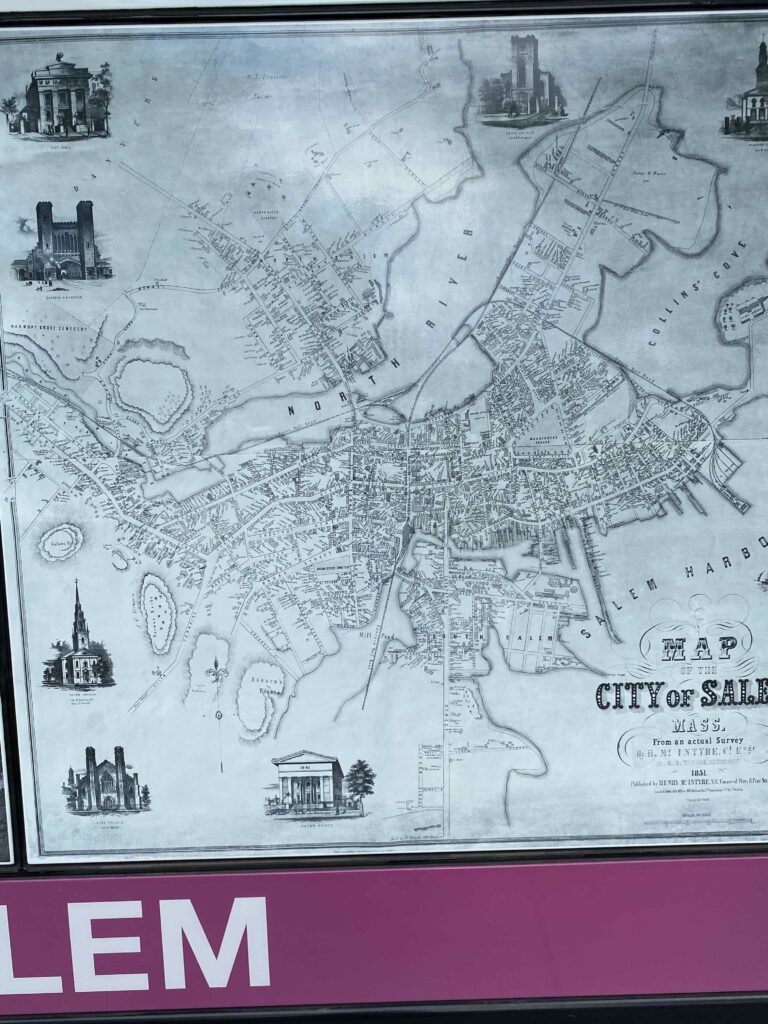
After lunch I walked passed the Historic Central Wharf, then along the length of the next wharf, where I passed the Friendship of Salem ship (now closed). I circled the Derby Wharf Light Station at the end, and returned the way I came, wondering how this area looked like back in the 1840s, and even the 1640s. It’s a city now choked with houses and businesses. Sure, some of the houses bear plaques as to when they were built, dating back to the seventeen or eighteen hundreds, but there are many new buildings. Salem, after all, is history, but history is fluid. Even though Hawthorne fled this city to Lenox in western Massachussetts, and later to Italy, he could never quite escape history, and remains connected to Salem more than any place today.

Nearby the Historic Central Wharf stood The House of the Seven Gables museum. As I didn’t care to spend another hour (and more money) to wander its rooms (and likely buy some Hawthorne edition of a book that I probably already owned), I simply walked around it, as much as was possible. Perhaps I’ll return to this strange town. if I do so, I hope it’s not during October, where all those witch-mad people storm the town, and also hawk their goods. Maybe, I’d even stay at a local hotel, drawn by the name of that notable scion of Salem. Then, I’ll check out this seven gables museum, perhaps in a more quiet moment, and also buy more books. After all, I do have a compulsion to buy books, and marking a book or more as “from Salem” might mean something to me, if only briefly.

On the way back to the train station, a sprinkling of rain fell, and I wondered about winter and Hawthorne’s dislike of the east wind that haunted this town. Did luck strike with an otherwise warm September day? Briefly, wandering the remote streets, I saw a rabbit in poke its head out a small yard and then disappear. I found this strange, as I was far from the countryside. Then again, I’ve spotted rabbits while in suburban Medford just outside Boston proper, so perhaps this sight was normal in New England, just as squirr. I paid homage to the Hawthorne statue, walked past the Hawthorne Hotel, and wondered what old Nathaniel would have thought had he witnessed Salem in 2026. Probably he would have shaken his head, made a disparaging remark or two, and disavowed any association with his birthplace, as he did back in 1849.
Having seen but a fraction of Salem, but also having become once more aware of Hawthorne as a person and writer, I’m now reading a biography of this person; it’s a book I bought years ago, but never touched, until I dug it out from behind a stack of books covering that time-period in American life and fiction. I’ve also gone ahead and arranged many of his books in order, and now plan to read or read them this Fall. I still remember a few of his stories from many decades ago when I read them in college, and look forward to revisiting them with the experience of having, at least, been to New England. Life is strange, indeed, as I never expected to visit that area of America. Now that I’ve been there, the lives of many of its writerly inhabitants suddenly has a greater meaning, and I feel the need to take another look at their lives and what they wrote.

I’ve even sketched out an itinerary to hike Katahdin, to walk in the footsteps of Henry David Thoreau, another of my literary (and personal) heroes. Perhaps that’s my own great awakening.
The Final Ford

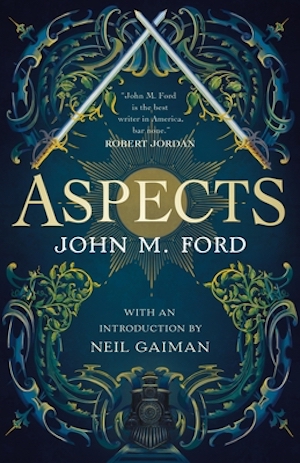
I know that I’ve heard of John M. Ford’s name, but I’d never come across any of his book until I found a copy of Aspects for sale in October, 2026. Only after I had this book in my hands did I learn that this was his final book, published after his death, no less.

Published by Tor books in 2022, with an introduction by Neil Gaiman (prior to his cancelation for “bad actions”), Ford’s novel is somewhat incomplete. Ford (1957 – 2006) passed away aged 49, comparatively young. He dealt with kidney and diabetes issues all his life, yet produced many stories. I believe his first book was Web of Angels (1980), but I’d never come across any of his books until now, and as fate would have it, this was his last book, published many years after he died.

Aspects is a heft book, clocking in at nearly 500 pages. Kudos to Tor for publishing the book, nearly two decades after Ford died. Back in 2021 or so when Gaiman wrote the introduction (as a longtime friend of Ford’s), Gaiman was still a major name in the SF/Fantasy genre. Things have changed since then, with Gaiman accused of sexual assault and such, so it’s somewhat strange to read his introduction now. It doesn’t diminish anything, but still it’s strange to connect that introduction to the present version of Gaiman.

Still, wow, to read the first couple of sentences of Ford’s book, knowing that he’s long dead, is strange if not disturbing. Perhaps I’ll come across more of books now, as I’m more aware of his name, but with his death almost two decades hence, that iwll likely be via online sellers, or by chance if I see any books in various used bookstores. It’s so tragic when this happens, but the past is the past.

Ray Garton’s Hateful Book

Is that a misleading title? Probably. And for that, I apologize, for I’ve always been impressed by all the Ray Garton stories that I’ve read.

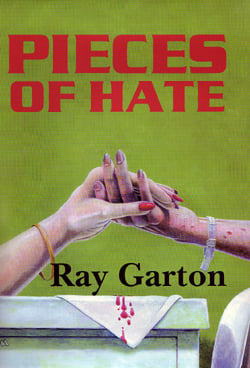
Recently, I picked up a nice copy of Ray Garton’s collection, Pieces of Hate, published by Cemetery Dance in 1996 — which is 30 years ago today! My copy is number 97 of 500 signed and numbered copy of this title. The book contains just nine stories, none of which I’ve read. I own just a handful of Garton’s books, all from small press publishers — Dark Harvest, Ziesing, Borderlands Press, and now Cemetery Dance. This is but a small subset of the books published during Garton’s lifetime. He died in 2024, all too young and with many years of fiction ahead of him. So tragic.

Horror and dark fantasy is but a small subset of genre fiction, but Garton was a major name in that arena. The first Garton story I read was “Monsters” in the Dark Harvest anthology, Night Visions 6, where he appeared alongside F. Paul Wilson and Sherri Tepper. I don’t remember anything from this story, but I do remember Lot Lizards, a vampire novella published by Ziesing back in 1991. Since then I’ve picked up a few more of his books, all hardcover. His original paperback horror books are hard to find these days, as are some of his more famous (or infamous) books, like Live Girls.

With Pieces of Hate you get the stories, and that’s it. No author introductions. No afterwords, no encomia from fellow authors. Leave that to other books. I look forward to readin this book with great anticipation. I’m sure the stories will be troubling. That was the case with Lot Lizards, as it was with Trade Secrets, another of Garton’s novels that I recently read. I still have a few of his unread books in my shelves, which sometimes is a good thing. I’ve yet to come across any Garton paperbacks anywhere, but perhaps someday I’ll find more of his books, and mourn the fact that he’s no longer around.

Another Dragon Griaule tale

Whenever I’m in Phoenix for a few hours, as was the case this month, I try to stop by Book Gallery. This sprawling bookstore carries used and rare books of almost every shape and genre. Precise labels on the shelves cover almost every imaginable subject, so that either one must visit every bookshelf to discover what lies within, or have a specific idea of what to seek.

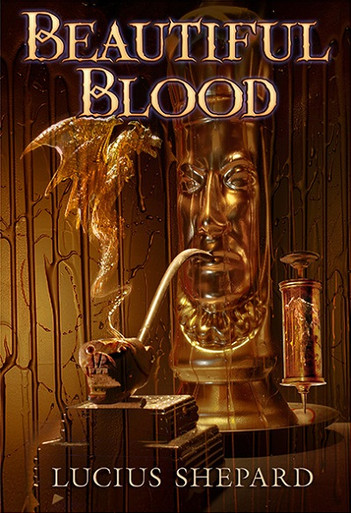
Over the past couple of years I’ve found some great books there. I’ve also had to put a few books back that were priced above what I could afford. This time, one of the books I could not put back on the shelf was Beautiful Blood, a novel from Lucius Shepard (1943 – 2014). I think it’s the third Shepard books that I’ve bought from Book Gallery, and likely not the last.

As I was checking out, I spoke with the owner, who mentioned that he started his career as a bookseller when one of Shepard’s first books was published. We thought it might have been The Jaguar Hunter, but only as I was driving away did I recall that it was likely Green Eyes (the owner recalled the name as “Green Jaguar”, a mix of both titles). Coincidentally, Green Eyes was the first Shepard book that I bought — the paperback with the green cover. Shortly thereafter, I bought Kalimantan at a bookstore while in New York City. Since then, I’ve bought a dozen of Shepard’s books. I would have bought more, had I been able to find them in bookstores, but sadly many of his books were published only by small presses. When I lived in Austin, TX, only one speciality book store existed (sadly, now long gone), and in my present location there’s no such option. Everything’s online these days, and prices escalate over the years. Still, coming across a physical copy breaks a certain monetary barrier.

Published by Subterranean Press in 2014, and limited to 1,000 numbered copies, my book is number 75. It’s a tale of the Dragon Griaule, one of many that Shepard wrote. I own and have a read a fair number of these tales, but by no means all of them. I probably also own just under half of Shepard’s published books. I still recall when I was able to afford one of his Arkham House collections, The Jaguar Hunter; years later I added his other Arkham House collection, The Ends of the Earth, to my library. Shepard is a quintessential American writer. Several of his stories are set in Central America, linked to events in the 1970s and 1980s, but he also drew inspiration from elsewhere in both reality and fantasy. The Dragon Griaule stories are dark, unrelenting, and tragic, as are many of his other stories, but the prose remains powerful. The more of his stories that I read, the more I want to go out and seek all his other books.

Thrillers x2

I’ve forgotten how many times I’ve read a book series out of order. I just know that it happens, and if by chance the second or third book in a series is good, and I read it first, well, I have to go hunt for book number one. Is a themed anthology in the same boat, however?

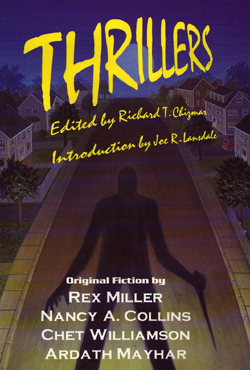
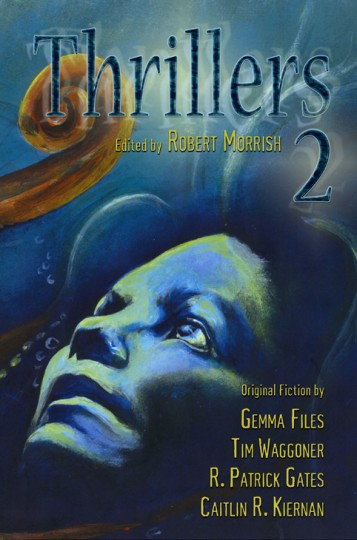
One of the books I picked up recently in Phoenix was Thrillers 2, published by Cemetery Dance in 2007. A signed/limited edition was too good to pass up. Edited by Robert Morrish, it features ca. 20,000 words each from four contributors — Gemma Files, Tim Waggoner, R. Patrick Gates, and Caitlin R. Kiernan. This anthology is apparently the “long-overdue return of a dark fiction series that debuted in 1993.” I’m not sure that a 14 year absence makes it a series, especially since no more books in this “series” followed. However, since I had book two, I naturally went out and searched for a copy of the first book…

Perhaps it’s unfair to compare Thrillers to another “dark fiction” series. Still, Thrillers seem to attempt to vill the void left from the demise of Dark Harvest’s Night Vision series, which ran for nine installments, then was partially resurrected by Subterranean Press for three more installments. The first Thrillers appears in 1993, just two years after Dark Harvest ceased the run of Night Visions books. The cover and concept seems to share a great deal with Night Visions: multiple writers contributing original fiction. With Night Visions, there were three writers – two well-known, and one new (and up-and-coming) writer. Majro names like F. Paul Wilson, Stephen King, Robert R. McCammon, Joe R. Lansdale, Dean Koontz, George R. R. Martin, and others, appears in Night Visions. Thrillers has four authors, a mix of new and well-known names. The font on the nine Night Visions books was consistent and recognizable. The font on the two Thrillers books, not so much.

The first book has stories by Rex Miller, Ardath Mayhar, Chet Williamson, and Nancy A. Collins, plus a short introduction by Joe R. Lansdale. The second Thrillers has fiction by Gemma Files, Tim Waggoner, R. Patrick gates, and Caitlin R. Kiernan. I checked ISFDB and despite close to 600 publications to its name, Cemetery Dance never released a third Thrillers.

It’s strange, but 2007 seems like just yesterday, and yet it’s almost two decades in the past. Going back to 1993 seems like a deep dive into the past. Since then, dark fantasy and horror anthologies have come and gone, yet there seems to be nothing like Night Visions, an annual publication with cutting edge fiction. Small press publishers have come and gone. Arkham House exists now in the distant past. Subterranean Press (soon to cease, alas) has published great fiction, mostly from individual authors. Golden Gryphon existed for a few years. Gauntlet Press and Borderlands Press publish just a few books each year. The same is the case for Cemetery Dance, which produced these two Thriller anthologies. Other small presses these days seem to focus on high-end expensive books for collectors with a lot of money.

Then again, with books like these day, I continue to mine the past with occasional success.

© 2026 Anders Monsen

Theme by Anders Noren — Up ↑

css.php