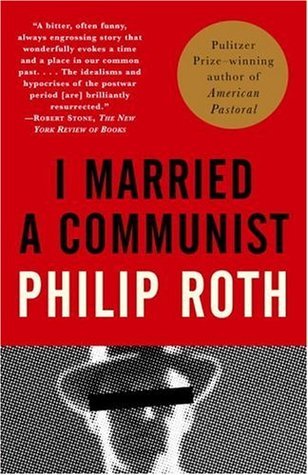
Recently, as I was perusing the shelves of a local used bookstore looking for something else entirely, I came across multiple Philip Roth books. I think the same person must have turned in these books, possibly as part of a box-load of items from a deceased relative. Many of these books were by the same publisher, but they also were in rough shape – broken spines, creases, folded covers. I put back all but one of them, the one with least damage. This book bore the title, I Married a Communist, which didn’t seem like a particularly inventive, or even compelling, title. Still, I thought, why not? Roth, after all, was one of the major American writers of the second half of the twentieth century. As I’ve been mining the past lately, this book was a prime candidate to continue that effort.
Inside the book, I found an airline boarding pass from 2008. That artifact, in itself, seemed both funny and tragic. That single printed page was more evidence that the original reader had owned multiple Roth books, and now those who went through his library and unloaded them to this particular used bookstore had no interest in Philip Roth’s fiction. The original reader, like myself, had apparently used any paper at hand as a bookmark, and so I felt some affinity toward this person.
I thought, as I started to read this book, that I’d never anything by Roth, but I was wrong. Back in college (so, so many years ago now) I’d read one of his short stories, “Goodbye, Columbus.” The memory of that story came back to me in a flash, as I read through Roth’s online bio. This single story was required reading in one my creative writing classes in college, back in the early 1990s. Now, decades later, I remember next to nothing about that story, aside from a snippet or two. Did I avoid Roth’s fiction because of this story, or because I gave up on modern fiction? I don’t know. It’s been thirty or more years, and the idea of Roth never crossed my mind until now.
The novel, I Married a Communist, features Roth’s alternate ego, Nathan Zuckerman, as its narrator. The books is a word-fest ( as I term it), as it doesn’t let up when it comes to focusing on any particular topic, spanning pages with commentary on that subject; any given person speaks for multiple pages without a break. Clearly, the author has never listened to a real person talk. That, or he’s the one talking, and has cornered someone and won’t let go. Is this normal fiction?
This book is now only the second Roth story I’ve read, and the first full-length novel. Roth, who died in 2018 at the age of 85, is supposedly one of the major writers in American fiction. He wrote over 30 books, yet I’ve skipped over all of them. Although I’ve seen his name many, many times when I perused fiction shelves, I don’t know why I avoided his name. Perhaps it was a reaction to “mainstream fiction,” or my aversion to current fiction.
At any rate, if I’m going to read his books, I have a lot of catching up ahead of me. Perhaps it’s too late; Roth didn’t see a future in novels, given the rise of various screens (TV and computer). I can sympathize, given that I’m writing this for my own sake. Some of his other titles look far more interesting.

Leave a Reply